
Posted on

Gibet de Montfaucon

7 Gibet de Montfaucon (Gibbet/Gallows of Montfaucon)

53, rue de la Grange aux Belles

Métro: Colonel Fabien

Hours: Not applicable—open to the public.

As you step out of the Metro, you should be facing Place du Colonel Fabien. Turn to your left and cross over Ave. Claude Vellefaux (on your left). The next street on your left will be Rue de la Grange aux Belles—turn left. Walk south until you arrive at no. 53 on your right.

You are standing in front of a garage with apartments built on top—exciting, huh? Seven hundred or so years ago, this was a pretty scary site. You never wanted to end up here.
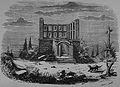
Representation of the Gibet de Mondaucon. Engraving (1863) Author unknown. Public Domain. Wikimedia Commons. This image shows the rear of the gibbet. It is usually represented with a view from the front.

You’re standing in an area that once was part of the countryside outside the medieval walls of Paris. Standing here, you would have had a pretty good view of the city since you’d be standing on a hill (actually, more like a mound). The hill we now call Montmartre would have been visible to you towards the northwest. Around you would have been the leper colony of St. Lazare, the Convent of the Filles-Dieu (a home for prostitutes), and the original Hôpital Saint-Louis (its modern counterpart is located to the southwest). It seems the king didn’t want any undesirable elements within the walls of the city.

One of the kings’ most undesirable icons stood in front of you. It was the Gibet of Montfaucon. Erected around the late 13th century, the gibbet was used until 1629 and finally dismantled in 1760. The structure was used to hang people and to display the bodies of the executed (both local and imported). There are accounts of the executed being displayed here for more than 3 years before they either exonerated or whatever remained of the body was turned over to the family. The gibbet erected on land once owned by Count Falco (Faucon). Since it was a hill or mound (Mont), the gibbet became known as Montfaucon. Its nickname was “Forks of the great justice.” The best description and image comes from a drawing by Eugène Viollet-le-Duc. It was an imposing 3-sided structure: 20 feet high, 46 feet long, and 39 feet wide. There were 45 “compartments” used to either hang or exhibit the victim’s bodies. Read More Gibet de Montfaucon

Posted on

Coco Chanel: Nazi Collaborator or Spy?

Several weeks after the liberation of Paris, Gabrielle (Coco) Chanel was arrested by members of the FFI (French Forces of the Interior—resistance fighters during latter stages of the war) and taken to the Free French Purge Committee headquarters. After two hours of questioning, Chanel was released. She would later tell her maid that she was released under the personal orders of Winston Churchill. Within hours of arriving back at 31, rue Cambon, Chanel left in her Cadillac for Lausanne, Switzerland where she would live in exile until her return to Paris in the mid-1950s (she would come back to Paris from time to time—once as a witness in a trial of her friend and collaborator, Baron Louis de Vaufreland—the judge would declare, “The answers Mademoiselle Chanel gave to the court were deceptive”).

Coco Chanel. Photo (c.1970). Photograph by Marion Pike. Public Domain - copyright expired. Wikimedia Commons.
Coco Chanel. Photo (c.1970). Photograph by Marion Pike. Public Domain – copyright expired. Wikimedia Commons.

Backstory

Chanel had been put on the French Resistance black list since 1942 as a German collaborationnistes (specifically as a horizontal collaborator—get the euphemism?). She was well known as being anti-Communist, pro-German, and virulently anti-Semitic (her verbal diatribes at dinner parties are legendary). Chanel was extremely adept at spinning any story to suit her needs or objectives. Her life story included a broken family childhood (i.e., insecurity—she was a very complex individual), prostitution, homosexuality, drug addiction, creativity, business acumen, betrayals, treason, promiscuous activities, a well-known spy mission, cover-ups, bribes, extreme poverty, extreme wealth, dance halls, lovers—men and women, intellectual friends, loyalty to her friends, and a passion for fashion and fragrances that remain legendary. Wow, how many of us have that resume? Read More Coco Chanel: Nazi Collaborator or Spy?