Jim Morrison. Photo by Electra Records (1968). PD. Wikimedia Commons.
If the title of this blog caught your eye, well then, you must be from my generation. If you know the answer to the question, good for you. Frankly, I didn’t know the answer when I decided to write my fifth book called Where Did They Bury Jim Morrison, TheLizardKing? —A Walking Tour of Paris Cemeteries. So for those of you who don’t know the answer, here is a multiple-choice test.
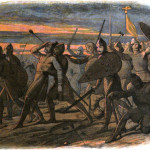
A Chronicle of England – The Death of Harold James Doyle (1864), Public Domain, Wikipedia Commons
We last left Edward the Confessor, king of England, as he died in January 1066 without leaving any offspring to succeed him. Who was going to be the next king of England? Would it be Duke William of Normandy, a distant cousin, or Earl Harold Godwin? What about the small child named Edgar brought back to England from Hungary by King Edward? Edgar’s family was part of a branch of Edward’s family exiled many years earlier (about the same time Edward was forced into exile in Normandy).
The Battle of Hastings
Let’s fast forward nine months to October 1066. A lot has happened between Edward’s death and October. Duke William gets annoyed that Harold has been crowned king of England after the crown had reportedly been offered to him by Edward (and Harold even went so far as to take a solemn oath to support William in this regard). So what does Duke William do? He puts together a fleet of Norman soldiers and invades England to claim his crown (William’s wife, Matilda, funds and outfits the ship William would sail in).
He and his men meet Harold and the Anglo-Saxon warriors on a hilly field in Hastings, a small village about an hour away from London on the southern coast of England. It was a fierce battle but in the end, Harold is killed and Duke William becomes the next king of England. He is now known for posterity as William the Conqueror. The future of England and France is changed forever. By the way, the next time this happens is on D-Day, 6 June 1944, when the invasion is reversed.
“Another outstanding, well-researched, and presented book by Stew Ross. It gives a detailed guided walking tour full of facts about the activities of the Gestapo during their occupation of Paris during World War II. I highly recommend this book to everyone who has an interest in what life was like during the Nazi occupation in France.”
Richard H.F. Neave, President Royal British Legion Paris branch, member Paris-based Libre Résistance SOE “F” Section and author of SOE: A Life in the Shadows
Lavishly illustrated, gripping guide to the Paris that existed under Nazi rule.
This is a fantastic new book that provides extensive information for both those planning a trip and for armchair historians. While there are are walks that take you past famous places made infamous by Nazi rule, there is also a lot of detailed information. Stew Ross provides details about many topics that are not necessarily popular, including anti-semitism and collaboration. Photos add poignancy. Paris is haunted by its past, and these pages show you exactly why. The days of the Occupation and the Resistance are not that distant.