Posted on

Muslims, Jews and the Gestapo

This is one of those stories you won’t find in textbooks nor is it widely known. In fact, it is a story that many people refuse to discuss or acknowledge. It’s the account of a religious man and his followers who sheltered and helped Jews escape from Paris during the Nazi occupation. There are thousands of stories about the bravery and courageous acts of Gentiles saving Jewish lives during World War II in spite of knowing that if caught, they would likely forfeit their lives.

Our story today is about the leader of Parisian Muslims who rescued Jews and others from certain deportation during the occupation.
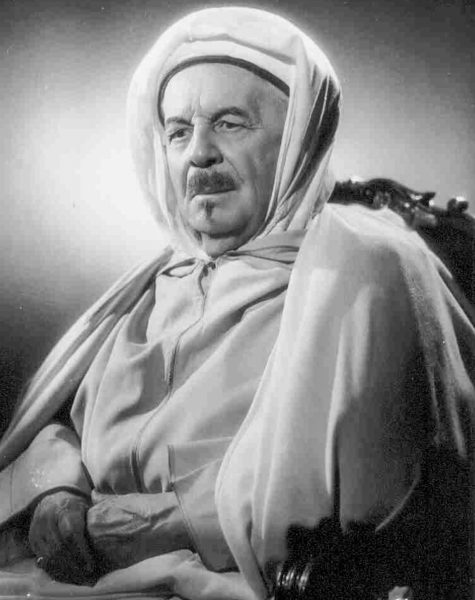
Si Kaddour Benghabrit. Photo by anonymous (date unknown).

Did You Know?

Did you know that the newest U.S. Navy aircraft carrier will be named after an African American military hero? Europeans like to say that it takes America a long time to make a decision but when she does, it’s usually the right one. In this case, they are correct.

Doris Miller was a mess attendant on the battleship USS West Virginia when it was attacked by Japanese planes on the morning of 7 December 1941 in Pearl Harbor. He carried the wounded to safety, assisted the ship’s mortally wounded captain, and manned an anti-aircraft machine gun (which he had never been trained on) and continued to shoot until he ran out of ammunition and had to abandon ship.

For his actions, Miller was awarded our country’s second highest military medal in 1943, the Navy Cross. He was the first African American to receive the medal. After surviving Pearl Harbor, Miller served on the USS Indianapolis and then, the escort carrier USS Liscome Bay after it was launched in April 1943. During the Battle of Makin in November 1943, a Japanese submarine sank the USS Liscome Bay. Six hundred forty-four or, seventy percent of the crew perished including Miller. He was posthumously awarded the Purple Heart.
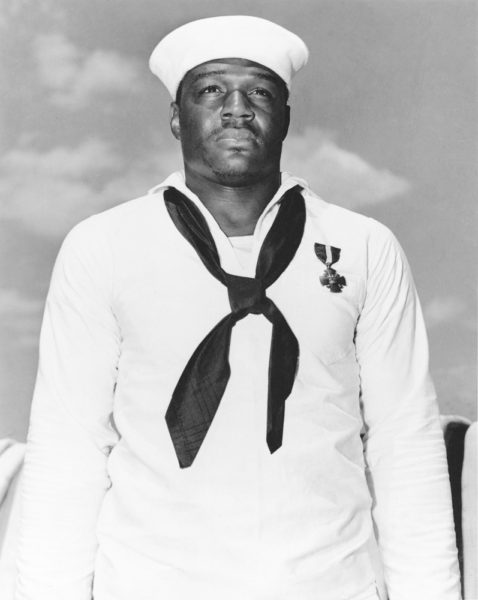
Doris Miller and his Navy Cross medal. Photo by anonymous (c. 1943).

Let’s Meet Is Kaddour Benghabrit

Si Kaddour Benghabrit (1868-1954) was born in French occupied Algeria to a prominent Andalusian family. After primary and secondary educations at leading Algerian schools, he studied law and began his practice in Algiers (capital of Algeria). After stints as an interpreter for the Legation of France and liaison between North Africa and France, Benghabrit founded the Mahkma of Algiers (a civil court) and the Society of Habous and Holy Places of Islam (an organization to facilitate Muslim pilgrimages to Mecca). Read More Muslims, Jews and the Gestapo


Posted on

“A Painted Lady”

Each generation is attached to one or more celebrities who take self-promotion to the highest level through publicity and somehow differentiating themselves. My parents had George Hamilton, the eternally tanned “actor” . . . well, we’re still not sure why he was a celebrity although his ads for Kentucky Fried Chicken were hilarious. My generation had Paris Hilton who was just as tan as George and . . . well, we’re still trying to figure out why she was a celebrity. Our children’s generation has been blessed with Miley Cyrus, Lindsay Lohan, the Kardashians, and Britney Spears, just to name a few. Watch “Extra Crispy” George Hamilton here.

George Hamilton. Photo by Angela George (2009). PD-CCA-Share Alike 3.0 Unported. Wikimedia Commons.
Paris Hilton. Photo by Peter Schäfermeier (2005). Universal Photo. PD-CCA-Share Alike 2.5 Generic. Wikimedia Commons.

My grandparents would have undoubtedly been well aware of a young lady who never had today’s media resources for self-promotion (e.g., social media, podcasts, television, and tattoo sleeves). In those days, it was accomplished through publicity agents and gossip columnists such as Walter Winchell, Hedda Hopper, and Louella Parsons via newspapers and radio. The subject of our blog today lived in France and had a very unique personal method for turning herself into a rich international celebrity.

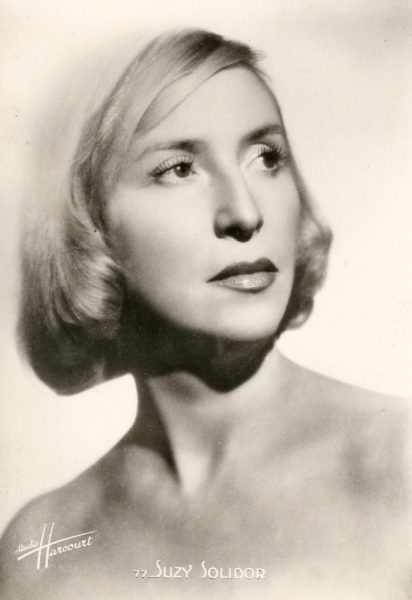
Suzy Solidor. Photo by Studio Harcourt (date unknown). Ministère de la Culture- Médiathèque de l’architecture et du patrimonine. Dist. RMN.

She was a beautiful woman. Her face and figure represent what we consider today to be the iconic image of the 1920s jazz age flapper: thin, broad shoulders, short blonde bob, and dressed in long flowing tight gowns. A well-known singer, actress, and cabaret star, Suzy Solidor’s self-promotion was her face and body captured in paintings and photographs by more than 225 artists. I don’t even think the Sun God, King Louis XIV, had that many portraits commissioned of himself during his seventy-two-year reign.

For more than thirty years, Suzy was the most popular model for artists and in fact, she became the most painted lady of her generation. I suppose her portraits were the forerunners to the “selfies” which Miley Cyrus and others like to post to social media. The difference is, Suzy’s “selfies” hang on the walls of museums and private collectors’ homes.


Did You Know?

Did you know that over the years, the British Broadcasting Corporation (BBC) has banned some pretty innocuous songs? Considering the recent uproar in the United States over the ban by selective radio stations of the 1949 Academy Award-winning song, Baby, It’s Cold Outside, I thought you might like to see this list, albeit certainly not all-inclusive.

Ding Dong the Witch is Dead (1939)             Sung by the Wizard of Oz film cast

Why banned? The song disrespected the deceased (and the BBC wasn’t referring to the Wicked Witch of the West). Actually, a band called Hefner released “The Day That Thatcher Dies” and used the Oz song at the end. It was a dig towards the former British Prime Minister, Margaret Thatcher, who had just passed away (2013). And I thought it was all about one of my high school teachers.

Deep in the Heart of Texas (1941)                 Sung by Bing Crosby

Why banned? The song was “too jaunty.” It was feared that factory workers would stop working in order to clap their hands. As I’ve always said, “I don’t make this stuff up.”

Monster Mash (1962)                                    Sung by Bobby Pickett & The Crypt-Kickers

Why banned? The song was too morbid. Really?

Leader of the Pack (1964)                              Sung by The Shangri-Las

Why banned? It talked about teenage death. I guess Ozzie Osbourne hadn’t hit the charts yet.

Lola (1970)                                                      Sung by The Kinks

Why banned? The BBC didn’t like the song advertising Coca-Cola. So, Ray Davies changed the lyrics to “Cherry cola.” At least Jim Morrison never gave in to Ed Sullivan on changing the lyrics to the song, “Light My Fire” before singing it on the Ed Sullivan Show ⏤ The Doors were permanently banned from the show.


Let’s Meet Suzy Solidor 

Suzy Solidor (1900-1983) was born in Brittany, France to an unwed mother and her employer. When her mother married another man, Eugène Rocher, Suzy took his last name. At the age of sixteen, Suzy obtained her drivers license and the next year, drove an ambulance on the front lines during World War I. After the war, Suzy moved to Paris and in the late 1920s, she changed her last name to Solidor, the name of a district where she had once lived. Read More “A Painted Lady”