Posting this blog on the fifth of each May has become a tradition for me.
Liberation Day (also known as Freedom Day) for the Netherlands (Holland) was 5 May 1945. Canadian forces along with other Allied forces were able to obtain the surrender of German forces in the small Dutch town of Wageningen. This led to the complete German surrender and liberation of the country. The Netherlands was one of the last European countries to be liberated. Two days later in Reims, Generaloberst Alfred Jodl signed the document for the unconditional surrender of the German armies.
Did You Know?
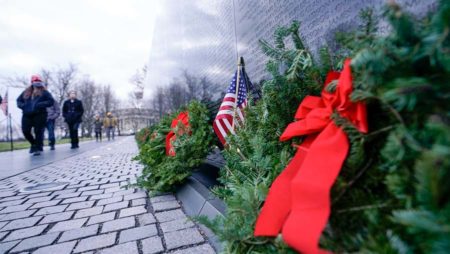
Did you know that for the past thirty years, “Wreaths Across America” has been responsible for placing holiday wreaths on thousands of American military graves? The secularist non-profit organization, “The Military Religious Freedom Foundation” (MRFF) has declared this tradition to be “unconstitutional, an atrocity, and a disgrace.” They believe the wreath-laying to be the “desecration of non-Christians veterans’ graves.” The MRFF says, “. . . forcing the non-Christian dead who didn’t celebrate Christmas in life to celebrate it in death.” Perhaps we should all take the position that the wreaths are really meant to celebrate, remember, and honor American veterans, fallen or otherwise.
Wreaths standing at the Vietnam Veterans Memorial as part of Wreaths Across America. Photo by Manuel Balce Ceneta (18 December 2020). Associated Press.
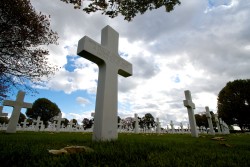
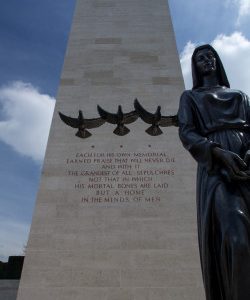
Netherlands American Cemetery (Margraten)
There is a cemetery near Maastricht. It is the final resting spot for 8,301 American soldiers and a memorial for 1,722 men missing in action. They were the casualties of Operation Market Garden (17–25 September 1944) and other battles aimed at liberating Holland. Operation Market Garden was a failed Allied attempt to liberate Holland while on their march to Germany and Berlin. Other military cemeteries are located nearby for the British and Canadian men who did not survive the battle. Learn more about Operation Market Garden here.
American World War II Cemetery in Margraten, The Netherlands. Photo by Kees Verburg (2014). PD-CCA-Share Alike 3.0. Wikimedia Commons.
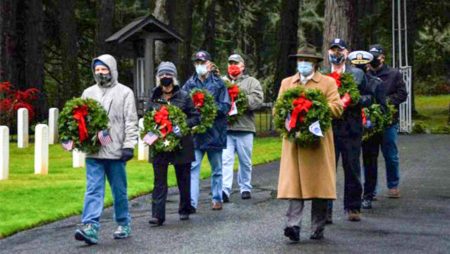
Four generations of Dutch families have adopted every man who perished in the battle. Each man’s grave is kept up and decorated by their adopted family. Every Memorial Day, American Embassy staff greets the Dutch families as they arrive at the cemetery to lay down flowers and wreaths. Even a portrait of their adopted soldier sits in their respective homes.
Townspeople arriving at Margraten Cemetery to lay wreaths and flowers on their adopted soldier’s grave. Photo by anonymous (date unknown). Nathan Wilkes, Joint Base Lewis-McChord Garrison Public Affairs.
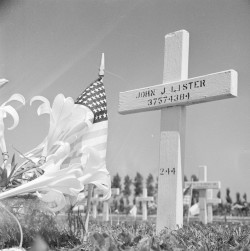
“Face of Margraten” was started by a young Dutch man to preserve the image of each of the fallen soldiers. About eight thousand images have been collected and every two years, each grave is marked with the image of its occupant.
John J. Lister killed in action on 7 April 1945 – 48 Infantry Batalion – 7th Armored Division – C Company. Photo by Erfgoed in Beeld (2006). PD-CCA-Share Alike 2.0. Wikimedia Commons.
Hongerwinter
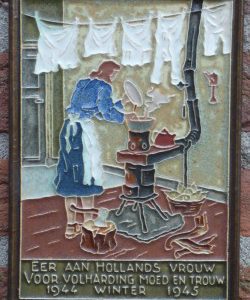
Tribute to Dutch Women of the Winter of Hunger. Photo by Peter de Wit (2008). Tile made by ‘De Porceleyne Fles’ in Delft, Netherlands. PD-CCA 2.0. Wikimedia Commons.
The Dutch railway workers called a strike before the battle began believing it would increase the chances of success by the Allied forces. The Allied efforts failed and Holland would have to wait another seven months to be liberated. In retaliation for the rail strike, Arthur Seyss-Inquart, the Nazi leader in charge of the German occupation of Holland, refused to allow any food into the country. Holland was literally being starved to death during the 1944-1945 Hongerwinter (winter of hunger). More than 20,000 people died that winter of starvation. By the end of the war, subsistence was four hundred calories per person. Seyss-Inquart was one of the Nuremberg defendants tried, convicted, and executed for various war crimes, including those committed in Holland. Watch a news clip here.
Liberation Day
Every May on the fifth, Liberation Day is celebrated in Holland. For two minutes, everything and everybody stops while the church bells ring. At the end of the day, a concert is held. Beginning in 1965 (the 20th anniversary of the liberation), Nino Rossi’s taps called “Il Silenzio” is played as the final piece of the concert.
As a 10-year-old living in the city of Wassenaar during the 1960s, I’ll never forget stopping on the street wherever we were when the church bells began to ring. We stopped talking and listened to the bells ring for 2 minutes—every year.
President’s Speech
“On this peaceful May morning we commemorate a great victory for liberty, and the thousands of white marble crosses and Stars of David underscore the terrible price we pay for that victory. For the Americans who rest here, Dutch soil provides a fitting home. It was from a Dutch port that many of our pilgrim fathers first sailed to America. It was a Dutch port that gave the American flag its first gun salute. It was the Dutch who became one of the first foreign nations to recognize the independence of the new United States of America. And when American soldiers returned to this continent to fight for freedom, they were led by a President (Roosevelt) who owed his family name to this great land.”
George W. Bush
President of the United States
28 May 2005
Netherlands American Cemetery
Recommended Reading and Viewing
Levin, Joseph E. (Producer). A Bridge Too Far. United Artists, 1977.
There may be a chance that after we publish this particular blog, the video links associated with the blog are no longer accessible. We have no control over this. Many times, whoever posts the video has done so without the consent of the video’s owner. In some cases, it is likely that the content is deemed unsuitable by YouTube. We apologize if you have tried to access the link and you don’t get the expected results. Same goes for internet links.
I think most of us are familiar with some of the aerial fighter squadrons from both world wars. The Flying Tigers, the Tuskegee Airmen (The Red Tails–click here to read the blog), and the U.S. Navy “Jolly Rogers” were several of the well-known squadrons during World War II. The Lafayette Escadrille and 94th Aero Squadron (“Hat in the Ring”) were two of the most famous World War I airplane squadrons.
The concept of foreign volunteers (i.e., mercenaries) joining to fight combatant nations is nothing new. The German Hessians joined the British to fight American revolutionaries, the Swiss Guards protected the Pope in Vatican City as well as French monarchs in Paris while the Nepalese Gurkhas once fought against the British but later fought alongside British soldiers.
Today, you will be introduced to a famous fighter squadron but not as well-known as the ones I have mentioned. The Eagle Squadrons were made up of American pilots who volunteered to join the British Royal Air Force (RAF) before the United States entered the war following Japan’s attack on Pearl Harbor (7 December 1941).
Click here to watch the video Americans Flying for Britain.
“If you thought that science was certain ⏤ well, that is just an error on your part.”
⏤ Dr. Richard Feynman
Theoretical physicist
Dr. Feynman also said, “Science is the belief in the ignorance of experts” because he knew that skepticism and a willingness to assimilate new evidence propel the scientific endeavor.
We are watching what seems to be a possible global rearrangement and at the very least, a new way of dealing with both our allies and not-so-friendly nations. Is this a temporary template for conducting foreign policy or are we seeing the beginnings of a permanent change?
We should revisit a quotation from Gen. Charles de Gaulle:
“No nation has friends, only interests”
It is always fun to read the many quotations from Winston Churchill who is also quoted quite often. It is too bad we are not exposed to more of Gen. de Gaulle’s quotes. Like Churchill, the French general had very insightful comments that are accurate and stand the test of time.
Did You Know?
Did you know that the first item sold on eBay was a broken laser pointer? A Silicon developer, Pierre Omidyar, invented eBay in 1995 (then called “Auction Web”) and tested his new online venture by loading an ad for his broken pointer that originally cost him US$30. He listed the laser pointer for $1.00 and after one week, bidding began with the final winning bid at $14.83.
Within two years, the site was re-branded as eBay and its millionth item was sold. So, who purchased the laser pointer? A Canadian, Mark Fraser, identified himself in 2015 as the person who became the first customer of eBay and has held on to the pointer for all these decades.
Mark Fraser holding the broken pointer he purchased from eBay. Photo by anonymous (c. September 2015). Rupley, Sebastian, eBay News Team, 11 September 2015. “Meet the Buyer of the Broken Laser Pointer.” https://www.ebayinc.com/stories/news/meet-the-buyer-of-the-broken-laser-pointer/
I wonder what the pointer would fetch today if Mr. Fraser were to put it on eBay.
The Origin of the Eagle Squadrons
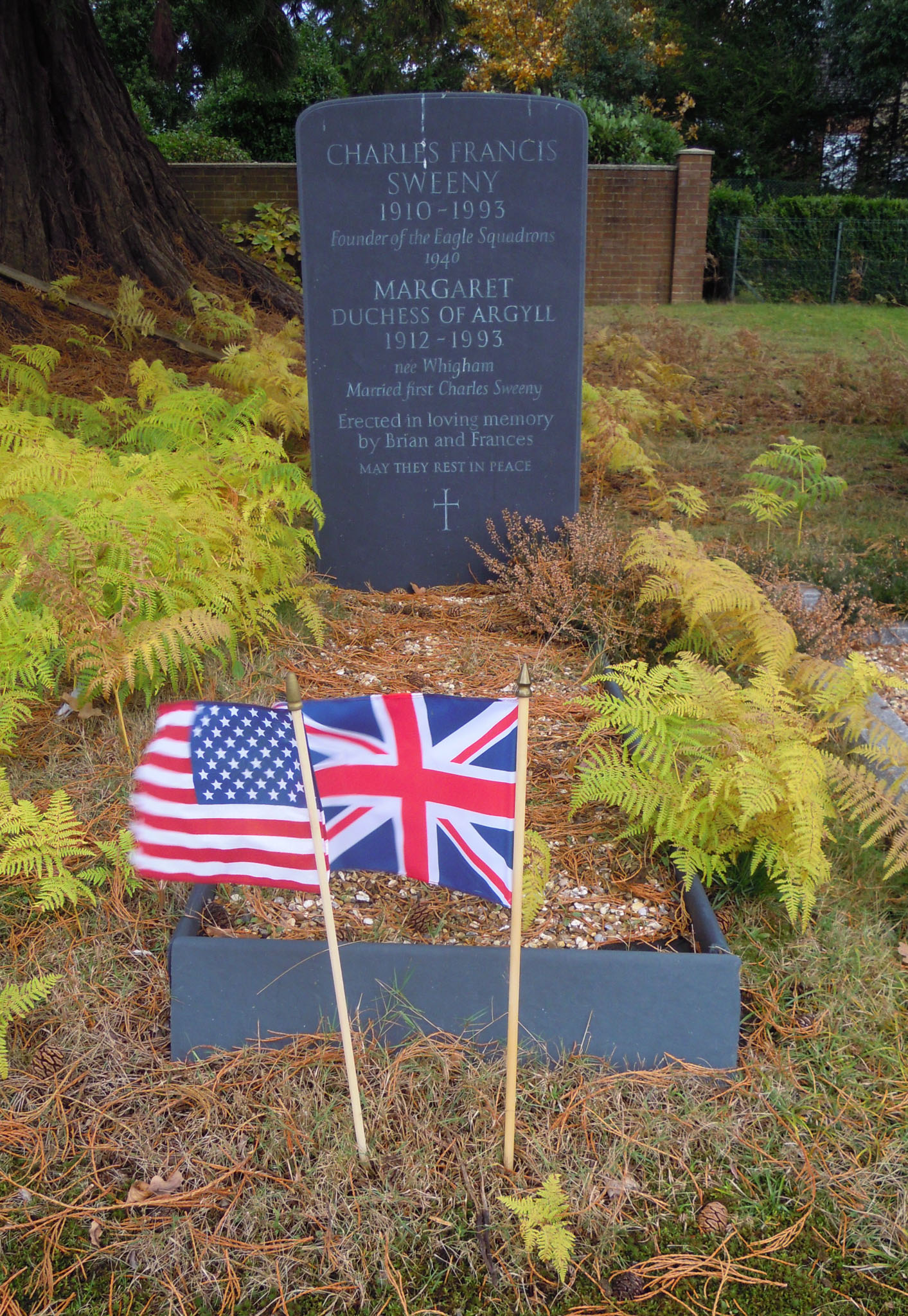
Prior to the United States entering World War II, a successful American businessman and socialite (and friend of Ernest Hemmingway), Charles Francis Sweeny (1909−1993), persuaded the British government to form a squadron comprised solely of American pilot volunteers. Sweeny and his wealthy friends not only raised the money to send the volunteers to England for training, but they also personally recruited the men.
Prior to the occupation of France in June 1940, Sweeny’s activities were considered illegal. He managed to thwart the FBI’s efforts to capture and imprison the “recruiters.” However, after France fell to Hitler, the United States government turned its head on his activities and even the FBI declared Sweeny’s recruiting efforts were legal.
Meanwhile, at the same time, there were parallel efforts being made in Canada. Several World War I aces, William (“Billy”) Bishop (1894−1956) and Clayton Knight (1891−1969), began to recruit and train Americans for service in the RAF. By the end of 1941, they had recruited more than 7,000 Americans with about 15% of them becoming pilots. (Sweeny’s uncle was recruiting Americans to fly for the French air force.)
Billy Bishop standing next to his Nieuport 23 airplane during World War I. Photo by anonymous (c. 1918). PD-No known copyright restrictions. Wikimedia Commons.
The British government decided to accept the American volunteer pilots in July 1940. By then, the Battle of Britain had begun, and Britain was fighting for its life. The American pilots were desperately needed.
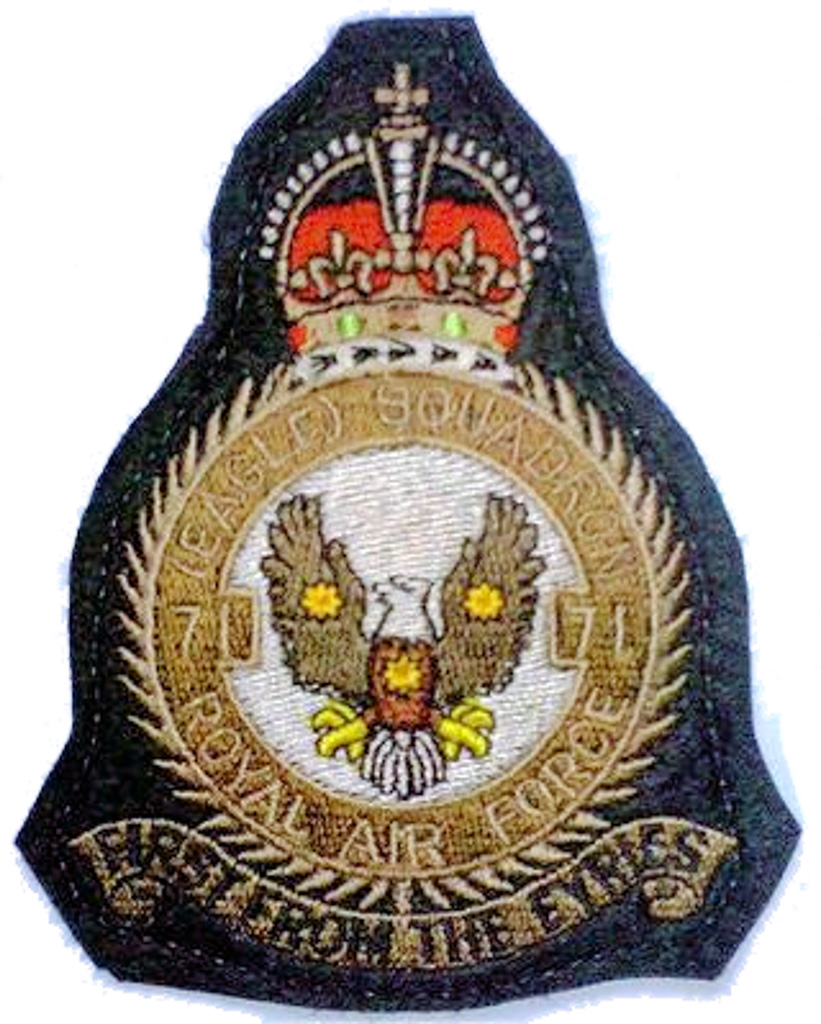
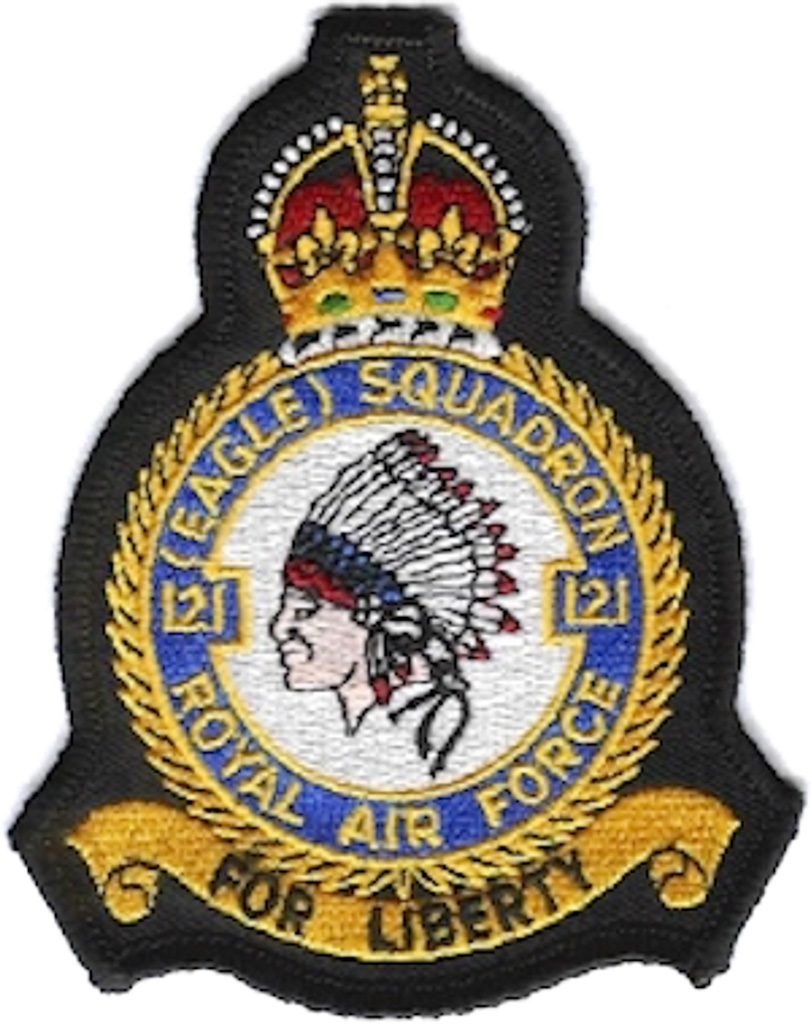
The first unit formed was the No. 71 Squadron known as “The Eagle Squadron.” Sweeny designed the shoulder patch bearing an American eagle. There were enough volunteers to form two additional units: the No. 121 and No. 133 Eagle Squadrons. The pilots began flying missions over France, escorting bombers, and performing targeted strikes.
The emblem of the Eagle Squadrons. Photo by anonymous. Patch design by Charles Francis Sweeny (date unknown). PD-Creative Commons CC0 1.0 Universal Public Domain Dedication. Wikimedia Commons.No. 71 Eagle Squadron RAF badge. Photo by anonymous (c. 1940). PD-U.K. Government public domain. Wikimedia Commons.No. 121 Eagle Squadron RAF badge. Photo by anonymous (c. 1940). PD-U.K. Government public domain. Wikimedia Commons.Grave site of Charles Francis Sweeny and his first wife. Photo by Jack1956 (17 November 2016). PD-Creative Commons CC0 1.0 Universal Public Domain Dedication. Wikimedia Commons.
The Eagle Squadrons
The requirements to join the Eagle Squadrons were a high school diploma, being of age 20 to 31 years, a vision of 20/40 correctable to 20/20, and 300 hours of certified flying time. It was actually easier to join the RAF than it was to get into the United States Army Air Corps (the predecessor of the United States Army Air Force, or “USAAF” formed in June 1941).
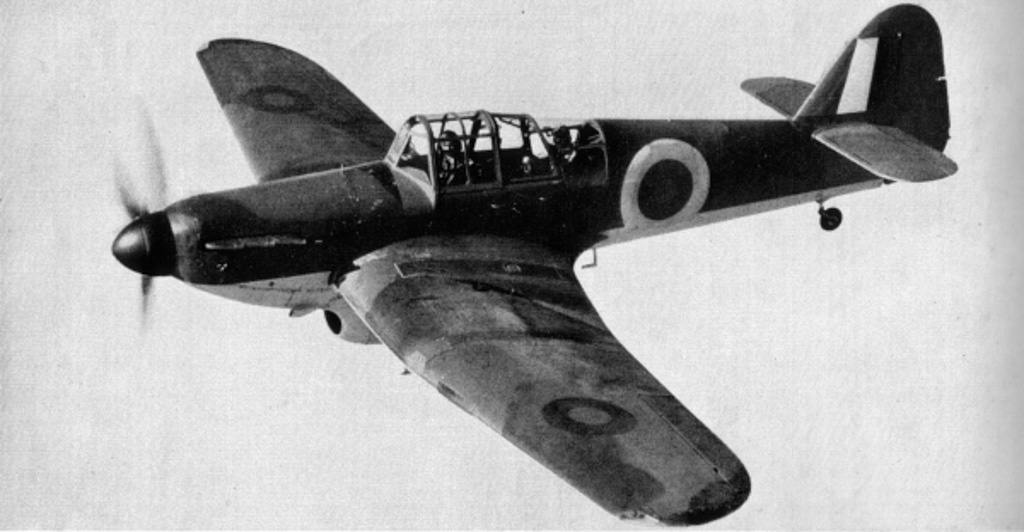
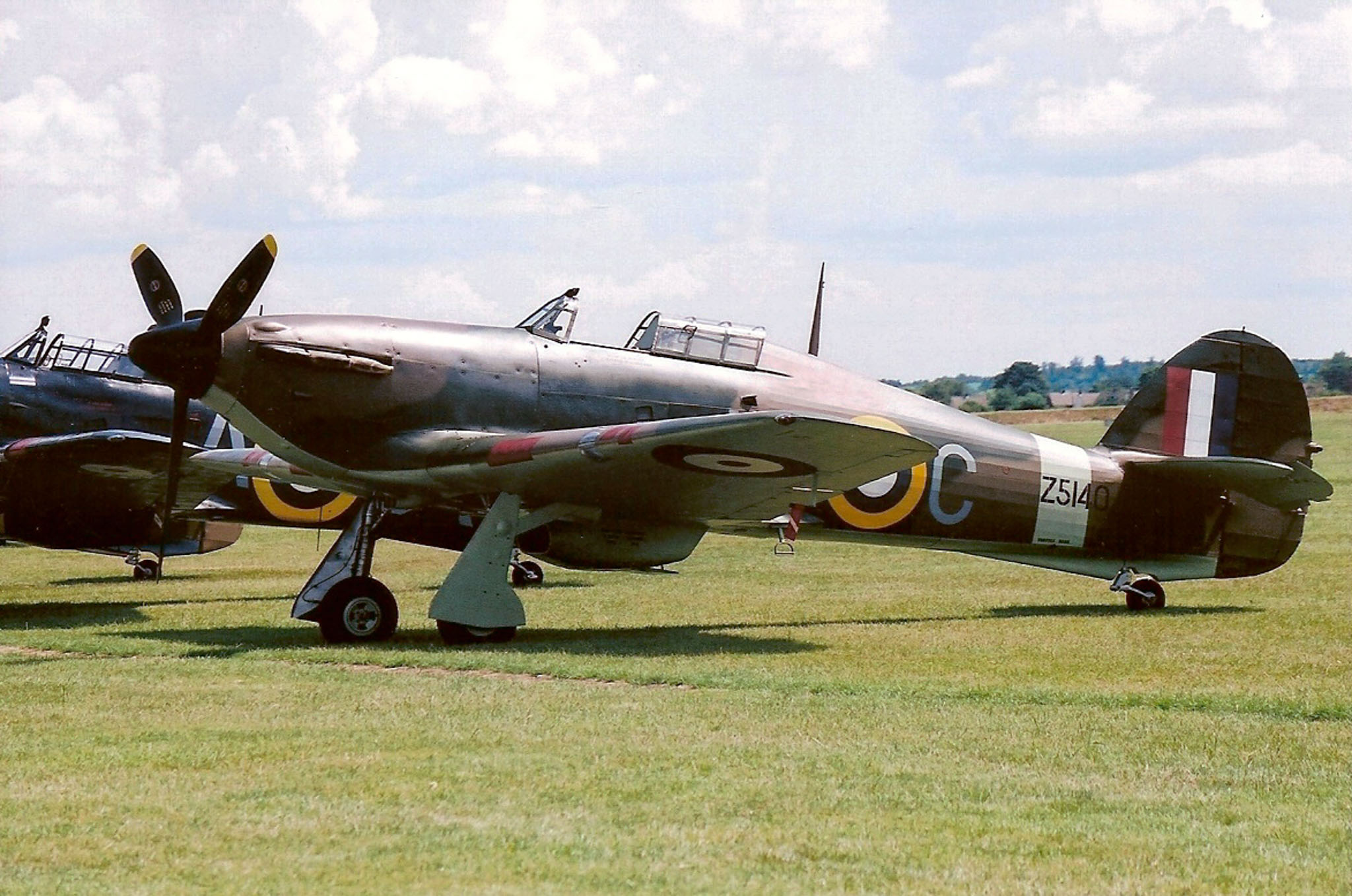
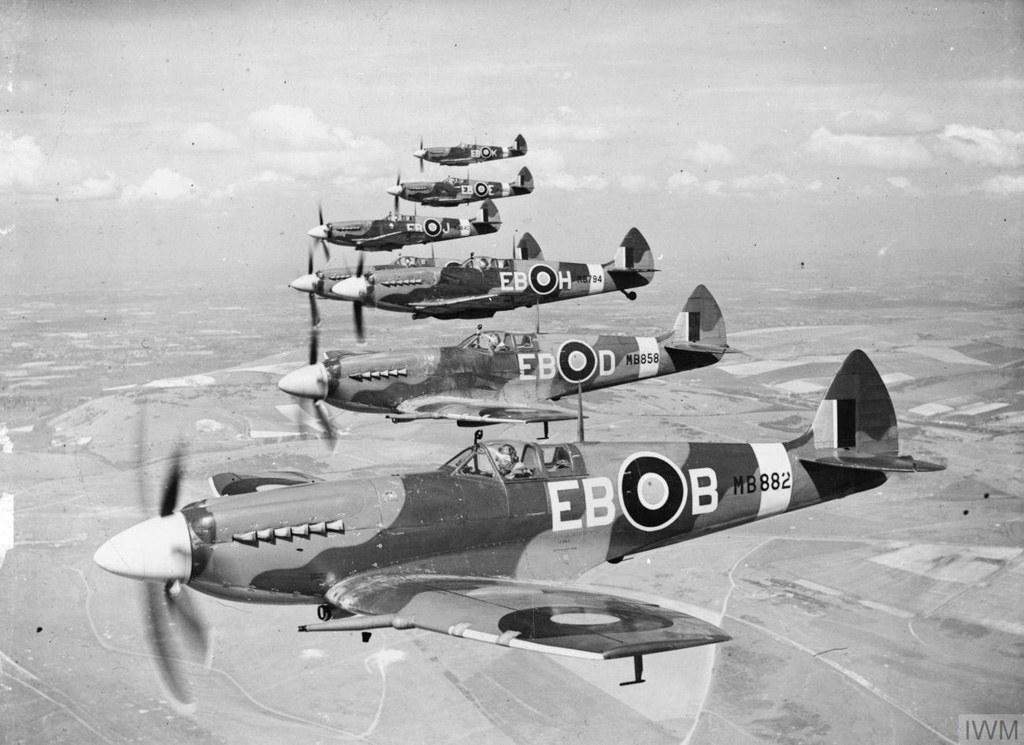
Training took place in England using Miles Master Trainers, Hawker Hurricanes, and Supermarine Spitfires. Upon graduation, the men were commissioned as RAF officers and assigned to various RAF fighter squadrons. The volunteers never renounced their American citizenship. Their RAF uniforms were modified to include the Eagle Squadron patch and the letters “ES” for Eagle Squadron.
Miles M.9A Master advanced trainer. Photo by anonymous. Prepared for Wikipedia by Keith Edkins (c. 1935-1940). PD-U.K. public domain. Wikimedia Commons.Hawker Hurricane Mk.IIB. Photo by anonymous (date unknown). PD-GNU Free Documentation License, Version 1.2 or later. Wikimedia Commons.Supermarine Spitfire F Mk XIIs of No. 41 Squadron. Photo by anonymous (date unknown). PD-U.K. Government public domain. Wikimedia Commons.
Between September 1940 and July 1941, three Eagle Squadrons were formed and attached to the RAF. After the United States entered the war, the squadrons were turned over to the USAAF in late September 1942. The commander of the USAAF in Europe, Maj. Gen. Carl Spaatz (1891−1974), wanted to disperse the pilots amongst other fighter groups. However, the pilots wanted to stay together, and Gen. Spaatz agreed to their request. The three squadrons became the 334th (“Fighting Eagles”), 335th (“Chiefs”), and 336th (“Rocketeers”) Fighter Squadrons and formed the elite 4th Fighter Group (4th FG) based at RAF Debden, England.
The pilots eventually transitioned from the Spitfires to American P-47 Thunderbolts (1943−44) and P-51 Mustangs (1944−45). The 4th FG achieved the highest air/ground enemy aircraft destruction record in the USAAF. Some of the group’s accomplishments were being credited with 1,016 enemy aircraft destroyed (37 pilots became aces), the first fighter group to fly missions over Germany, the first to escort bombers over Germany, and the first to use belly tanks. Nathaniel Maranz (1919−?), an Eagle Squadron pilot, became the first American prisoner of war when he was shot down over the English Channel on 21 June 1941 and rescued by a German patrol boat.
American pilots of No. 71 “Eagle Squadron” rush to their Hawker Hurricanes at RAF Kirton-in-Lindsey. Photo by anonymous (17 May 1941). Imperial War Museum. PD-U.K. Government public domain. Wikimedia Commons.American volunteer pilots of No. 121 Eagle Squadron playing poker in the dispersal hut at RAF Rochford in Essex. Photo by anonymous (c. August 1942). Imperial War Museum. PD-U.K. Government public domain. Wikimedia Commons.
The 4th FG is considered to have been instrumental in achieving Allied air superiority over Europe. Their final mission of World War II was on 25 April 1945. Today, the 4th Fighter Wing (assigned to the Air Combat Command’s Fifteenth Air Force) is the legacy of the Eagle Squadrons.
Click here to visit the Fourth Fighter Group WWII seb-site.
Click here to visit the American Air Museum Fourth Fighter Group WWII web-site.
Pilots of the Eagle Squadrons
The first pilots of the Eagle Squadrons were Vernon “Shorty” Keogh (1911−1941), Andrew Mamedoff (1912−1941), and Eugene “Red” Tobin (1917−1941). The three Americans were among the first 32 volunteers recruited by Charles Sweeny, and he intended to have them join the French air force. However, Germany invaded France and the men were sent to England to join the RAF. As part of the No. 609 Squadron RAF, the men participated in the Battle of Britain earning them the Battle of Britain clasp to the 1939−45 campaign star. In September 1941, they were transferred to No. 71 Eagle Squadron. Unfortunately, all three men perished in 1941 during Eagle Squadron missions. On a side note, Mamedoff became the first American to take a “war bride” after marrying an English woman in 1941. He is also believed to be the first Jewish American pilot to have been killed in World War II (unsubstantiated).
The uniform of an American volunteer in No. 121 Eagle Squadron RAF. Photo by Daderot (4 November 2017). Oregon Air and Space Museum. PD-Creative Commons CC0 1.0 Universal Public Domain Dedication. Wikimedia Commons.Three American pilots of No. 71 Eagle Squadron RAF: Left to right: Pilot Officers G. Tobin, V.C. “Shorty” Keough, and A. Mamedoff. They are showing off their new squadron badge at RAF Church Fenton. Photo by anonymous (c. 1940). Imperial War Museum. PD-U.K. Government public domain. Wikimedia Commons.
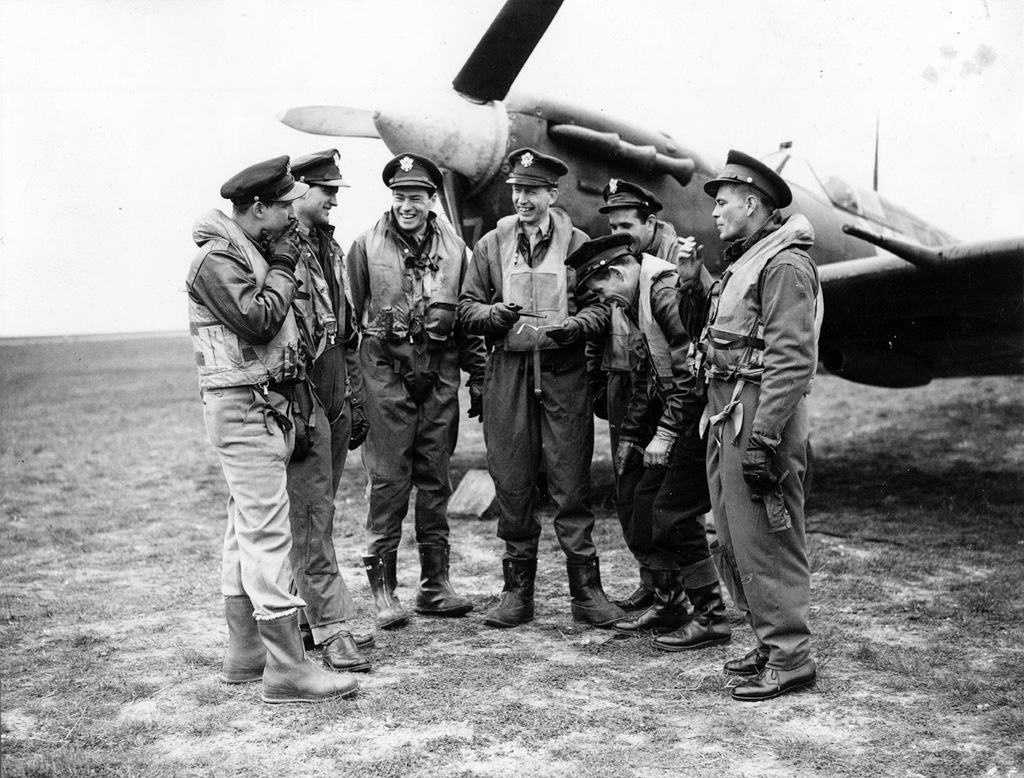
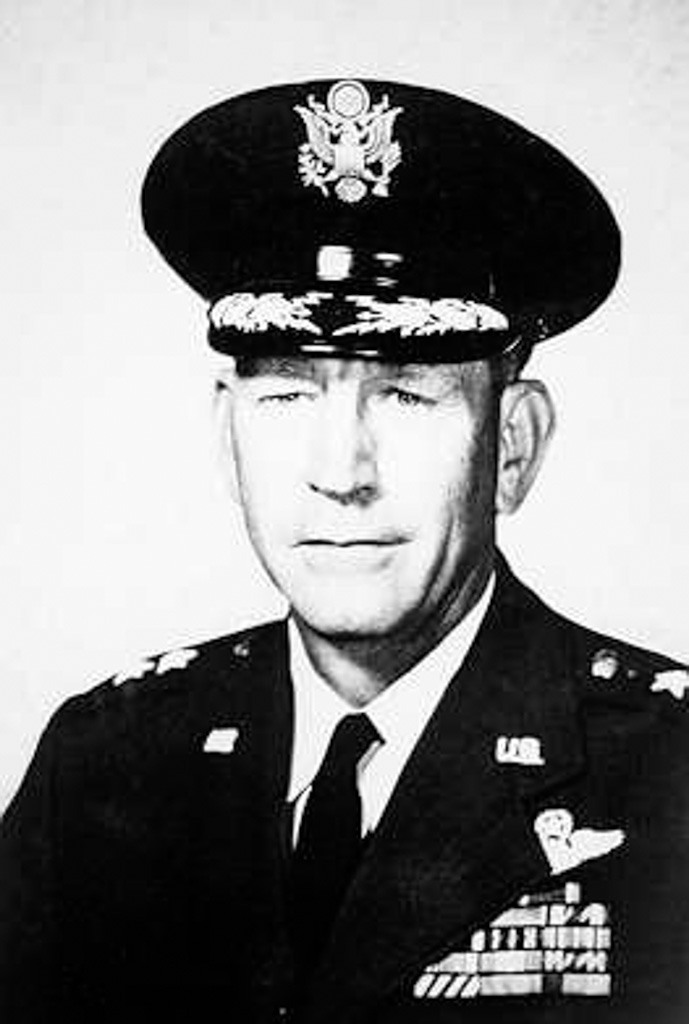
Chesley “Pete” Peterson (1920−1990) was assigned to the No. 71 Squadron upon his arrival in England in late September 1940. At the age of 21, Peterson was given command of the squadron and flew 42 missions (he flew a total of 130 missions during the war). As part of the group assigned to the USAAF 4th FG, Peterson was promoted to major and served as the FG’s executive officer. He became the youngest (age 23) colonel in the USAAF eventually rising to become a major general in 1965.
Pilots from the 4th Fighter Group in front of a Spitfire at RAF Debden airbase. The pilot in the center holding a pipe is Lt. Col. Chesley G. Peterson. The Spitfire is Peterson’s aircraft. Photo by anonymous (c. 1943). American Air Museum. PD-U.S. Government. Wikimedia Commons.Maj. Gen. Chesley G. Peterson. Photo by anonymous (date unknown). PD-U.S. Government. Wikimedia Commons.
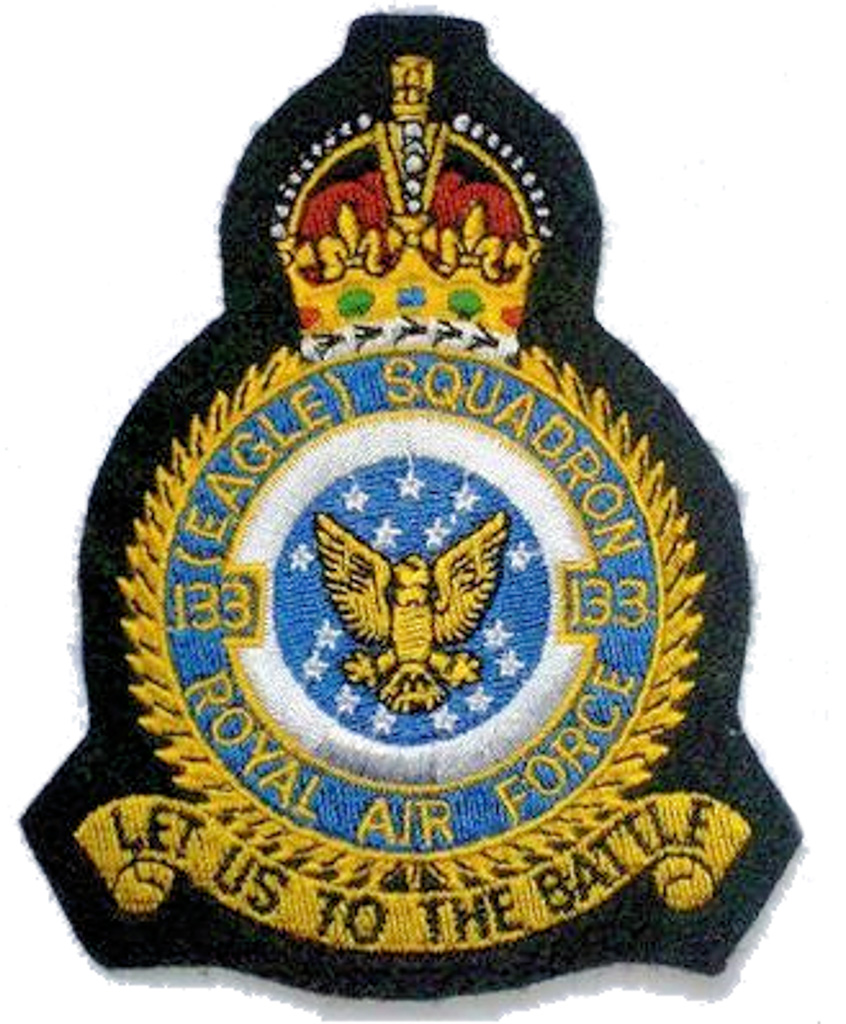
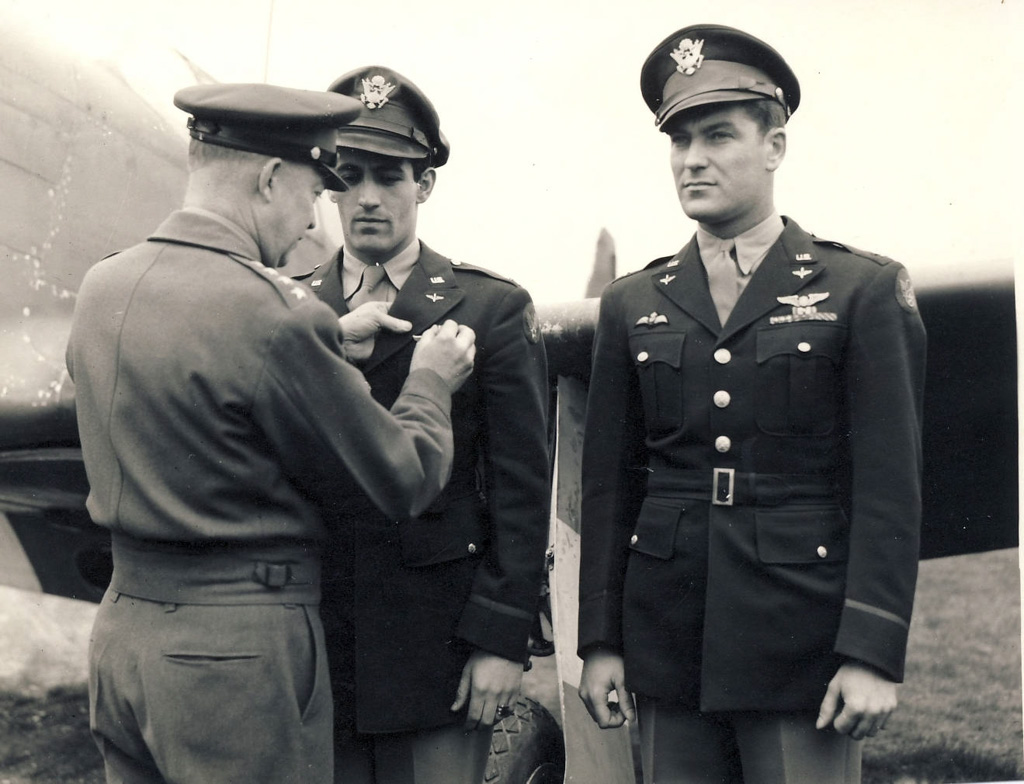
Donald Blakeslee (1917−2008) joined the RAF in May 1941. He quickly became known for his ability to shoot down enemy aircraft. He was assigned to the No. 133 Eagle Squadron as its commanding officer. Blakeslee quickly became an ace and has been credited with more than 500 missions flown. He is considered to be the most decorated World War II USAAF fighter pilot. His awards and honors include the Distinguished Service Cross, Silver Star, Legion of Merit, Distinguished Flying Cross, British Distinguished Flying Cross, and the French Croix de Guerre. He retired as a full colonel.
No. 133 Eagle Squadron RAF badge. Photo by anonymous (c. 1940). PD-U.K. Government public domain. Wikimedia Commons.Generals gather for the occasion of the awarding of the Distinguished Service Cross to Col. Blakeslee and Capt. Gentile. Left to right: Gen. Jesse Auton, Gen. Eisenhower, Gen. Carl Spaatz, Gen. Jimmy Doolittle, Gen. Kepner, and Col. Blakeslee. Photo by anonymous (c. April 1944). PD-U.S. Government. Wikimedia Commons.
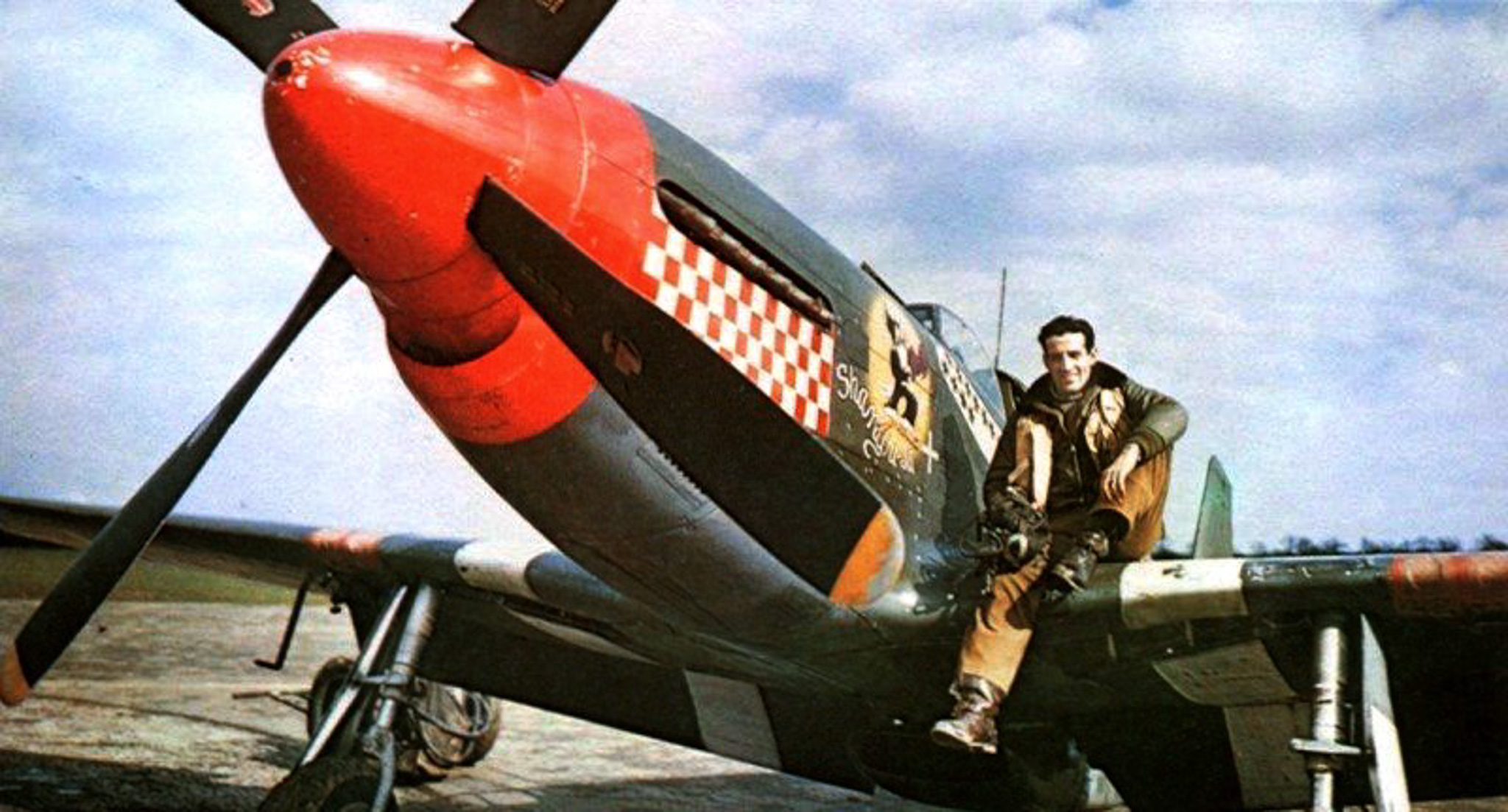
Dominic “Don” Gentile (1920−1951) almost surpassed Eddie Rickenbaker’s World War I record of 26 downed enemy aircraft. (Gentile was credited with 19.83 kills.) He flew the Supermarine Spitfire for the No. 133 Eagle Squadron before his transfer to the 4th FG where he first flew the P-47 before moving on to the P-51. On 13 April 1944, Gentile crashed his P-51 at Debden RAF while showing off for a group of journalists. Commanding Officer Blakeslee immediately grounded Gentile and sent him back to the United States to sell war bonds. He stayed in the air force after the war but in January 1951, Gentile was killed in a trainer aircraft crash.
Don Gentile on the wing of his P-51B, “Shangri-La.” Photo by anonymous (c. 1944). PD-U.S. Government. Wikimedia Commons.Gen. Dwight D. Eisenhower awarding the Distinguished Service Cross to Dominic (“Don”) Salvatore Gentile (left) and Donald Blakeslee (right). Photo by anonymous (11 April 1944). PD-U.S. Government. Wikimedia Commons.
The Classic Eagle Squadron March
Listen to this rousing march written specifically in memory of the Eagle Squadrons.
We welcome everyone to contact us either directly or through the individual blogs. Sandy and I review every piece of correspondence before it is approved to be published on the blog site. Our policy is to accept and publish comments that do not project hate, political, religious stances, or an attempt to solicit business (yeah, believe it or not, we do get that kind of stuff). Like many bloggers, we receive quite a bit of what is considered “Spam.” Those e-mails are immediately rejected without discussion.
Our blogs are written to inform our readers about history. We want to ensure discussions are kept within the boundary of historical facts and context without personal bias or prejudice.
We average about one e-mail every two days from our readers. We appreciate all communication because in many cases, it has led to friendships around the world.
Gentile, Don. One Man Air Force. New York: L.B. Fischer, 1944. Copyright held by North American Newspaper Alliance.
Haugland, Vern (author), Lt. Gen. Ira C. Eaker (USAF Ret.) (Foreword). The Eagle Squadrons: Yanks in the RAF, 1940−1942. New York: Ziff-Davis Flying Books (1979). Republished by TAB Books in 1992. Lt. Gen. Eaker was the model for the fictional Maj. Gen. Pat Pritchard in the 1949 movie, Twelve O’Clock High. (If you haven’t seen the movie you are missing out on probably the most realistic movie about World War II heavy bombers.)
There may be a chance that after we publish this particular blog, the video links associated with the blog are no longer accessible. We have no control over this. Many times, whoever posts the video has done so without the consent of the video’s owner. In some cases, it is likely that the content is deemed unsuitable by YouTube. We apologize if you have tried to access the link and you don’t get the expected results. Same goes for internet links.
What’s New With Sandy and Stew?
Three months after moving into our new home outside the Nashville area, we were hit with the Polar Vortex creating one of the worst ice storms the area has seen. Funny but the winter before we left Nashville some nine years ago, the worst ice storm in fifty years came through. Someone asked me if we were to blame for both. I don’t know. Two weeks after I joined a bank some forty years ago, the Challenger blew up. Two weeks after I joined another bank in late August 2001, the 9/11 terrorist attacks occurred. Trust me, I didn’t have anything to do with the Covid pandemic (that I can recall).
I have read The Wall Street Journal (WSJ) now for about fifty years. There are several sections that are of particular interest to me. One is the “Review” section every Saturday. In this section there are book reviews and I focus on non-fiction books with subjects that pertain to what I write about in our blogs and the Paris walking tour books. I have found over the years that if a book makes it to the WSJ, I can be assured it’s well-written and at least worth a look. Many of the books in my library were purchased based on their reviews.
Recently, a book caught my eye. It is Josephine Baker’s Secret War by Hannah Diamond (Yale University Press, 2025). Our 2021 blog, An African American in Paris (click here to read the blog), told the story of Josephine and her wartime exploits. For an expanded story, you might want to check out Ms. Diamond’s book.
Another book I would highly recommend is David L. Roll’s book, George Marshall: Defender of the Republic (Caliber, 2019). Gen. Marshall was an incredible person, and it would have been difficult for the Allies to win the war without him. He would have been the commander of Allied troops for the invasion of Europe, but Gen. Marshall was indispensable to President Roosevelt as his chief of staff and as such, Gen. Eisenhower was appointed Supreme Commander. This is a book I originally purchased based on the WSJ review. The personal and professional standards set by Gen. Marshall should be taught in every school. I gave each of my children a copy of this book.
Thank you to all of you who subscribe to our bi-weekly blogs. It seems there isn’t a day that goes by where we don’t increase our readership. Please let your history buff friends and family members know about our blog site and blogs.
Someone Is Commenting On Our Blogs
I have a lot of people to thank so it will take me several blogs to catch up. If I miss someone who has communicated with us (in a nice way), please don’t get mad at me for not mentioning your comments. I’m trying my best to catch up after our little sabbatical.
First and foremost, thanks to all of you who reached out to us after the last blog was published. It is good to be back, and I appreciate all of your kind comments and concerns about us.
Thanks to Edward N. for his comments on our blog, Salon Kitty (click here to read the blog). Edward is an expert in film and noted how the technical process of recording in the 1940s might have been different than what the blog mentioned.
Hazel S. contacted us about the blog, Cour des Miracles (click here to read the blog). There was an image of an illustration of a beggar that she identified as “The Man with the Twisted Lip” from Sir Arthur Conan Doyle’s short story. The artist was Sidney Paget and the story appeared in the Strand Magazine. Thanks Hazel. We have corrected the accreditation in the blog.
Monique T. wrote us about her family in response to the blog, An (extra)Ordinary Holocaust Story of Survival (click here to read the blog). Madame T. is 82-years-young and gave me permission to pass her contact information onto Marianne Golding. Marianne is from the Seidler family and is writing a book about Monique’s family and the Seidler family during World War II. It seems Monique will be able to fill in some of the unknown blanks Marianne has run into.
Paul A. is researching a particular French resistance operative and needed some information on the White Buses from the blog, Ten Gifts of the White Bus Rescue (click here to read the blog). Recall this was a guest blog written by Dr. Roger Ritvo. We were able to connect Paul and Roger. Ironically, several weeks later I received an email from Marzio A. It seems his grandfather assisted Count Bernadotte with the White Bus rescue. He took exception to the Count being called a hero and proceeded to explain what happened behind the scenes as told to him by his grandparents. An interesting twist to the accepted story.
Tim P. has been reading a lot about the French Resistance and contacted us about our blog, The Rasputin of the Abwehr (click here to read the blog). He mentioned he was going on a trip to France and asked about areas where he could visit to gain more knowledge. That’s hard to pin down when the entire country was occupied. That’s why I concentrated on Paris for my three books, Where Did They Put the Gestapo Headquarters? For example, Viriginia Hall (The Butcher of Lyon–click here to read the blog) operated in and around Lyon. Yet there really aren’t any specific sites that I know of to follow her footsteps. Same goes for Nancy Wake (The White Mouse—click here to read the blog). I do know of many resistance museums. However, the printed content accompanying the photographs and exhibits are only in French.
If there is a topic you’d like to see a blog written about, please don’t hesitate to contact me. I love hearing from you so keep those comments coming.
This book presents three detailed walking tours and numerous metro station oriented short walks that identified significant occupation locations. Each location on the walk is fully explained. In addition, the author uses many sidebars to provide additional supporting information. The appendix provides a wealth of additional information and pictures that the novice and well read Occupation scholar will find helpful. Whether your first exposure to the Occupation or one of many books you have read, this book is a must read prior to visiting Paris. The format and size of the book make it easy to carry in your carry-on luggage. The book is the first of a three volume set. I can’t wait to see the information to be presented in Volumes 2 & 3.
Patrick from Albuquerque.
Patrick Morrissey, Amazon customer
“Informative and entertaining, Stew Ross’ newest work evokes a difficult and frightening time in the history of the City of Light. The detailed descriptions of sites such as the Vél’ d’hiv’ or Gestapo headquarters reminds us of the choices people made during those years.”
Cynthia Bisson, PhD, Professor of History, Belmont University, French Resistant Expert






 Walks Through History