
Posted on

Night and Fog

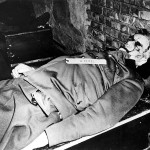
The body of Wilhelm Keitel after being hanged, 16 October 1946. Photo by U.S. Army. P.D.-U.S. Government. Wikimedia Commons.

Early on the morning of 16 October 1946, Wilhelm Keitel walked up 13 steps of the scaffold, had the rope adjusted around his neck, and dropped 6 feet through the trap door. The Nuremburg Court’s verdict of death by hanging was carried out on one of the major architects and perpetrators of the Nazi war machine.

Today, we tend to see World War II through the lens of the History Channel framed by the events of Pearl Harbor, D-Day, and the Holocaust. Rarely do we dig below the surface and become exposed to the sheer brutality, horrors, and inhuman behavior of the Nazi regime and its criminals (yes, these were criminals, thugs, lowlife, misfits, and degenerates). Researching my new book Where Did They Put the Gestapo Headquarters? A Walking Tour of Nazi Occupied Paris has brought many of these barbaric events and behaviors to my attention. I have trouble comprehending so many horrific stories as I scratch the surface. One of these stories is Nacht und Nebel. Read More Night and Fog

Posted on

London’s Black Death–1665

The Great Plague 1665. Painting by Rita Greer (2009). By permission of the artist.

One of the points I make in my new book Where Did They Burn the Last Grand Master of the Knights Templar? A Walking Tour of Medieval Paris, is that entire cities such as Paris and London are virtual museums—all you have to do is dig.

I also discussed this in my June 6, 2015 blog post Stop the Presses: Skeletons and Not Buildings. A dig in the basement of a Paris supermarket revealed the final resting place (i.e., burial pit) of many medieval citizens (likely from a now defunct hospital located near the pit).

Moving across the Pond, Londoners have been looking forward to their new rail system that goes through Crossrail’s Liverpool Station. That is until they dug up a burial pit containing the remains of 30 plague victims. Plague pits are actually quite common across England. During the 1665 plague, it is estimated that more than 100,000 London citizens (approximately one-fifth of the city’s total population at the time) died of the plague. Read More London’s Black Death–1665