Posted on

Operation Long Jump

Do you remember the 1971 fictional story, The Jackal, written by Frederick Forsyth? It was about an assassination attempt on General Charles de Gaulle and based on the actual 1962 unsuccessful attempt on the general’s life. Today’s story takes place less than twenty years earlier during World War II however, this time, the assassination targets were the Allied leaders, commonly known as the “Big Three.”
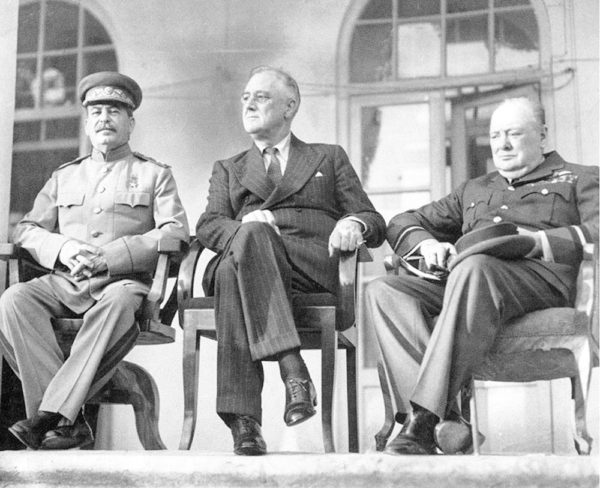
The Allied “Big Three” at the Tehran Conference: Stalin (left), Roosevelt (center), and Churchill (right). Photo by U.S. Government (c. November 1943). PD-U.S. Government. Wikimedia Commons.

Did You Know?

Did you know that twenty-two percent of Millennials surveyed several years ago knew nothing about the Holocaust and an amazing sixty-six percent of them had never heard of Auschwitz? Frankly, I find those statistics to be unbelievable and clearly, it is a sad commentary on our education system. I’m the first one to stand up for teaching more of the three R’s (reading, writing, and arithmetic). However, I cannot comprehend that we ignore teaching our children about the Nazis and the twelve years of their systematic murder of eleven million people. Aren’t there some very important basic and fundamental lessons here to be learned?

We will very shortly reach the time when the last World War II participant dies. This is true of Nazi concentration camp and extermination camp survivors. When these people are gone, who will tell their stories to future generations? Allied troops demanded General Eisenhower tour the liberated Buchenwald Ohrdruf concentration camp (the first camp liberated by the Americans). Eisenhower was so appalled that he ordered photographers to come in and document the atrocities. The general later said that one of the reasons he ordered photographic documentation was to prevent future generations from being able to deny the Nazis’ crimes.
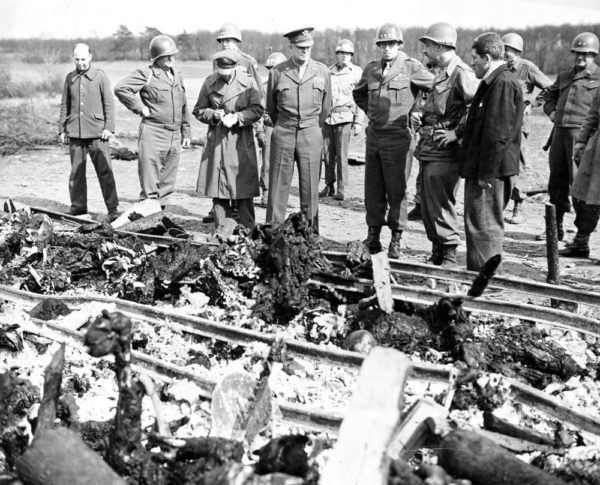
General Dwight Eisenhower at Buchenwald Ohrdruf Concentration Camp
General Dwight Eisenhower (center) and high-ranking officers view the charred remains of prisoners who were burned during the Nazi evacuation of Buchenwald Ohrdruf concentration camp. Photo by Colonel Meches (12 April 1945). United States Holocaust Memorial Museum. Courtesy of National Archives and Records Administration, College Park. PD-U.S. Government. Wikimedia Commons.

When Sandy and I toured the former Nazi rally grounds at Nuremburg, we had the opportunity to visit the nearby museum. There were no attempts to whitewash what the Germans and the Nazis did during the twelve years of the Third Reich. The museum was organized in such a way as to take you through the journey of how and why these events evolved. The museum is considered so important that after a young man or woman enters the German military, they are immediately required by law to take a tour of this museum.

Thirty-years ago, Jack was a client of mine and he was a brilliant businessman who lost some of his family during the Holocaust. One day on the way out to see his new manufacturing facility, we had a discussion about the Holocaust. At some point, I mentioned it was so horrific that it could never happen again. Jack slammed on the brakes and once he pulled the car over to the side of the road, he turned to me and sternly said, “Stew, don’t you ever think something like this couldn’t happen again. It can and it will should the right circumstances and people present themselves. We must study how and why this happened because that is the only way we have any hope of preventing it again.”

The creation of Holocaust museums and memorials were driven primarily by Holocaust survivors. Education programs have relied on first-hand stories from these survivors. When these people are gone, who will step up and ensure no one ever forgets?

Forgive but never forget.


The Tehran Conference

The Tehran Conference was the first of the major meetings involving the “Big Three” (United States, Britain, and the Soviet Union). Roosevelt, Churchill, and Stalin met in the Soviet Embassy in Tehran between 28 November and 1 December 1943. Despite different agendas, the primary outcome was agreement that a second front would be established against the Nazis in May 1944. This was a “win” for Stalin who had been pushing for this since the Nazis had invaded the Soviet Union in mid-1941. The second front would divert German troops away from the east. One of the overriding factors of the conference was the security of the three Allied leaders. The night before the meetings began, Stalin’s right-hand man, Vyacheslov Molotov, informed British and American representatives that an assassination plot against the Big Three leaders had been uncovered. A Soviet agent, Nikolai Kuznetzov (1911-1944), working undercover while posing as a Wehrmacht officer had been tipped off by a German officer who had had a little too much to drink. Click here to watch the video The Big Three in Teheran (1943).
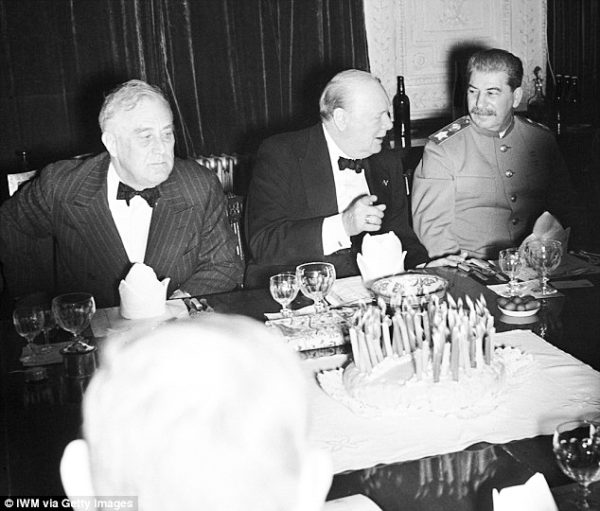
Roosevelt (left), Churchill (center), and Stalin (right) at dinner during the Tehran Conference. Photo by anonymous (c. November 1943). ©️ IWM via Getty Images.

Read More Operation Long Jump

Posted on

After VE Day

On 8 May 1945, the Germans surrendered unconditionally thus ending the war in Europe. This day became known as “Victory in Europe Day” or simply, “VE Day” (Russia, Belarus, Serbia, and Israel celebrate VE Day on 9 May). So, the war was over, and everyone went home to promptly forget the nightmare of the past six years. Right? Well, not everyone.

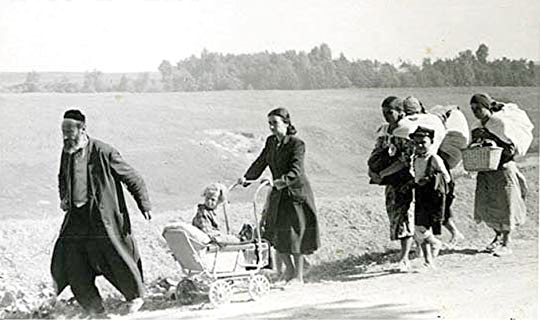
Displaced families. Photo by anonymous (c. 1945).

When major conflicts end (e.g., the American Civil War), the tendency is for the participants to return to their previous lives and take up where they had left off. It was normal for them to “forget” about the tragic experiences of whatever conflict they had been involved in. Most of us know about the men and women returning from the Pacific and European theaters after the end of World War II. They were our parents, grandparents, or other relatives and most of them never spoke about their experiences ever again ⏤ all they wanted to do was get an education, marry, and go on with their lives.

Well, not everyone could go home or forget.


Did You Know?

Did you know that in France, there is no official state “Victory in Europe Day” or even a Liberation Day? Officially, they call it Victoire 1945. Unlike other European countries which were liberated on a single day (e.g., Netherlands on 5 May 1945), France was liberated town-by-town. So, each town or city would likely celebrate its own Liberation Day corresponding to the date it was liberated.

The utter devastation in Europe (the Pacific Theater was no different) at the end of the war meant that tens of millions of people were displaced, facing extreme hunger, and likely looking for shelter and their relatives. These people, both German as well as the former oppressed, could not go home and forget about the war. For these unfortunate people, the aftermath of World War II horrors continued for years. It is a story that has never received much attention and so, we all believe the war ended on 8 May and that was that.


The War’s Toll

Nearly forty million people died during World War II. More than half were non-combatant fatalities. Six million Jews were exterminated. Soviet deaths ⏤ military and civilian ⏤ are estimated to be between twenty-five and twenty-seven million. American deaths in the combined war theaters totaled around 420,000.

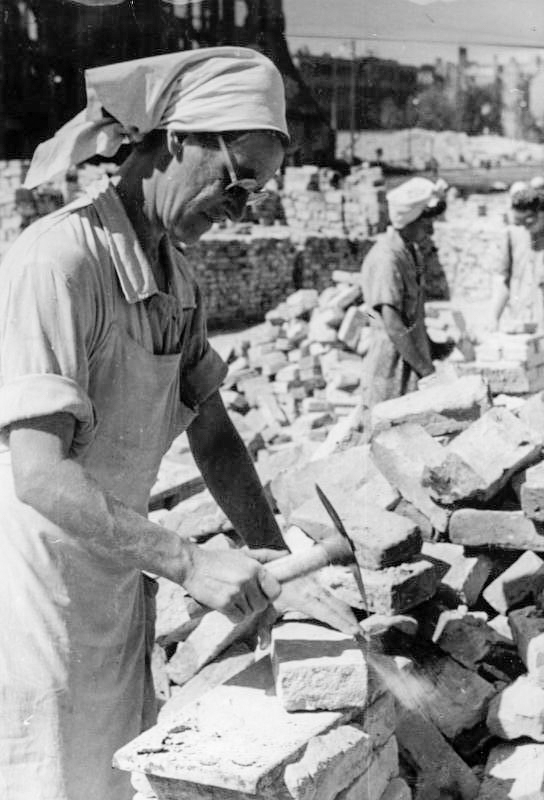
Dresden “Trümmerfrau” (Rubble Woman or Brick Lady) clearing Dresden of the bricks after the end of the war. Dresden was destroyed by Allied bombing and a devastating firestorm. Photo by anonymous (c. 1948). Bundesarchiv, Bild 183-H26824/CC-BY-SA 3.0. Wikimedia Commons.

What we call “collateral damage” today was huge. Food sources were cut in half and wouldn’t recover for years.  Sixty percent of Yugoslavia’s roads were destroyed while the Netherlands lost the same percentage of its road, rail, and canal transport systems. Poland lost a third of its rail tracks and one-fifth of its roads while eighty-five percent of its rolling stock (i.e., trains) was destroyed. One fifth of all German living spaces were uninhabitable leaving twenty million of the country’s civilians homeless. The Soviet Union suffered the worse. Some seventy thousand villages, two thousand towns, and numerous cities were completely leveled. Thirty-two thousand factories were destroyed while forty thousand miles of rail track was decimated. Around twenty-five million Soviet citizens were without shelter.

Homeless

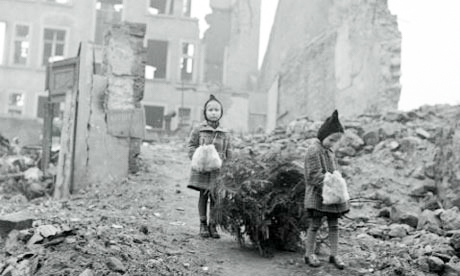
Millions of people were left homeless after the war. After returning to their cities, towns, and villages, they found utter destruction with nothing left. Adding to their misery, food was scarce and near starvation became a way of life. Families had been torn apart. It was thought that half of the European population was in transit at the end of the war.

Orphaned children. Photo by anonymous (c. 1945).

Also returning home were the surviving victims of the Nazi concentration, extermination, and forced labor camps. Approximately two thousand French soldiers were captured during the Battle of France in 1940 and now, the POWs were released to find their way back to France. Everyone shared three things in common: finding shelter, food, and trying to locate their families.

Refugee camps were initially established by nationality. “Displaced persons,” including Jewish survivors, were placed in these camps but it became apparent very quickly that former inmates were being housed with their former torturers. It was not until the fall of 1945 that President Truman ordered General Eisenhower to create separate facilities for the Jews and increase their rations. A concerted effort was made to identify the leaders in the refugee camps who, as General Patton stated, looked at Jews as “lower than animals.” These segregated camps remained open for three to five years because countries would not offer asylum to the survivors. Read More After VE Day