Posted on

The Pianist & Wehrmacht Captain

There is a 2002 film that is based on the memoirs of a Polish-Jewish pianist who barely escaped (twice) deportation to KZ Treblinka, survived the 1943 Warsaw Ghetto Uprising, and the razing of Warsaw in late 1944 by the Germans as they retaliated against an uprising by the Polish home guard.

The film is called The Pianist and stars Adrien Brody as Władysław Szpilman, the Jewish pianist. It was nominated for seven Academy Awards and won three: Best Director (Roman Polanski), Best Actor (Brody), and Best Adapted Screenplay (Ronald Harwood).
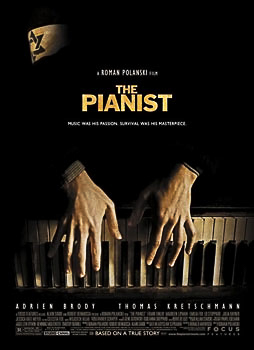
Promotional poster for the movie “The Pianist.” Photo by anonymous (c. 2002). Focus Features. PD-Fair Use. Wikimedia Commons.

I’ve never seen the film. I don’t watch movies. I would prefer to see a well-researched documentary that is true to the historical facts. However, it is my understanding from reading various reviews, the movie pretty much sticks to the true story of Władysław Szpilman without the usual Hollywood historical distortions. Perhaps after I have completed and published this blog, I might change my mind about watching The Pianist.

After the war, most of the Holocaust survivors asked the question, “Why me? Why did I survive when millions did not?” I’m certain Mr. Szpilman asked himself that question many times as he was the sole survivor of his family. As his memoirs point out, he experienced many lucky breaks during those five horrible years in Warsaw. But one lucky experience stands out in particular. It was the effort by a German Wehrmacht captain to shelter Mr. Szpilman and protect the pianist from certain death.

I invite you to read several of our previous blogs that focused on the 1943 Warsaw Uprising (Nazi Frankenstein [click here to read] and Ghetto Girls [and here to read]).


Errare humanum est, sed perseverare diabolicum

(“To err is human, but to persist in error is diabolical”)

⏤ Larry Stern’s sixth-grade Latin teacher


Did You Know?

Did you know that France is drowning in ACRONYMS? A recent article calls them “cradle-to-grave acronyms” that are now “an inescapable feature of life in France.”

First through fifth elementary school grades are referred to as CP, CE1, CE2, CM1, and CM2. Earning a minimum wage? If so, it’s called the SMIC. If you start a new small business, then you’ve opened a TPE. Selling your mansion? You will pay the IFI tax. Many French senior citizens live in an EHPAD, or nursing home. Army officers are trained in the CNFCSTAGN. French workers are classified as CDI or CDD (a work contract of unlimited duration or temporary contract, respectively). We all know France has a 35-hour work week. If you go beyond the 35-hours, you are entitled to RTT, or offsetting vacation time. If you are poor and qualify for government subsidiaries, you are known as RSA, APL, and PA. Lastly, France’s consumer protection agency is referred to as DGCCRF.

This is the TGV 4406 “Basel” train waiting to leave the Bahnhof Basel. SBB CFF FFS refers to the Swiss Federal Railways known as “Schweizerische Bundesbahnen” (SBB) in German, “Chemins de fer fédéraux suisses” (CFF) in French, and “Ferrovie federali svizzere” (FFS) in Italian. Photo by Socoa (12 September 2009). PD-CCA-Share Alike 3.0 Unported license.

Even President Macron bemoans the acronym crisis. He is trying to simplify the acronym bureaucracy. His government is ordering officials to “Speak French to us.” The United States government certainly has its issues with acronyms as military “speak” can attest. But in France, it seems acronyms have permeated every inch of daily life.

It’s hard to understand how this situation could get so out of hand. One French expert blames the “all-encompassing government bureaucracy” and says, “It has a tentacular character.” She thinks it is a paradox due to the country’s fixation on its literary culture and preservation of the French language. In 1635, The Académie français was founded as the official authority on the usages, vocabulary, and grammar. Although this government agency has no official power, its mission is to preserve the French language and prevent the Anglicization of the language. I believe we have highlighted some examples in previous blogs.

ATM I’m working on a new blog and BTW, LMK if you like our blog topics. FWIW, I’m NGL but it’s a chore coming up with TBD stories. My favorite acronym is BOGO. Stella, our beagle, suffers from FOMO. I wrote this on Sandy’s birthday so HBD to her.

TYVM for reading our blogs.

TTYL.


Władysław Szpilman 

Władysław Szpilman (1911−2000) was born in Sosnowiec, Poland. (Between 1902 and 1918, the town was considered part of the Russian Empire.) His academic studies in music took place in Warsaw and Berlin where he studied under several pupils of the famous composer, Franz Liszt. After Warsaw, Mr. Szpilman was accepted to the Berlin Academy of Arts. When Hitler came to power in 1933, Mr. Szpilman moved back to Warsaw where he became a celebrated pianist due to his performances on Polish Radio, concerts, and tours. Read More The Pianist & Wehrmacht Captain
Posted on

The Nazi Frankenstein

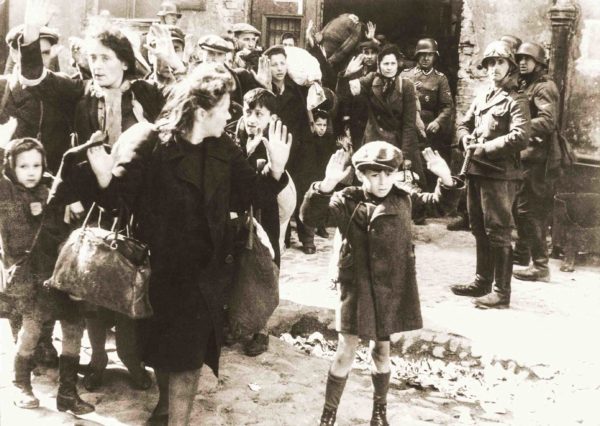
There are many iconic images of World War II. One of them is a 1943 photograph of women and children exiting a bunker during the Warsaw Ghetto Uprising with their hands raised in surrender led by a little boy. Off to the side, holding his machine gun on them, stands SSRottenführer Josef Blösche. He was serving as a policeman in the Warsaw Ghetto during the monthlong uprising and according to post-war testimony, carried out his daily duties with such cruelty that Blösche earned the nickname, “Frankenstein.” It also earned him the death sentence twenty-six years later.

A Jewish boy surrenders in Warsaw (original title). Polish Jews are captured by Germans during the suppression of the Warsaw Ghetto Uprising. Josef Blösche stands (right with goggles on helmet) with machine gun pointed at the young boy. Photo by Franz Konrad or Propaganda Kompanie nr 689 (c. April/May 1943). The Stroop Report. U.S. National Archives and Records Administration and Polish Institute of National Remembrance. PD-Expired Copyright. Wikimedia Commons.

Did You Know?

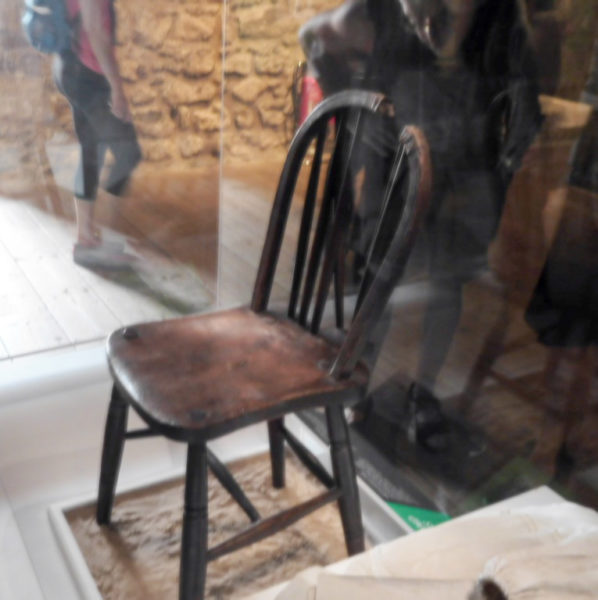
Did you know that the last person executed in the Tower of London was a Nazi spy named Josef Jakobs (1898-1941)? Parachuting into England on 31 January 1941, Jakobs was immediately arrested by the Home Guard. They knew he was coming because the authorities had been tipped off by a double agent working for British intelligence under Operation Double Cross [Read The Double Cross System here]. Found guilty of spying, Jakobs was executed by a firing squad (he was condemned as an enemy combatant and therefore, not hanged). Jakobs’s granddaughter, Giselle Jakobs, began researching her grandfather’s story in the early 1990s. As classified documents were released to the U.K. National Archives, Giselle was able to piece together the story of Josef’s life including his allegiance to Nazi Germany. It was not a pretty story, but it did provide some sort of closure for Giselle as well as for her father, Josef’s son. Her book, The Spy in the Tower: The Untold Story of Joseph Jakobs, the Last Person to be Executed in the Tower of London is available through Amazon.com.

The chair in which Josef Jakobs sat when he was executed by firing squad on 15 August 1941 at the Tower of London. Photo by Hu Nhu (October 2018). PD-CCA-Share Alike 4.0 International. Wikimedia Commons.

The Warsaw Ghetto

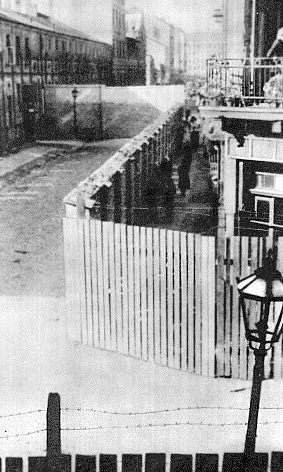
Prior to World War II, a quarter of Warsaw’s population were of the Jewish faith. Immediately after the German invasion in 1939, Polish Jews were subjected to the Nazi anti-Jewish laws. In November 1940, the Germans established the Jewish ghetto in Warsaw, and it became the largest ghetto in any of the Nazi occupied countries.  More than 400,000 Jews were required to live within the 1.3 square mile area surrounded by a ten-foot-high wall topped with barbed wire. The actual size of the ghetto decreased over time as the population declined due to deportations, executions, and death through disease or starvation along with the deliberate destruction of the ghetto by the Nazis. Beginning in the summer of 1942, approximately a quarter million of the Jews living in the ghetto were rounded up and deported fifty miles to the northeast of Warsaw to the Treblinka extermination camp.

On 15 November 1940, the Warsaw Ghetto is sealed with a wall. Photo by Meczenstwo Walka, Zaglada Zydów Polsce 1939-1945. Poland. No. 75. (c. 1941).

Read More The Nazi Frankenstein