Posted on

Hitler’s Directives

I’ve touched on several of Hitler’s directives, or decrees in past blogs. I thought I would outline some of the more infamous decrees he made over the twelve years of the Third Reich. You can be assured that the stories of the people these decrees targeted did not end well.

Hitler came to power in 1933 and immediately began issuing his directives and proclamations. They initially went after Jews, Untermensch, and political enemies of the Nazis. From there he moved on to the physically and mentally disabled. As the war progressed, Hitler began to circumvent the Geneva Convention and its rules on how POWs and captured military/combat personnel were to be treated.
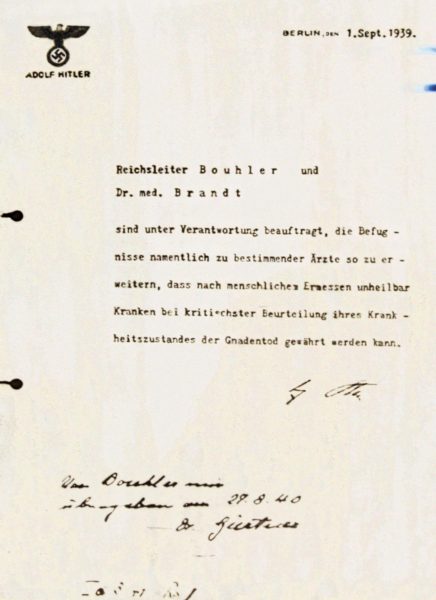
Official directive on Hitler’s personal stationary (and signed by the Führer) directing Bouhler and Brandt to establish the euthanasia program known as “Aktion T4.” Photo by Marcel (March 2008). PD-Official Decree (German). Wikimedia Commons.

In the end, several of these decrees were used by the International Military Tribunal during the Nuremberg Trials as evidence to convict former senior Nazi officials of one or more of the four counts: conspiracy for the accomplishment of crimes against peace, waging wars of aggression, war crimes, and crimes against humanity. Many of Hitler’s decrees aimed at military combatants were used to convict the former Nazis leaders and their underlings of the third count⏤war crimes. Most of the convictions came with the death penalty. Read More Hitler’s Directives
Posted on

Paris Art Nouveau

Everyone who travels returns home with certain images imbedded in their memories. One of the images of Paris that I have always retained is the decorative entrances to the métro stations. No, not every bulky, uninspired, or “run-of-the-mill” station but rather, those métro entrances that exhibit the iconic flamboyant signage designed in the style of Art Nouveau.

What is “Art Nouveau?” Art Nouveau, or “New Art” was an art movement that began around 1890 and ended in 1910. The movement was international (in England, it was known as “Modern Style”) and exhibited a style inspired by flowers and plants. There is a lot of movement with asymmetrical but sinuous and elegant lines. Materials used included glass, iron, and ceramics. By the end of World War I, Art Nouveau had disappeared and was replaced by Art Deco followed by Modernism.

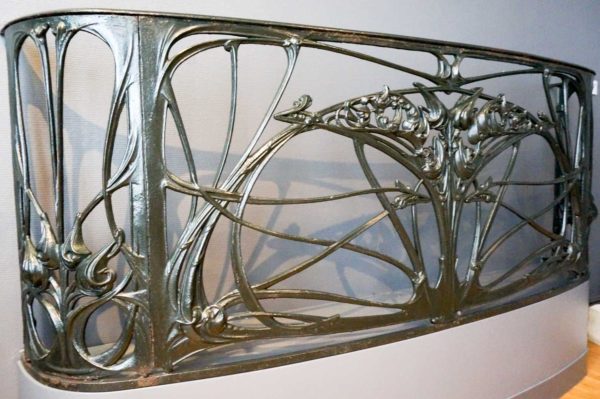
Balcony created by Hector Guimard for the Musée Fonte d’art Saint-Dizier. Photo by G. Garitan (September 2013). PD-CCA-Share Alike 3.0 Unported. Wikimedia Commons.

Art Nouveau was influenced by the Arts and Crafts movement (originating in Great Britain) and the first Art Nouveau architecture and interior design appeared in Brussels in 1890. It was quickly adopted by Hector Guimard in Paris. Artists such as Guimard, Alphonse Mucha, Aubrey Beardsley, and Louis Comfort Tiffany were leading proponents of Art Nouveau in architecture, jewelry, posters, graphic arts, and furniture. Mucha rejected the terminology of Art Nouveau. He said, “Art is eternal, it cannot be new.” However, the Paris art world quickly termed Art Nouveau as “le style Mucha,” or Mucha Style.

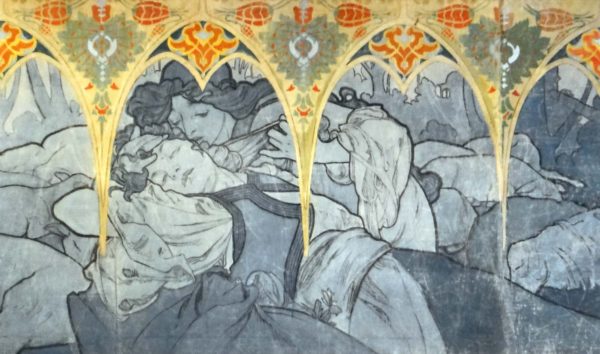
Detail of the mural at the Pavilion de la Bosnie-Herzégovine during the Paris Exhibition of 1900. Mural painting by Alfonse Mucha (c. 1900). Photo by Jean-Pierre Dalbéra (June 2014). PD-CCA 2.0 Generic. Wikimedia Commons.
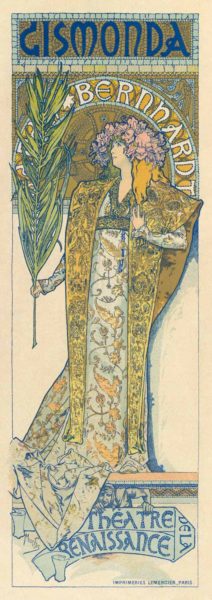
Poster for the premier production of “Gismonda” starring Sarah Bernhardt. Lithograph poster by Alphonse Mucha (c. 1894). Gallica Digital Library – Sakai Collection. PD-Author’s Life + 80 years or fewer. Wikimedia Commons.
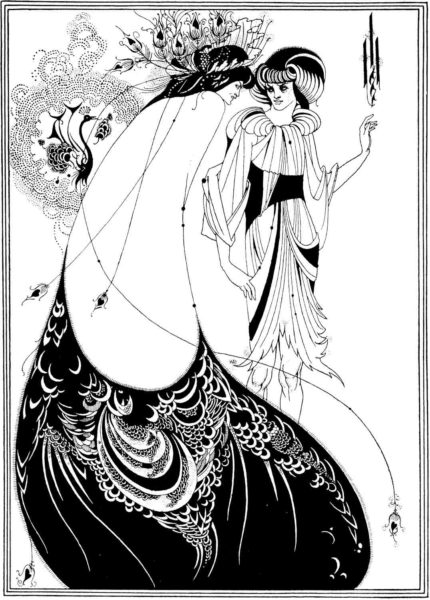
“The Peacock Skirt” for Oscar Wilde’s play, “Salomé” (1892). Illustration by Aubrey Beardsley (c. 1892). PD-Author’s Life + 100 years or fewer. Wikimedia Commons.

Guimard was the first to embrace Art Nouveau in Paris when he agreed to design the first generation of entrances to underground stations of the new Paris métro system at the turn of the century. Read More Paris Art Nouveau