Posted on

The Eagle Squadrons

I think most of us are familiar with some of the aerial fighter squadrons from both world wars. The Flying Tigers, the Tuskegee Airmen (The Red Tails–click here to read the blog), and the U.S. Navy “Jolly Rogers” were several of the well-known squadrons during World War II. The Lafayette Escadrille and 94th Aero Squadron (“Hat in the Ring”) were two of the most famous World War I airplane squadrons.

The concept of foreign volunteers (i.e., mercenaries) joining to fight combatant nations is nothing new. The German Hessians joined the British to fight American revolutionaries, the Swiss Guards protected the Pope in Vatican City as well as French monarchs in Paris while the Nepalese Gurkhas once fought against the British but later fought alongside British soldiers.

Today, you will be introduced to a famous fighter squadron but not as well-known as the ones I have mentioned. The Eagle Squadrons were made up of American pilots who volunteered to join the British Royal Air Force (RAF) before the United States entered the war following Japan’s attack on Pearl Harbor (7 December 1941).

Click here to watch the video Americans Flying for Britain.


“If you thought that science was certain well, that is just an error on your part.”

     ⏤ Dr. Richard Feynman

Theoretical physicist

Dr. Feynman also said, “Science is the belief in the ignorance of experts” because he knew that skepticism and a willingness to assimilate new evidence propel the scientific endeavor.


We are watching what seems to be a possible global rearrangement and at the very least, a new way of dealing with both our allies and not-so-friendly nations. Is this a temporary template for conducting foreign policy or are we seeing the beginnings of a permanent change?

We should revisit a quotation from Gen. Charles de Gaulle:

“No nation has friends, only interests”

It is always fun to read the many quotations from Winston Churchill who is also quoted quite often. It is too bad we are not exposed to more of Gen. de Gaulle’s quotes. Like Churchill, the French general had very insightful comments that are accurate and stand the test of time.


Did You Know?

Did you know that the first item sold on eBay was a broken laser pointer? A Silicon developer, Pierre Omidyar, invented eBay in 1995 (then called “Auction Web”) and tested his new online venture by loading an ad for his broken pointer that originally cost him US$30. He listed the laser pointer for $1.00 and after one week, bidding began with the final winning bid at $14.83.

Within two years, the site was re-branded as eBay and its millionth item was sold. So, who purchased the laser pointer? A Canadian, Mark Fraser, identified himself in 2015 as the person who became the first customer of eBay and has held on to the pointer for all these decades.

Mark Fraser holding the broken pointer he purchased from eBay. Photo by anonymous (c. September 2015). Rupley, Sebastian, eBay News Team, 11 September 2015. “Meet the Buyer of the Broken Laser Pointer.”
https://www.ebayinc.com/stories/news/meet-the-buyer-of-the-broken-laser-pointer/

I wonder what the pointer would fetch today if Mr. Fraser were to put it on eBay.


The Origin of the Eagle Squadrons

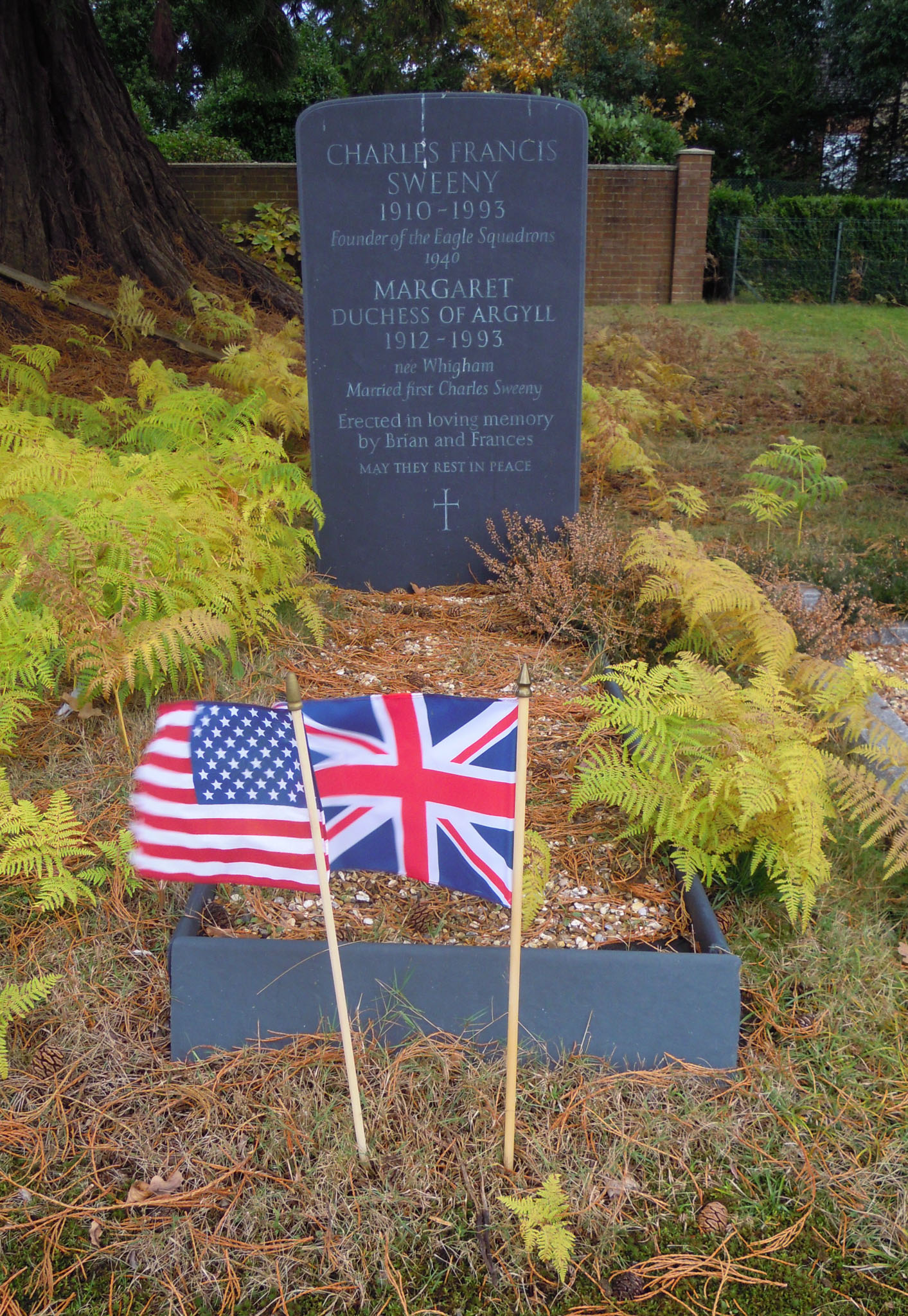
Prior to the United States entering World War II, a successful American businessman and socialite (and friend of Ernest Hemmingway), Charles Francis Sweeny (1909−1993), persuaded the British government to form a squadron comprised solely of American pilot volunteers. Sweeny and his wealthy friends not only raised the money to send the volunteers to England for training, but they also personally recruited the men.

Prior to the occupation of France in June 1940, Sweeny’s activities were considered illegal. He managed to thwart the FBI’s efforts to capture and imprison the “recruiters.” However, after France fell to Hitler, the United States government turned its head on his activities and even the FBI declared Sweeny’s recruiting efforts were legal.

Meanwhile, at the same time, there were parallel efforts being made in Canada. Several World War I aces, William (“Billy”) Bishop (1894−1956) and Clayton Knight (1891−1969), began to recruit and train Americans for service in the RAF. By the end of 1941, they had recruited more than 7,000 Americans with about 15% of them becoming pilots. (Sweeny’s uncle was recruiting Americans to fly for the French air force.)

Billy Bishop standing next to his Nieuport 23 airplane during World War I.
Billy Bishop standing next to his Nieuport 23 airplane during World War I. Photo by anonymous (c. 1918). PD-No known copyright restrictions. Wikimedia Commons.

The British government decided to accept the American volunteer pilots in July 1940. By then, the Battle of Britain had begun, and Britain was fighting for its life. The American pilots were desperately needed.

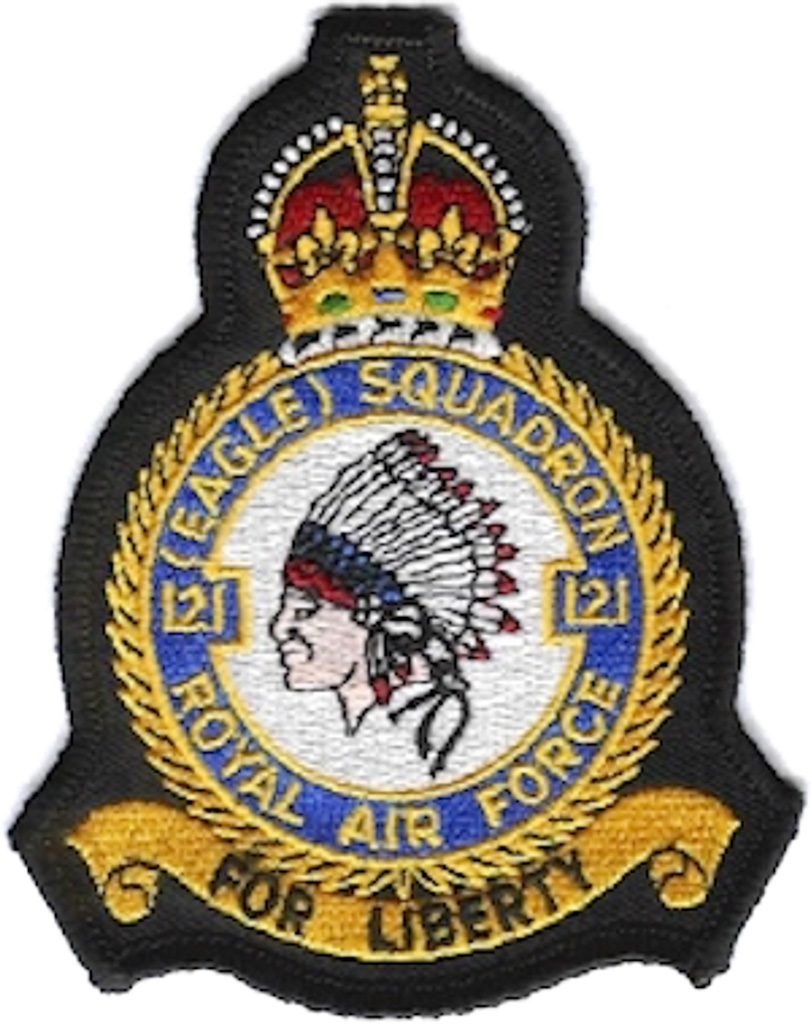
The first unit formed was the No. 71 Squadron known as “The Eagle Squadron.” Sweeny designed the shoulder patch bearing an American eagle. There were enough volunteers to form two additional units: the No. 121 and No. 133 Eagle Squadrons. The pilots began flying missions over France, escorting bombers, and performing targeted strikes.

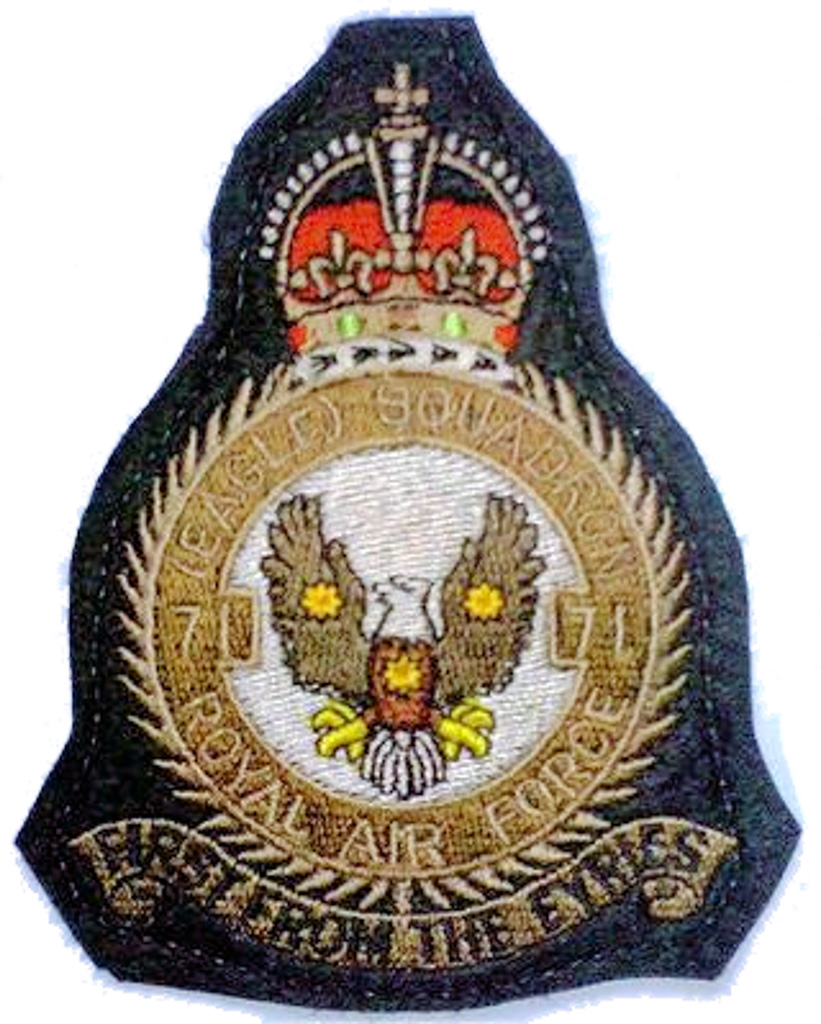
The emblem of the Eagle Squadrons. Photo by anonymous. Patch design by Charles Francis Sweeny (date unknown). PD-Creative Commons CC0 1.0 Universal Public Domain Dedication. Wikimedia Commons.
No. 71 Eagle Squadron RAF badge.
No. 71 Eagle Squadron RAF badge. Photo by anonymous (c. 1940). PD-U.K. Government public domain. Wikimedia Commons.
No. 121 Eagle Squadron RAF badge.
No. 121 Eagle Squadron RAF badge. Photo by anonymous (c. 1940). PD-U.K. Government public domain. Wikimedia Commons.
Grave site of Charles Francis Sweeny and his first wife. Photo by Jack1956 (17 November 2016). PD-Creative Commons CC0 1.0 Universal Public Domain Dedication. Wikimedia Commons.

The Eagle Squadrons

The requirements to join the Eagle Squadrons were a high school diploma, being of age 20 to 31 years, a vision of 20/40 correctable to 20/20, and 300 hours of certified flying time. It was actually easier to join the RAF than it was to get into the United States Army Air Corps (the predecessor of the United States Army Air Force, or “USAAF” formed in June 1941).

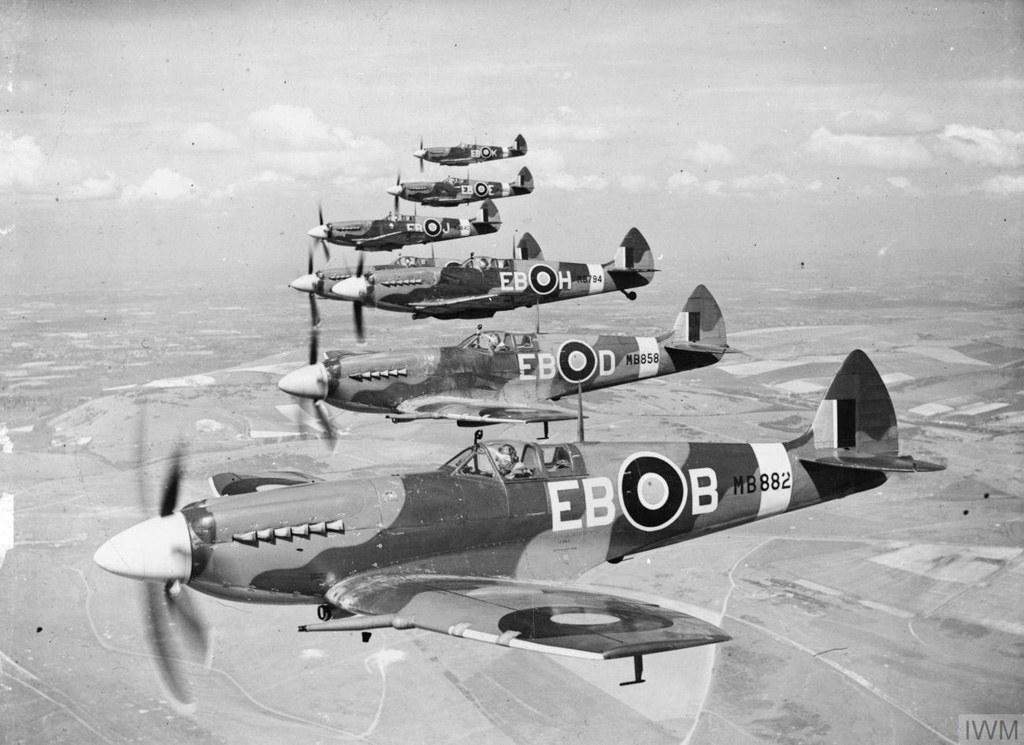
Training took place in England using Miles Master Trainers, Hawker Hurricanes, and Supermarine Spitfires. Upon graduation, the men were commissioned as RAF officers and assigned to various RAF fighter squadrons. The volunteers never renounced their American citizenship. Their RAF uniforms were modified to include the Eagle Squadron patch and the letters “ES” for Eagle Squadron.
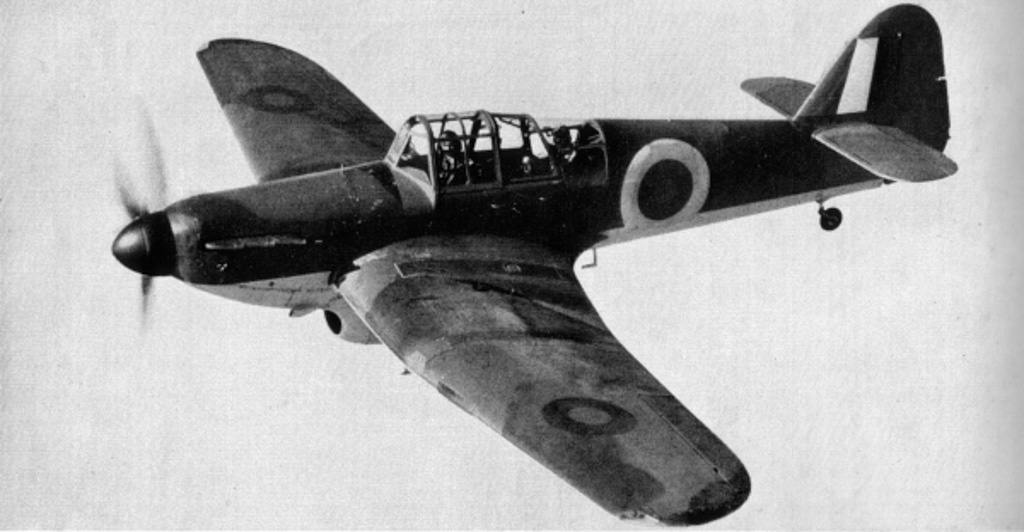
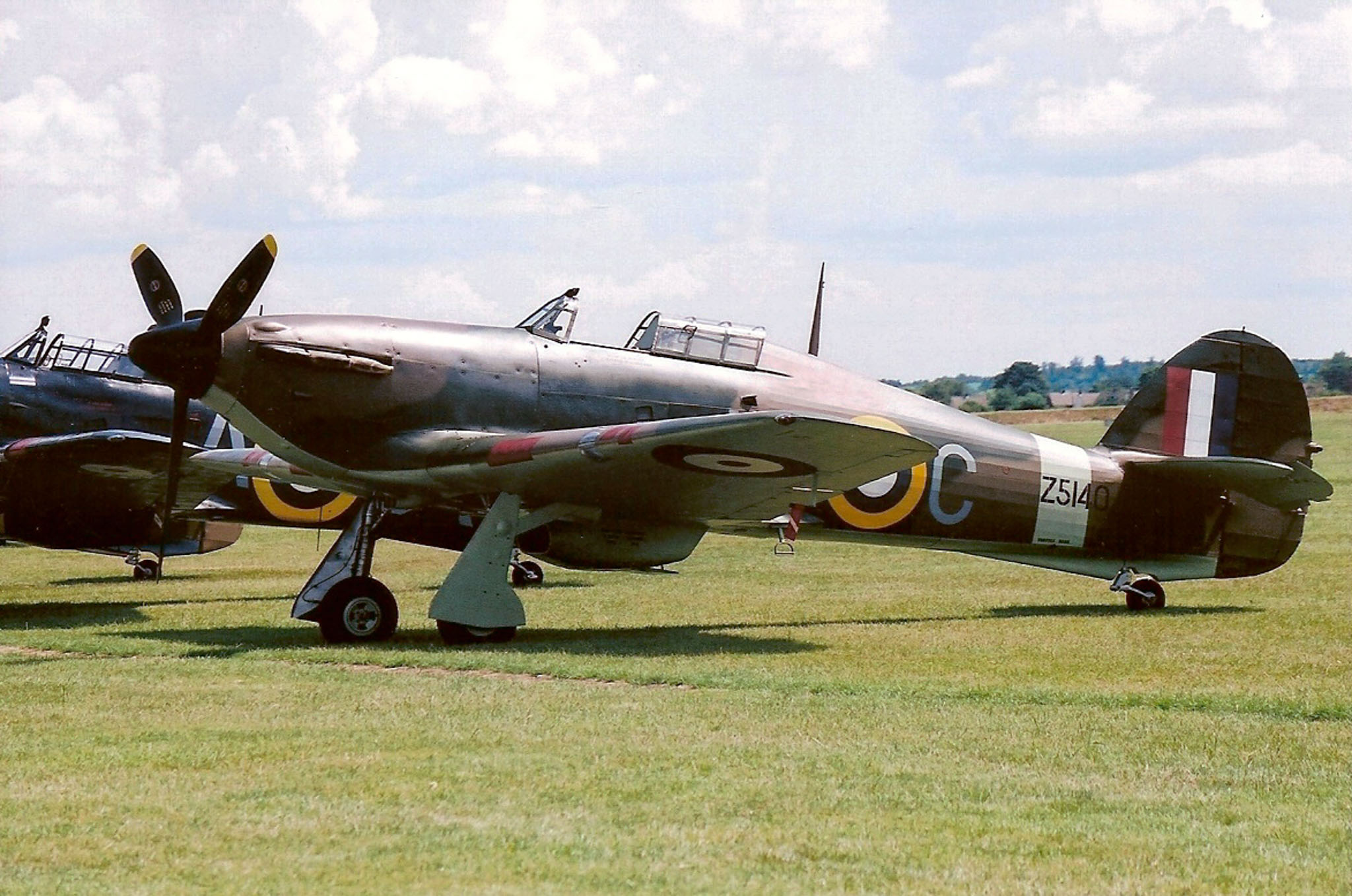
Miles M.9A Master advanced trainer.
Miles M.9A Master advanced trainer. Photo by anonymous. Prepared for Wikipedia by Keith Edkins (c. 1935-1940). PD-U.K. public domain. Wikimedia Commons.
Hawker Hurricane Mk.IIB.
Hawker Hurricane Mk.IIB. Photo by anonymous (date unknown). PD-GNU Free Documentation License, Version 1.2 or later. Wikimedia Commons.
Supermarine Spitfire F Mk XIIs of No. 41 Squadron. Photo by anonymous (date unknown). PD-U.K. Government public domain. Wikimedia Commons.

Between September 1940 and July 1941, three Eagle Squadrons were formed and attached to the RAF. After the United States entered the war, the squadrons were turned over to the USAAF in late September 1942. The commander of the USAAF in Europe, Maj. Gen. Carl Spaatz (1891−1974), wanted to disperse the pilots amongst other fighter groups. However, the pilots wanted to stay together, and Gen. Spaatz agreed to their request. The three squadrons became the 334th (“Fighting Eagles”), 335th (“Chiefs”), and 336th (“Rocketeers”) Fighter Squadrons and formed the elite 4th Fighter Group (4th FG) based at RAF Debden, England.

The pilots eventually transitioned from the Spitfires to American P-47 Thunderbolts (1943−44) and P-51 Mustangs (1944−45). The 4th FG achieved the highest air/ground enemy aircraft destruction record in the USAAF. Some of the group’s accomplishments were being credited with 1,016 enemy aircraft destroyed (37 pilots became aces), the first fighter group to fly missions over Germany, the first to escort bombers over Germany, and the first to use belly tanks. Nathaniel Maranz (1919−?), an Eagle Squadron pilot, became the first American prisoner of war when he was shot down over the English Channel on 21 June 1941 and rescued by a German patrol boat.

American pilots of No. 71 “Eagle Squadron” rush to their Hawker Hurricanes at RAF Kirton-in-Lindsey. Photo by anonymous (17 May 1941). Imperial War Museum. PD-U.K. Government public domain. Wikimedia Commons.
American volunteer pilots of No. 121 Eagle Squadron playing poker in the dispersal hut at RAF Rochford in Essex. Photo by anonymous (c. August 1942).
American volunteer pilots of No. 121 Eagle Squadron playing poker in the dispersal hut at RAF Rochford in Essex. Photo by anonymous (c. August 1942). Imperial War Museum. PD-U.K. Government public domain. Wikimedia Commons.

The 4th FG is considered to have been instrumental in achieving Allied air superiority over Europe. Their final mission of World War II was on 25 April 1945. Today, the 4th Fighter Wing (assigned to the Air Combat Command’s Fifteenth Air Force) is the legacy of the Eagle Squadrons.

Click here to visit the Fourth Fighter Group WWII seb-site.

Click here to visit the American Air Museum Fourth Fighter Group WWII web-site.

Pilots of the Eagle Squadrons 

The first pilots of the Eagle Squadrons were Vernon “Shorty” Keogh (1911−1941), Andrew Mamedoff (1912−1941), and Eugene “Red” Tobin (1917−1941). The three Americans were among the first 32 volunteers recruited by Charles Sweeny, and he intended to have them join the French air force. However, Germany invaded France and the men were sent to England to join the RAF. As part of the No. 609 Squadron RAF, the men participated in the Battle of Britain earning them the Battle of Britain clasp to the 1939−45 campaign star. In September 1941, they were transferred to No. 71 Eagle Squadron. Unfortunately, all three men perished in 1941 during Eagle Squadron missions. On a side note, Mamedoff became the first American to take a “war bride” after marrying an English woman in 1941. He is also believed to be the first Jewish American pilot to have been killed in World War II (unsubstantiated).

The uniform of an American volunteer in No. 121 Eagle Squadron RAF. Photo by Daderot (4 November 2017). Oregon Air and Space Museum.
The uniform of an American volunteer in No. 121 Eagle Squadron RAF. Photo by Daderot (4 November 2017). Oregon Air and Space Museum. PD-Creative Commons CC0 1.0 Universal Public Domain Dedication. Wikimedia Commons.
Three American pilots of No. 71 Eagle Squadron RAF: Left to right: Pilot Officers G. Tobin, V.C. “Shorty” Keough, and A. Mamedoff. They are showing off their new squadron badge at RAF Church Fenton. Photo by anonymous (c. 1940). Imperial War Museum. PD-U.K. Government public domain. Wikimedia Commons.

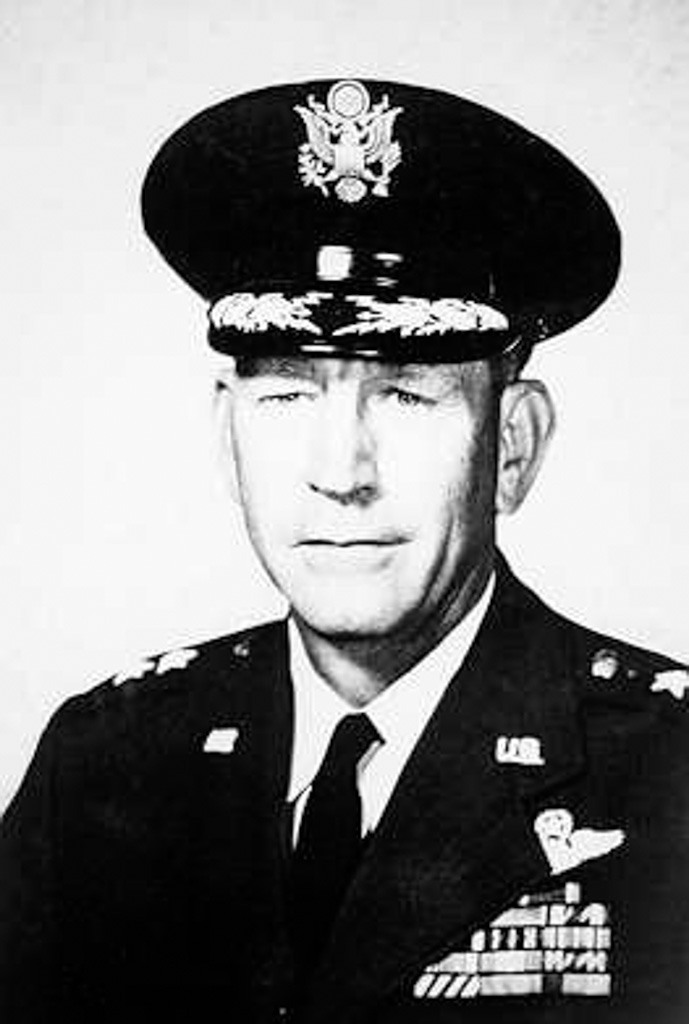
Chesley “Pete” Peterson (1920−1990) was assigned to the No. 71 Squadron upon his arrival in England in late September 1940. At the age of 21, Peterson was given command of the squadron and flew 42 missions (he flew a total of 130 missions during the war). As part of the group assigned to the USAAF 4th FG, Peterson was promoted to major and served as the FG’s executive officer. He became the youngest (age 23) colonel in the USAAF eventually rising to become a major general in 1965.
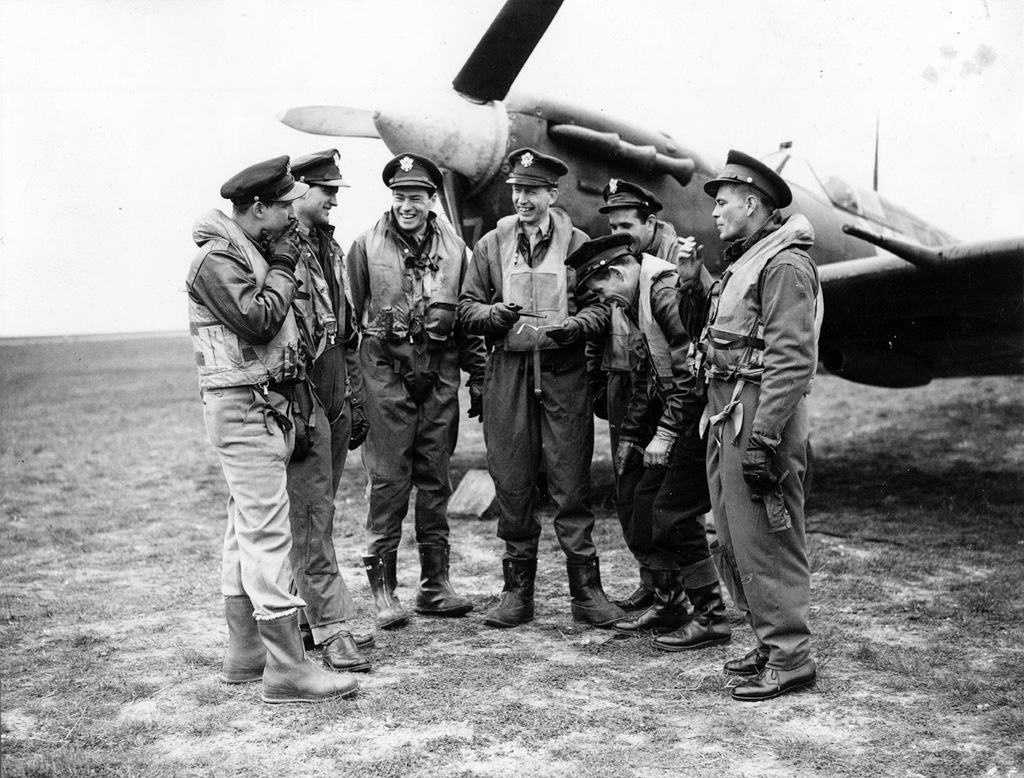
Pilots from the 4th Fighter Group in front of a Spitfire at RAF Debden airbase. The pilot in the center holding a pipe is Lt. Col. Chesley G. Peterson. The Spitfire is Peterson’s aircraft. Photo by anonymous (c. 1943). American Air Museum. PD-U.S. Government. Wikimedia Commons.
Maj. Gen. Chesley G. Peterson.
Maj. Gen. Chesley G. Peterson. Photo by anonymous (date unknown). PD-U.S. Government. Wikimedia Commons.

Donald Blakeslee (1917−2008) joined the RAF in May 1941. He quickly became known for his ability to shoot down enemy aircraft. He was assigned to the No. 133 Eagle Squadron as its commanding officer. Blakeslee quickly became an ace and has been credited with more than 500 missions flown. He is considered to be the most decorated World War II USAAF fighter pilot. His awards and honors include the Distinguished Service Cross, Silver Star, Legion of Merit, Distinguished Flying Cross, British Distinguished Flying Cross, and the French Croix de Guerre. He retired as a full colonel.
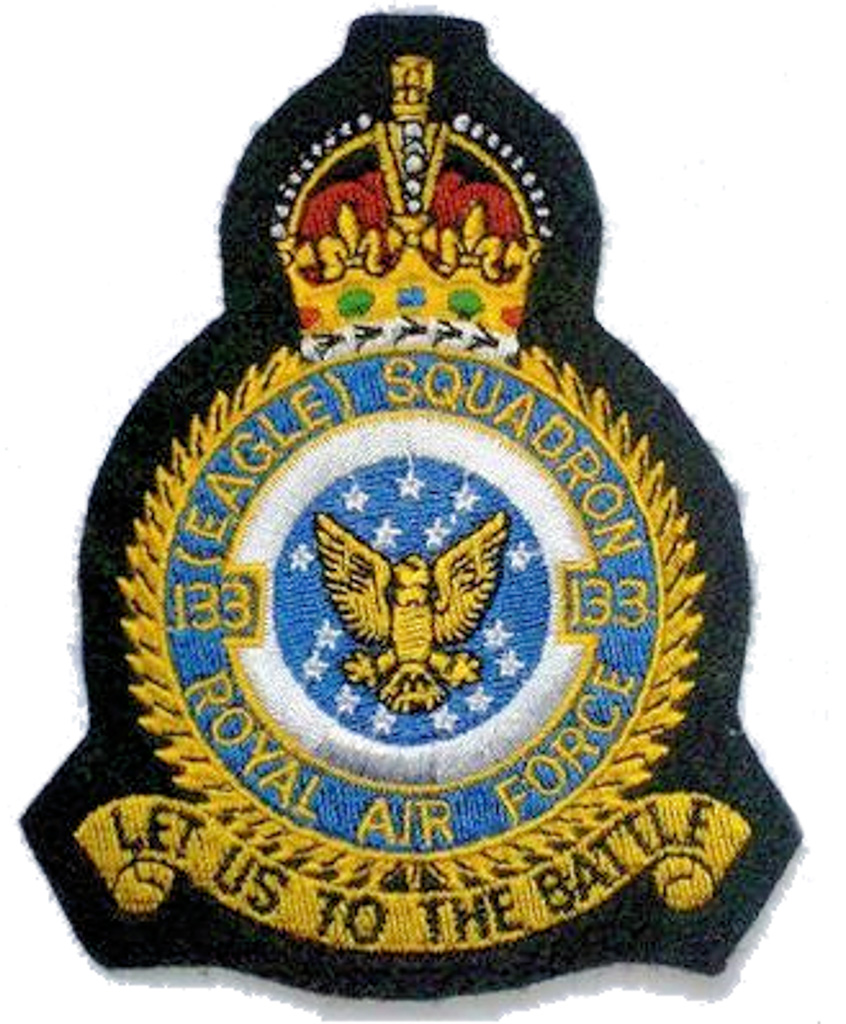
No. 133 Eagle Squadron RAF badge.
No. 133 Eagle Squadron RAF badge. Photo by anonymous (c. 1940). PD-U.K. Government public domain. Wikimedia Commons.
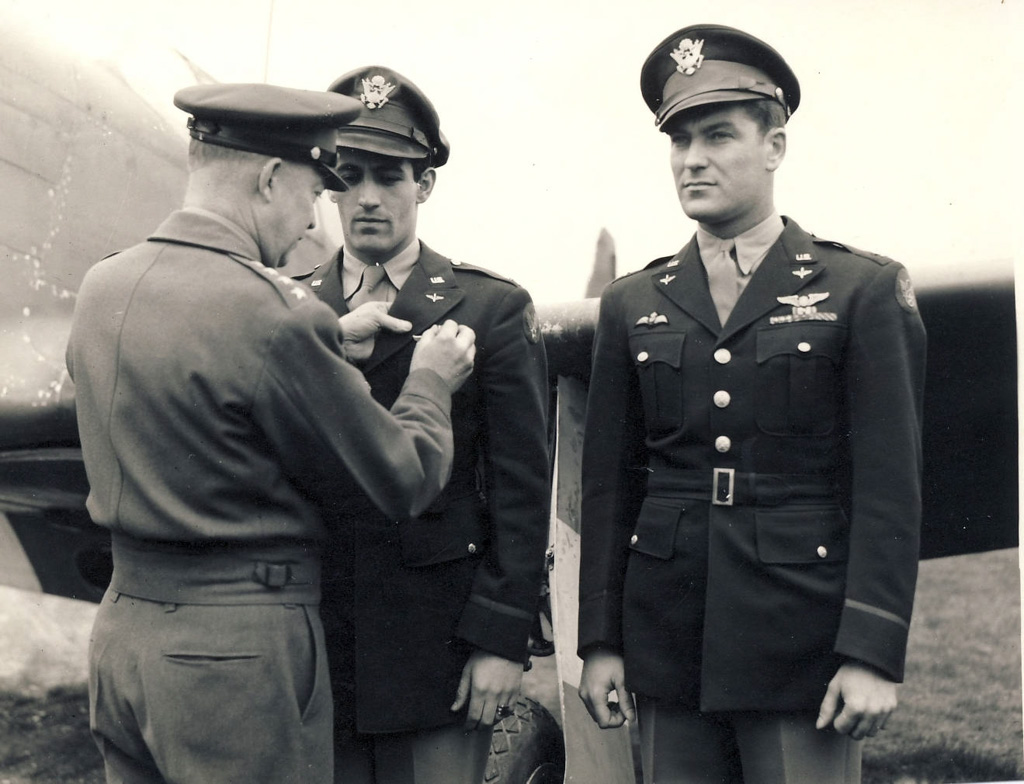
Generals gather for the occasion of the awarding of the Distinguished Service Cross to Col. Blakeslee and Capt. Gentile. Left to right: Gen. Jesse Auton, Gen. Eisenhower, Gen. Carl Spaatz, Gen. Jimmy Doolittle, Gen. Kepner, and Col. Blakeslee. Photo by anonymous (c. April 1944). PD-U.S. Government. Wikimedia Commons.

Dominic “Don” Gentile (1920−1951) almost surpassed Eddie Rickenbaker’s World War I record of 26 downed enemy aircraft. (Gentile was credited with 19.83 kills.) He flew the Supermarine Spitfire for the No. 133 Eagle Squadron before his transfer to the 4th FG where he first flew the P-47 before moving on to the P-51. On 13 April 1944, Gentile crashed his P-51 at Debden RAF while showing off for a group of journalists. Commanding Officer Blakeslee immediately grounded Gentile and sent him back to the United States to sell war bonds. He stayed in the air force after the war but in January 1951, Gentile was killed in a trainer aircraft crash.
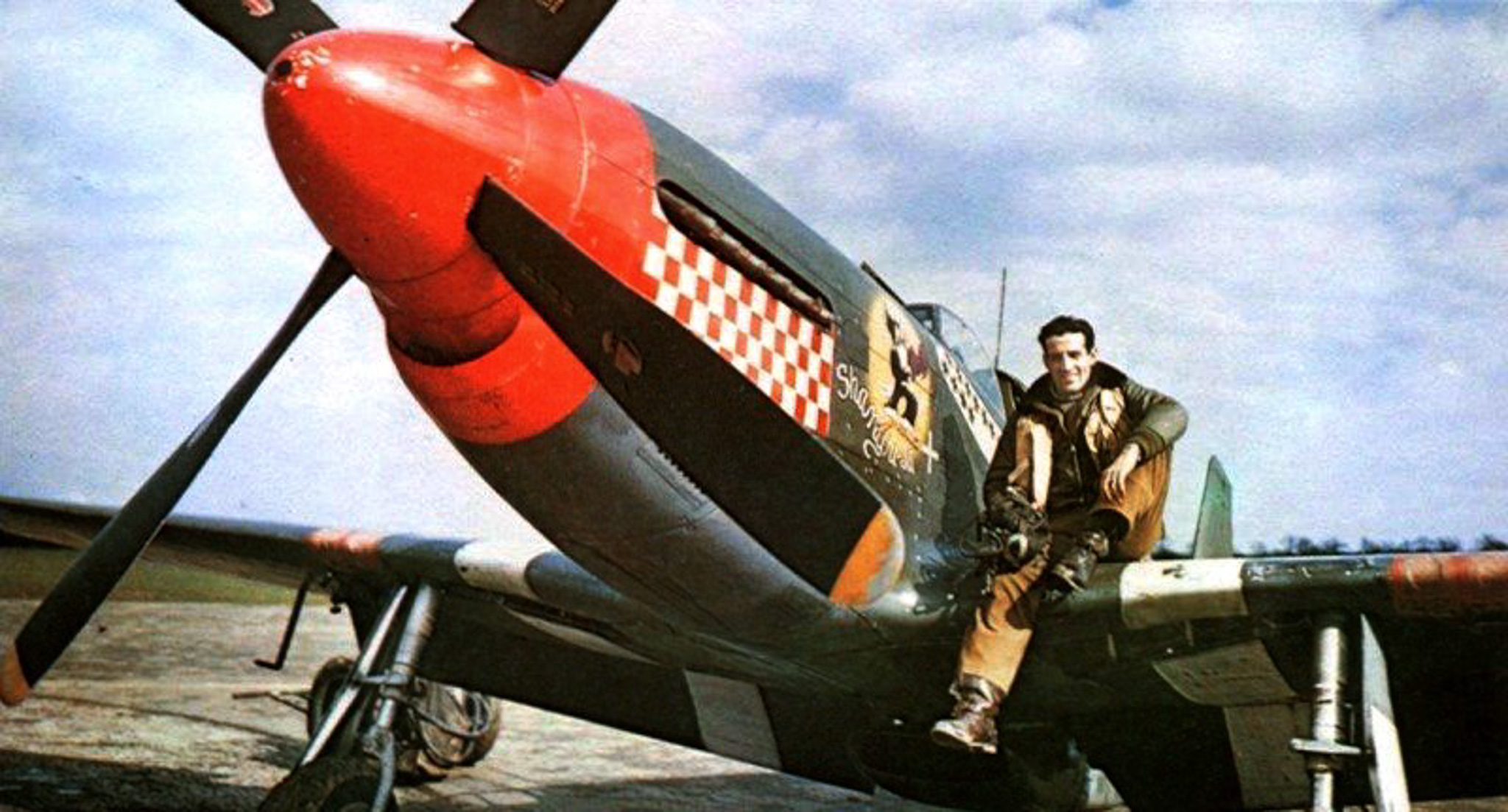
Don Gentile on the wing of his P-51B, “Shangri-La.”
Don Gentile on the wing of his P-51B, “Shangri-La.” Photo by anonymous (c. 1944). PD-U.S. Government. Wikimedia Commons.
Gen. Dwight D. Eisenhower awarding the Distinguished Service Cross to Dominic (“Don”) Salvatore Gentile (left) and Donald Blakeslee (right).
Gen. Dwight D. Eisenhower awarding the Distinguished Service Cross to Dominic (“Don”) Salvatore Gentile (left) and Donald Blakeslee (right). Photo by anonymous (11 April 1944). PD-U.S. Government. Wikimedia Commons.

The Classic Eagle Squadron March

Listen to this rousing march written specifically in memory of the Eagle Squadrons.

Click here.

Next Blog:       “SS Cap Arcona


Correspondence and Commentary Policy 

We welcome everyone to contact us either directly or through the individual blogs. Sandy and I review every piece of correspondence before it is approved to be published on the blog site. Our policy is to accept and publish comments that do not project hate, political, religious stances, or an attempt to solicit business (yeah, believe it or not, we do get that kind of stuff). Like many bloggers, we receive quite a bit of what is considered “Spam.” Those e-mails are immediately rejected without discussion.

Our blogs are written to inform our readers about history. We want to ensure discussions are kept within the boundary of historical facts and context without personal bias or prejudice.

We average about one e-mail every two days from our readers. We appreciate all communication because in many cases, it has led to friendships around the world.


★ Read and Learn More About Today’s Topic ★

Caine, Philip D. Eagles of the RAF The World War Eagle Squadrons. Washington, D.C.: National Defense University Press, 1991.

Childers, Col. James Saxon. War Eagles: The Story of the Eagle Squadron. Halstad, MN: Pickle Partners Publishing (2016). Originally published by Windmill Press, 1943.

Gentile, Don. One Man Air Force. New York: L.B. Fischer, 1944. Copyright held by North American Newspaper Alliance.

Haugland, Vern (author), Lt. Gen. Ira C. Eaker (USAF Ret.) (Foreword). The Eagle Squadrons: Yanks in the RAF, 1940−1942. New York: Ziff-Davis Flying Books (1979). Republished by TAB Books in 1992. Lt. Gen. Eaker was the model for the fictional Maj. Gen. Pat Pritchard in the 1949 movie, Twelve O’Clock High. (If you haven’t seen the movie you are missing out on probably the most realistic movie about World War II heavy bombers.)

Holmes, Tony. American Eagles: US Fighter Pilots in the RAF 1939-1945 (Images of War). Barnsley, UK: Pen & Sword Aviation Publishing, 2015.

Kan, Kenneth C. First in the Air: The Eagle Squadrons of World War II. Washington, D.C.: Air Force History and Museums Program, 2007.

Kershaw, Alex. The Few: The American “Knights of the Air” Who Risked Everything to Fight in the Battle of Britain. Boston: Da Capo Press, 2006. This book includes the stories of the first three men to join the Eagle Squadrons.


Disclaimer: 

There may be a chance that after we publish this particular blog, the video links associated with the blog are no longer accessible. We have no control over this. Many times, whoever posts the video has done so without the consent of the video’s owner. In some cases, it is likely that the content is deemed unsuitable by YouTube. We apologize if you have tried to access the link and you don’t get the expected results. Same goes for internet links.


What’s New With Sandy and Stew?

Three months after moving into our new home outside the Nashville area, we were hit with the Polar Vortex creating one of the worst ice storms the area has seen. Funny but the winter before we left Nashville some nine years ago, the worst ice storm in fifty years came through. Someone asked me if we were to blame for both. I don’t know. Two weeks after I joined a bank some forty years ago, the Challenger blew up. Two weeks after I joined another bank in late August 2001, the 9/11 terrorist attacks occurred. Trust me, I didn’t have anything to do with the Covid pandemic (that I can recall).

I have read The Wall Street Journal (WSJ) now for about fifty years. There are several sections that are of particular interest to me. One is the “Review” section every Saturday. In this section there are book reviews and I focus on non-fiction books with subjects that pertain to what I write about in our blogs and the Paris walking tour books. I have found over the years that if a book makes it to the WSJ, I can be assured it’s well-written and at least worth a look. Many of the books in my library were purchased based on their reviews.

Recently, a book caught my eye. It is Josephine Baker’s Secret War by Hannah Diamond (Yale University Press, 2025). Our 2021 blog, An African American in Paris (click here to read the blog), told the story of Josephine and her wartime exploits. For an expanded story, you might want to check out Ms. Diamond’s book.

Another book I would highly recommend is David L. Roll’s book, George Marshall: Defender of the Republic (Caliber, 2019). Gen. Marshall was an incredible person, and it would have been difficult for the Allies to win the war without him. He would have been the commander of Allied troops for the invasion of Europe, but Gen. Marshall was indispensable to President Roosevelt as his chief of staff and as such, Gen. Eisenhower was appointed Supreme Commander. This is a book I originally purchased based on the WSJ review. The personal and professional standards set by Gen. Marshall should be taught in every school. I gave each of my children a copy of this book.

Thank you to all of you who subscribe to our bi-weekly blogs. It seems there isn’t a day that goes by where we don’t increase our readership. Please let your history buff friends and family members know about our blog site and blogs.

Someone Is Commenting On Our Blogs

I have a lot of people to thank so it will take me several blogs to catch up. If I miss someone who has communicated with us (in a nice way), please don’t get mad at me for not mentioning your comments. I’m trying my best to catch up after our little sabbatical.

First and foremost, thanks to all of you who reached out to us after the last blog was published. It is good to be back, and I appreciate all of your kind comments and concerns about us.

Thanks to Edward N. for his comments on our blog, Salon Kitty (click here to read the blog). Edward is an expert in film and noted how the technical process of recording in the 1940s might have been different than what the blog mentioned.

Hazel S. contacted us about the blog, Cour des Miracles (click here to read the blog). There was an image of an illustration of a beggar that she identified as “The Man with the Twisted Lip” from Sir Arthur Conan Doyle’s short story. The artist was Sidney Paget and the story appeared in the Strand Magazine. Thanks Hazel. We have corrected the accreditation in the blog.

Monique T. wrote us about her family in response to the blog, An (extra)Ordinary Holocaust Story of Survival (click here to read the blog). Madame T. is 82-years-young and gave me permission to pass her contact information onto Marianne Golding. Marianne is from the Seidler family and is writing a book about Monique’s family and the Seidler family during World War II. It seems Monique will be able to fill in some of the unknown blanks Marianne has run into.

Paul A. is researching a particular French resistance operative and needed some information on the White Buses from the blog, Ten Gifts of the White Bus Rescue (click here to read the blog). Recall this was a guest blog written by Dr. Roger Ritvo. We were able to connect Paul and Roger. Ironically, several weeks later I received an email from Marzio A. It seems his grandfather assisted Count Bernadotte with the White Bus rescue. He took exception to the Count being called a hero and proceeded to explain what happened behind the scenes as told to him by his grandparents. An interesting twist to the accepted story.

Tim P. has been reading a lot about the French Resistance and contacted us about our blog, The Rasputin of the Abwehr (click here to read the blog). He mentioned he was going on a trip to France and asked about areas where he could visit to gain more knowledge. That’s hard to pin down when the entire country was occupied. That’s why I concentrated on Paris for my three books, Where Did They Put the Gestapo Headquarters? For example, Viriginia Hall (The Butcher of Lyon–click here to read the blog) operated in and around Lyon. Yet there really aren’t any specific sites that I know of to follow her footsteps. Same goes for Nancy Wake (The White Mouseclick here to read the blog). I do know of many resistance museums. However, the printed content accompanying the photographs and exhibits are only in French.

If there is a topic you’d like to see a blog written about, please don’t hesitate to contact me. I love hearing from you so keep those comments coming.

Share This:


Follow Stew:

1462420482_Twitter1462422248_InstagramAmazonScreen Shot 2017-10-09 at 10.20.30 AM badgeRGB

Find Stew’s books on Amazon and Apple Books.

Please contact Stew directly for purchase of books, Kindle available on Amazon. Stewross55@gmail.com or  Contact Stew on the Home Page.


Please note that we do not and will not take compensation from individuals or companies mentioned or promoted in the blogs.

Stew_Ross_Logo_CMYKWalks Through History

Copyright © 2026 Stew Ross

Posted on

The Butcher of Lyon

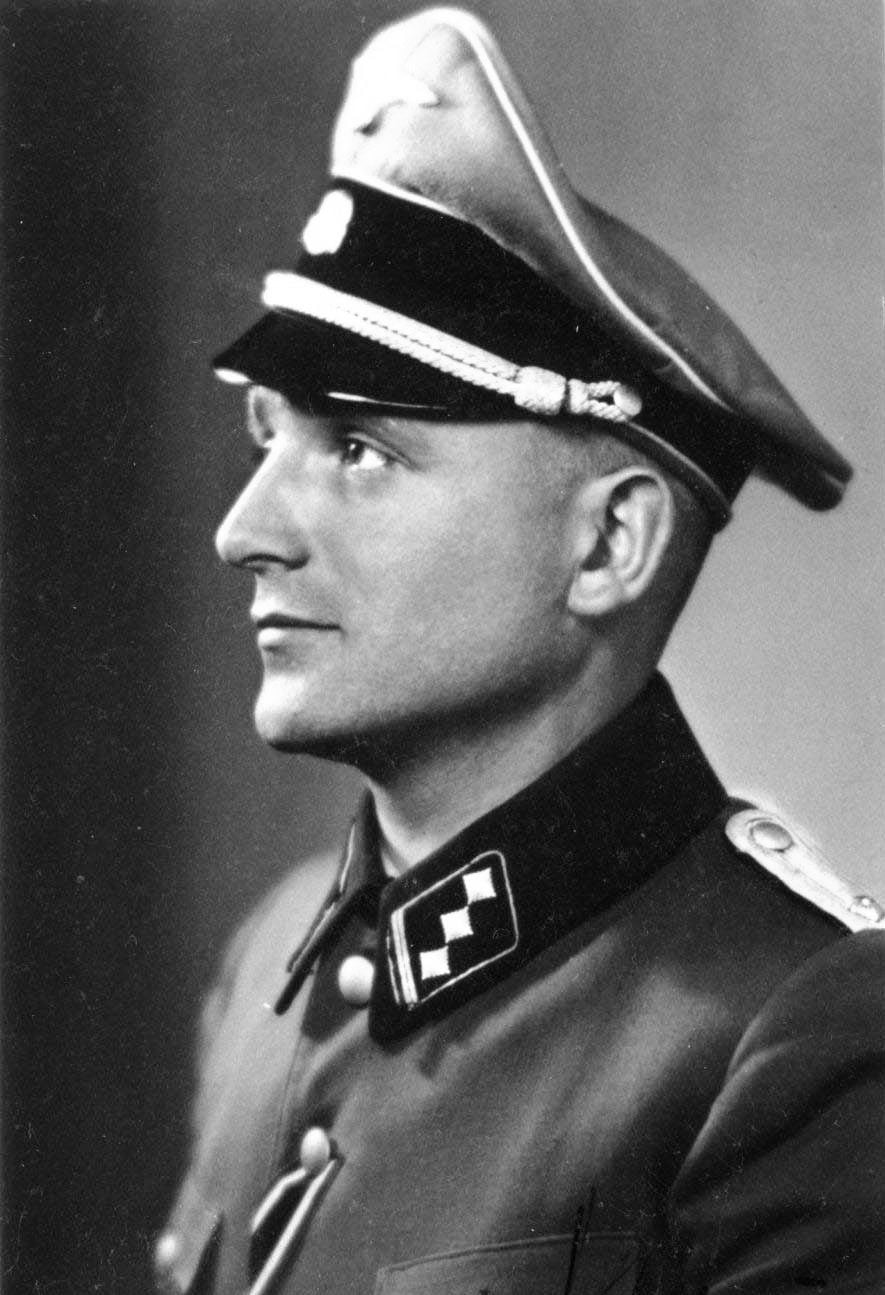
Lyon became a hotbed of French resistance activity during World War II. So, when the Germans invaded the occupied zone (i.e., “free zone,” or zone libre) in November 1942, it was no wonder Himmler sent SS-Untersturmführer (second lieutenant) Klaus Barbie to Lyon with orders to eliminate the French Resistance. Barbie excelled at carrying out his orders and enjoyed using barbaric and sadistic methods of torture. But unlike many other Gestapo interrogators who used others to do their dirty work, Barbie personally participated in torturing men, women, and even children.  Klaus Barbie’s brutality earned him the infamous moniker, “The Butcher of Lyon.”

Klaus Barbie in his SS uniform. Photo by anonymous (date unknown). PD-Expired copyright. Wikimedia Commons.

Click here to watch the video Crimes of the Nazi “Butcher of Lyon”.


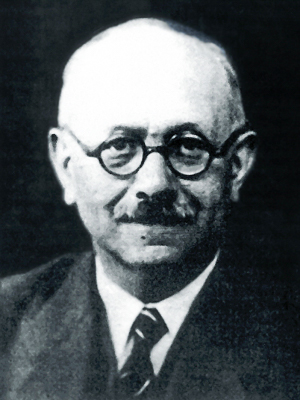
“Ill-understood history could, if care were not taken, drag better-understood history down into discredit in its wake.”

⏤ Marc Bloch (1886−1944)

      French historian and résistant

      Executed by the Nazis

Marc Bloch. Photo by anonymous (c. 1944). PD-Franc; author died more than 70 years ago. Wikimedia Commons.

Did You Know?

Did you know that I normally try and have a blog or at the very least, a comment on a topic that fits with Halloween? In past years, we’ve posted The Ghost Army (click here to read) and The Night Witches (click here to read), to name several blogs published on or just before Halloween. Although we are a couple of days past Halloween, I wanted to try and continue the tradition. So, did you know about “The Witches of Bucha”? Yep, that’s what this all-female volunteer air defense unit calls itself. They are Ukrainian women devoted to protecting the skies of Ukraine from Russian missile strikes and drone attacks.

The women work normal jobs during the day and at night, they report for their military shifts. With their hand-held machine-guns (from 1939) as well as truck mounted guns, the women fight from the front lines and go into action when the air alert is sounded. Almost every night the Russian drones loaded with explosives appear in the sky. If the drones are determined to be of imminent danger for the city of Bucha, the machine guns are ready to shoot them down.

Bucha’s air defense was once comprised of men but as the war has progressed, they were needed at the front. There were very few options for replacing these men and initially, there was not much trust in using women as replacements. However, that has completely changed as the “Witches” have proven themselves time and time again. The women take great pride in learning to defend themselves, their family, and Ukraine. One woman said, “I won’t ever sit like a victim again and be so very afraid.”

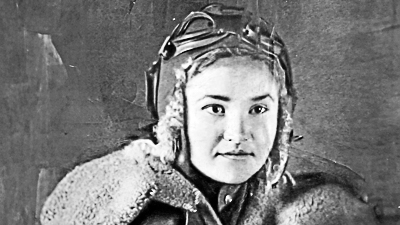
Since we are on the topic of witches, did you know the last surviving Soviet “Night Witch” died several months ago? Galina Brok-Beltsova (1925−2024) was a navigator who flew 36 missions during World War II as one of the all-women volunteer combat unit known as “The Night Witches.” I refer you to the October 2021 blog for the complete story of the Soviet night witches (see above for the link). The link to Galina’s obituary is listed below in the recommended reading section.

Galina Brok-Beltsova soon after she volunteered for combat duty with the Soviet army during World War II. Photo by anonymous (date unknown). The Times, 16 October 2024. https://www.thetimes.com/uk/obituaries/article/galina-brok-beltsova-obituary-last-survivor-of-the-soviet-night-witches-9jnm1db8t
Galina Brok-Beltsova soon after she volunteered for combat duty with the Soviet army during World War II. Photo by anonymous (date unknown). The Times, 16 October 2024.
https://www.thetimes.com/uk/obituaries/article/galina-brok-beltsova-obituary-last-survivor-of-the-soviet-night-witches-9jnm1db8t

Lyon and Vichy France 

The city of Lyon can trace its existence to the Roman Empire in 43 B.C. (The city’s Roman name was Lugdunum.) It is located at the confluence of the rivers Rhône and Saône, about 243 miles southeast of Paris. The city population is more than a half million with the metropolitan area home to about 2.3 million people. Lyon is the second largest French city and is well-known for its tradition of culinary and gastronomical cuisine. (It was once the capital of the silk industry.) However, our story today revolves around the city’s role during its occupation between 19 June 1940 (five days after the Germans marched into Paris) and 3 September 1944 (Lyon’s liberation day).

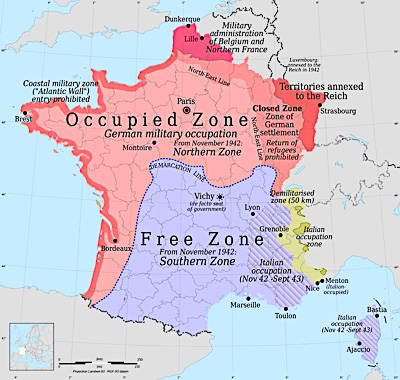
As part of the 1940 armistice with Nazi Germany, about one-third of France was designated as the unoccupied zone, or free zone while the remainder was occupied by the German military. The new French government, “Vichy France” (Régime de Vichy) took up residence in the small town of Vichy and began its collaboration with the Germans.

Map of occupied France during World War II. Illustration by Eric Gaba (blank map) and Rama (zones) (c. 2008). PD-GNU Free Documentation License v.1.2 or later. Wikimedia Commons.

On 8 November 1942, British and American troops landed in North Africa as part of “Operation Torch.” In retaliation, Hitler’s “Operation Anton” began with the German Wehrmacht forces entering the free zone three days later. At this point, France was completely occupied, and Vichy France was exposed for what it was: a false government. For the preceding two years, the free zone had been spared many of the Nazi atrocities that were committed in the occupied zone. However, after November 1942, the Germans imported their brutal methods to suppress the citizens and in particular, résistants and Jews. Nowhere was this felt more than in Lyon.

Lyon Gestapo

Almost immediately, Gestapo leaders in Paris sent six Einsatzkommandos into the former free zone and established six regional “branches” in the cities of Lyon, Limoges, Marseilles, Montpellier, Toulouse, and Vichy. Each became the hub and regional headquarters for the Gestapo and the S.D., or Sicherheitsdienst (the intelligence arm of the Nazi party). SS-Untersturmführer Klaus Barbie was appointed as the Lyon chief of Amt IV, the Gestapo section responsible for searching out and the repression of Third Reich opponents. For Klaus Barbie, this meant his responsibilities were two-fold: the destruction of French Resistance forces using any methods he deemed necessary and secondly, hunt down and deport Jews to KZ Auschwitz II-Birkenau.

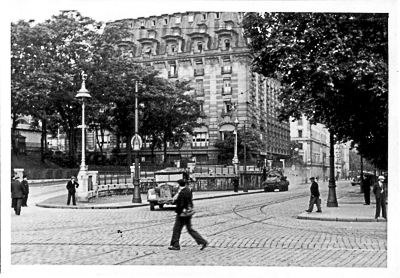
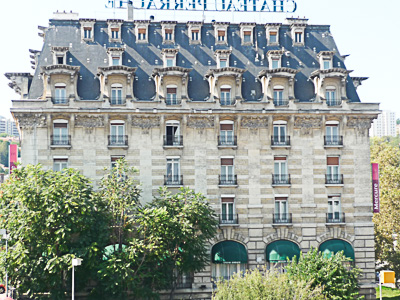
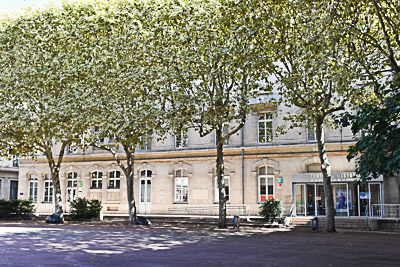
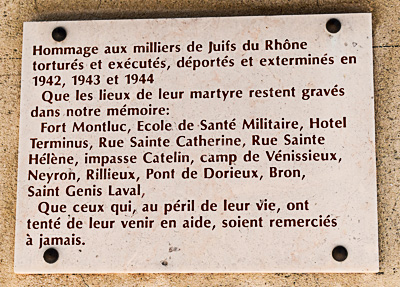
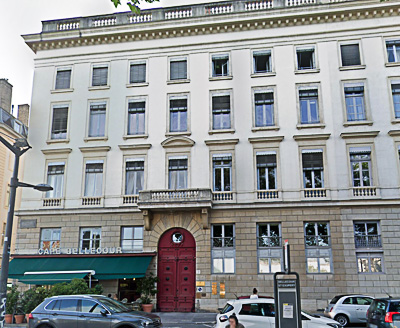
Barbie’s first headquarters in Lyon was in the Hotel Terminus (November 1942 to June 1943). He moved his offices in June to 14, ave. Berthelot. The massive building, built in 1894, was once the French army’s medical school (École de santé militaire) and during World War I, it was used as a hospital. Originally, the Germans occupied the Larrey and Percy wings of the building but in February 1943, the French medical students were evicted, and the entire building was occupied by German units, including Amt IV. (The basement of the Larrey wing was converted to cells and execution chambers.) The building was severely damaged by Allied bombs on 26 May 1944. For the third time, Barbie relocated his men to 33, place Bellecour and remained there before fleeing to Germany in August 1944.

Hôtel Terminus, site of the first headquarters for Lyon Gestapo. Original photo by anonymous (c. 1940). Posted by Niko fr. PD-CCA-Share Alike 4.0 International. Wikimedia Commons.
Former Hôtel Terminus. Today it is the “Grand Hôtel Mercure Château Perrache. Photo by Sebleouf (7 September 2012). PD-CCA-Share Alike 3.0 Unported License. Wikimedia Commons.
Exterior of the former Lyon Gestapo headquarters at 14, ave. Berthelot, the former medical school for the French army. The entrance to the resistance museum can be seen on the right. Photo by Sandy Ross (14 September 2024).
Memorial plaque on the exterior wall of the former Lyon Gestapo headquarters at 14, ave. Berthelot. “Tribute to the thousands of Jews from the Rhône tortured and executed, deported and exterminated in 1942, 1943 and 1944. May the places of their martyrdom remain grave in our memory: May those who, at the risk of their lives, tried to help them, be forever thanked.” Photo by Sandy Ross (14 September 2024).
Exterior view of former Gestapo headquarters (May 1944 to August 1944) located at 33, place Bellecour, Lyon. Google Maps.

Nikolaus ‘Klaus” Barbie

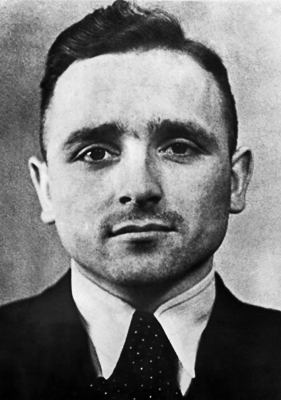
Nikolaus ‘Klaus’ Barbie (1913−1991) was born in what is today part of Bonn, Germany. Abused by his father, the young Barbie was sent to a boarding school where he was considered a below average student. In 1933, the year Hitler took power, his father and younger brother died. Barbie was unemployed and went to work in the Reich Labor Service, a paramilitary organization established to fight unemployment and indoctrinate its members in Nazi ideology. Two years later, Barbie joined the Schutzstaffel, or SS and was assigned to the S.D., the party’s intelligence gathering service. In 1937, Barbie officially joined the Nazi Party.

Klaus Barbie. Photo by anonymous (date unknown). Archives du department du Rhǒne et de la métropole de Lyon. PD-Expired copyright. Wikimedia Commons.

Barbie began his career in Berlin where he developed his skills as an interrogator and investigator. His first major assignment was with Adolf Eichmann’s Amt IV-B4 in Amsterdam. (click here to read the blog, The Argentina Papers) The Gestapo section’s responsibilities were identification, roundup, and deportation of Dutch Jews, Freemasons, and Communists. SS-Untersturmführer Barbie was so efficient and brutal that he was awarded the Iron Cross. By the end of May 1942, Barbie had been promoted to Obersturmführer and assigned as an investigator to a Gestapo branch on the border of France and Switzerland. Five months later, it was a short trip to Lyon to take up his new assignment as head of Lyon’s Gestapo.

Lyon Resistance

After the war, Gen. Charles de Gaulle declared Lyon to be France’s “Capital of Resistance.” As an aside, five cities were awarded the Ordre de la liberation, or the Order of Liberation, an honor bestowed on the “heroes of the French liberation.” Lyon was not one of the five cities. I wonder why Lyon wasn’t honored considering Gen. de Gaulle’s proclamation. Anyway, just a thought.

Barbie was faced with hunting down two primary resistance foes. The first was the Maquis, or guerilla fighters. These were men and women who hid in the forests and hit the enemy in spontaneous raids and sabotage. They were people evading the Service du travail obligatoire, a joint French-German edict forcing French citizens to enlist as laborers in Germany.

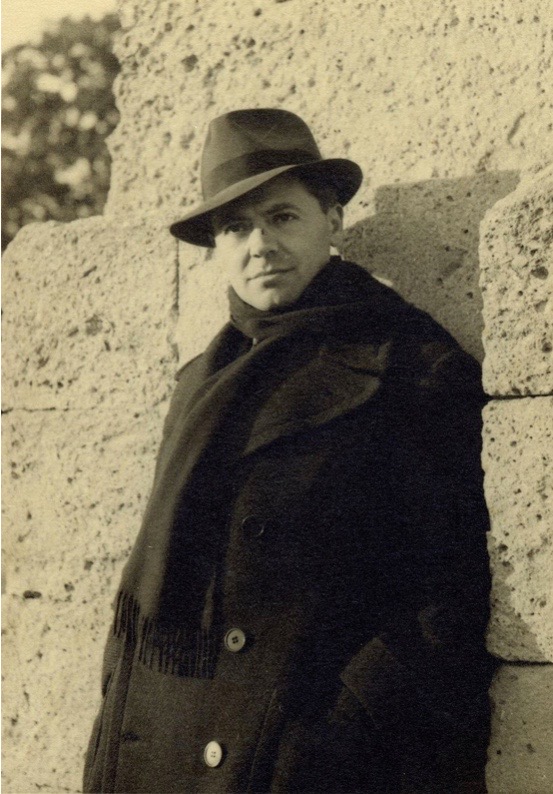
Barbie’s second resistance target were the multiple groups operating in the former free zone. Many of these networks had their headquarters in Lyon but were never united. That is, until Gen. de Gaulle sent Jean Moulin (1899−1943) in March 1943 to unify the major resistance networks under an umbrella organization called the Conseil national de la Résistance, or “National Resistance Council.” Moulin had earlier formed the Armée secrete, led by Charles Delestraint (1879−1945), but Gen. Delestraint was arrested on 9 June 1943 (he was executed at KZ Dachau days before its liberation). Faced with having to replace Delestraint, Moulin set up a meeting of resistance leaders at a house in the suburbs of Lyon. Betrayed by an insider, Moulin and the others (including Raymond Aubrac) were arrested by Barbie’s men and sent to Fort Montluc Prison in Lyon. Moulin was severely tortured by Barbie to the point where eyewitnesses later said they could not recognize him. Moulin reportedly died in early July on a train taking him to Berlin.

Jean Moulin near the Promenade du Peyrou in Montpellier, France. Photo by Marcel Bernard (c. 1940). Musée de la liberation de Paris and the musée Jean-Moulin. Christine Levisse-Touzé. “Jean Moulin,” L’Histoire Par l’Image, January 2015. https://histoire-image.org/etudes/jean-moulin
Jean Moulin near the Promenade du Peyrou in Montpellier, France. Photo by Marcel Bernard (c. 1940). Musée de la liberation de Paris and the musée Jean-Moulin. Christine Levisse-Touzé. “Jean Moulin,” L’Histoire Par l’Image, January 2015.
https://histoire-image.org/etudes/jean-moulin

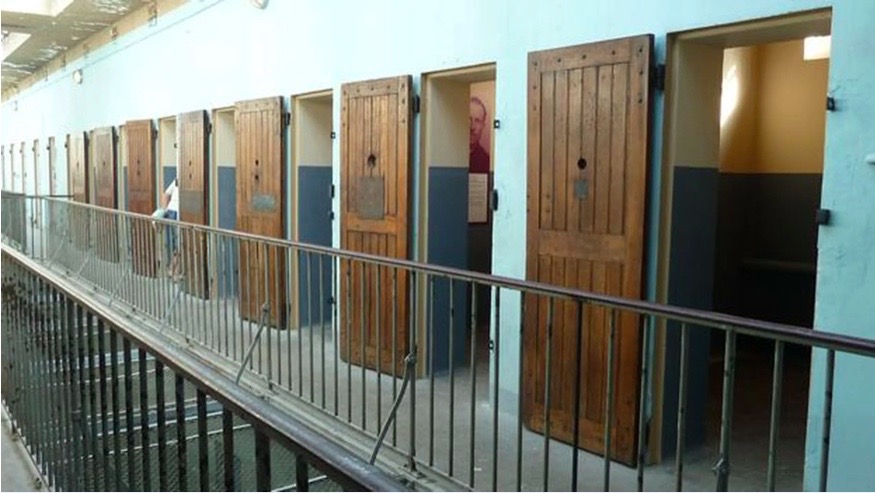
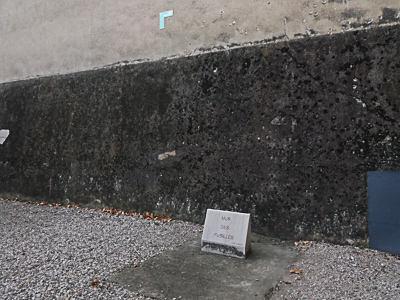
Montluc Prison was used by the Gestapo as a place for internment, interrogation, torture, and executions ⏤ similar to Fresnes Prison in Paris. More than 15,000 people were held in the prison with about 900 executed within its walls. As liberating forces were headed for Lyon in August 1944, Barbie authorized two massacres of Montluc prisoners. The action, Le Charnier de Bron, or “The Charnel House of Bron,” saw 109 prisoners taken to the Bron Airfield and murdered. Days later, about 120 prisoners were driven to Fort de Cǒte-Lorette and shot. Notable Montluc prisoners include Jean Moulin (cell #130), Marc Bloch, Raymond Aubrac and finally about 40-years later, Klaus Barbie (cell #136). The prison was closed in 1997 and today is designated as a monument historique.

Row of cells in Montluc Prison. Photo by anonymous (c. April 2013). France info: Culture, France Télévisions. https://www.francetvinfor.fr/culture/patrimoine/traces-d-histoire-dans-les-cellules-de-la-prison-montluc-a-lyon_3307611.html
The wall within Montluc Prison where executions took place. Photo by Romainbehar (16 September 2018). PD-CC0 1.0 Universal Public Domain Dedication. Wikimedia Commons.

Click here to watch the video Klaus Barbie.

Torture and Deportations 

The majority of Barbie’s interrogations and resultant torture of men, women, and children took place in the building on Berthelot Avenue. In addition to “normal” torture methods (e.g., waterboarding, beatings, electroshock, burning with cigarettes, etc.), Barbie tortured his victims with immersing their heads in buckets of ammonia, tore off his victim’s skin, shoved nails under their fingernails, forcibly removed finger and toenails using pliers, broke knuckles and hand bones by placing hands in door frames and slamming the door shut.  Whenever women were interrogated, they were ordered to disrobe. Barbie always had two German shepherds nearby. One was trained to bite and eat the victim’s flesh. The other was trained to mount and rape the naked woman. A common torture method was for the victim to be hung up by handcuffs with spikes inside them and then beaten by Barbie with a rubber bar.

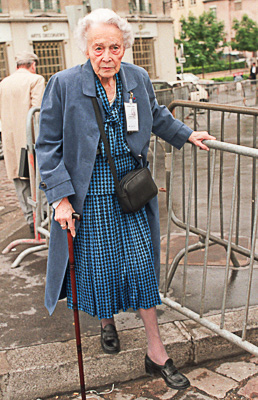
Survivor testimonies from Barbie’s trial included Lise Lesevre (1901−1992) who told about Barbie torturing her for nine days. Barbie savagely beat Lesevre, nearly drowned her in a tub of water, and used a spiked ball to break her vertebrae. Ennat Léger (1895−1993) talked about Barbie breaking her teeth while Simone Lagrange (1930−2016) described Barbie giving her a “smile as thin as a knife blade,” then proceeded to severely beat her in the face. Simone was thirteen at the time. Lesevre testified that Barbie purposely paraded tortured people by the cells and if Barbie believed the victim was Jewish, he would crush their skull with the heel of his boot.

Former resistance member, Lise Lesevre, arriving at the Barbie trial in Lyon to testify against Klaus Barbie. Photo by anonymous (12 May 1987). AFP Correspondent. https://correspondent.afp.com/trial-butcher-lyon

Historians estimate that Barbie was directly responsible for the deportation of 14,000 Jews and resistance fighters. (In total, about 75,000 Jewish men, women, and children were deported from France.) Simone Lagrange was deported along with her mother and father to KZ Auschwitz II-Birkenau. Her mother was immediately sent to the gas chamber. Simone and 25,000 other inmates were eventually marched to KZ Ravensbrück (only 2,000 survived) and along the way, she saw her father in another convoy of prisoners. A German officer told her to go and embrace her father. As she approached, her father was shot in front of her. Simone would later say, “It wasn’t Barbie who pulled the trigger, but it was him who sent us there.”

The Children of Izieu 

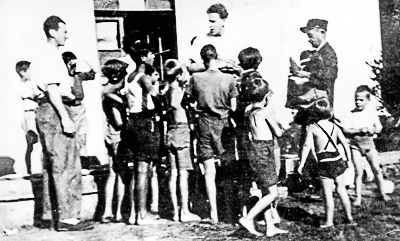
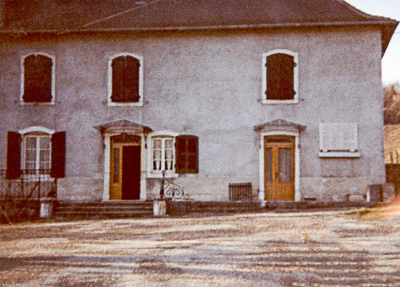
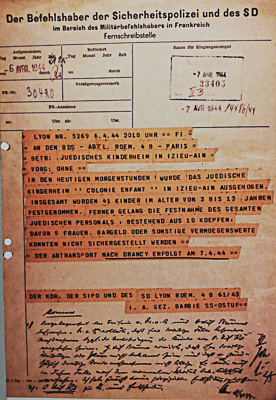
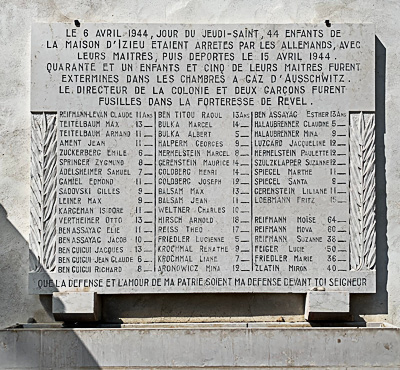
On 6 April 1944 at 9:00 am under the orders of Barbie, three vehicles pulled up in front of Maison d’Izieu, a children’s home near Lyon that provided refuge for dozens of Jewish children whose parents had been arrested and deported. A squad of a dozen soldiers with their officers and members of the Milice were there to arrest the children. (The Milice was a Vichy paramilitary organization that worked with the Germans to arrest resistance fighters and deport Jews.) Miron and Sabine Zlatin ran the home while Léon Reifman, a medical student, took care of the sick children while his sister, Sarah, was the home’s regular doctor and his parents lived at the home. The forty-four children, ranging in age from three to fourteen, along with seven adults were loaded into two trucks and taken to Montluc Prison and the next day, to Drancy, an internment camp outside Paris. On 13 April 1944, the children and adults were put on the next train (Convoy #71) leaving for KZ Auschwitz II-Birkenau. Only one adult, Léa Feldblum (1918−1989), survived and in 1987, she testified against Klaus Barbie at his trial in Lyon.

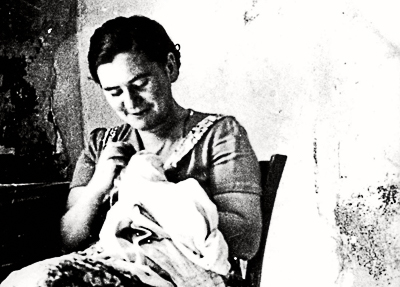
Distributing the mail at the children’s home in Izieu. Léon Reifman is in the center handing out the mail. Far left is Miron Zlatin who was executed by the Nazis. Other than Reifman and two others in this photo, everyone pictured here was murdered. Photo by anonymous (c. summer 1943). Yad Vashem Photo Archives, 1408/1.
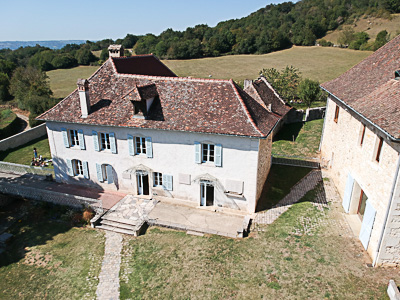
The exterior of the Izieu children’s home. Photographed after the war. Photo by anonymous (date unknown). Yad Vashem Photo Archives, 1408/28.
7 April 1944 announcement by Klaus Barbie to his superiors of the arrest of Izieu’s children. Photo by anonymous (date unknown). Maison de la conference de Wannsee.
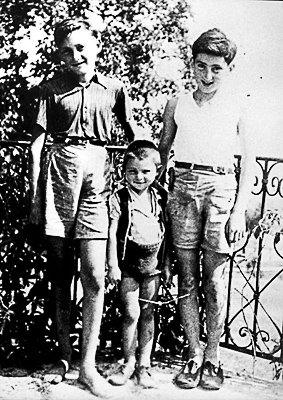
Left to right: Majer-Marcel Bulka, his brother, Albert, and his friend, Alek Bergman. The Bulka brothers were murdered at KZ Auschwitz II-Birkenau. Alek left the home before the Gestapo raid and survived. Photo by anonymous (c. Summer 1943). Yad Vashem Photo Archives, 1408/14.
Léa Feldblum, a teacher at the Izieu children’s home. Her parents, brother, and sister were murdered at KZ Auschwitz II-Birkenau. Léa survived the war and settled in Israel. Photo by anonymous (c. 1943). Yad Vashem Photo Archives, 1408/10.
Contemporary aerial view of Maison d’Izieu. Today, the building is a museum dedicated to the children. Photo by Benoît Prieur (178 September 2019). PD-CC0 1.0 Universal Public Domain Dedication. Wikimedia Commons.
Memorial plaque placed on the exterior wall of the Maison d’Izieu. It memorializes the victims who were deported to KZ Auschwitz II-Birkenau. The children range in age from 5 to 18. Six adults are reflected but only five died at the extermination camp. Miron Zlatin was executed separately by the Nazis. Photo by Benoît Prieur (17 September 2019). PD-CC0 1.0 Universal Public Domain Dedication. Wikimedia Commons.

Post-War

Barbie returned to Germany in 1944. Three years later, France tried and convicted him in absentia with the former Gestapo leader sentenced to death. (A French military tribunal passed the same judgement on Barbie in 1954.) During the post-war years up until 1983, Barbie was protected by various governments.

It is well-known that the United States and the Counterintelligence Corps (CIC) used former Nazis as agents in the post-war struggle against the Soviet Union. Barbie was one of those agents, having been recruited in 1947 for his skills in gathering intelligence. He was used to improve America interrogation methods, identify other former SS officers that could be recruited as agents, and spy on France. (U.S. intelligence believed the French occupation zone had been infiltrated by the KGB.) The French eventually discovered that Barbie was under the protection of the U.S. government, and they petitioned John J. McCloy, High Commissioner for Germany, to turn over Barbie. He refused (click here to read the blog, The Wise Men).

At this point, the CIC assisted the relocation of Barbie to Bolivia where he was once again protected by a friendly government (click here to read the blog, ODESSA: Myth or Truth?). Assuming the name “Klaus Altmann,” Barbie settled in Cochabamba as a businessman. He also worked for Bolivia’s secret police supporting the country’s military regimes through arms-trading operations, murders, torture, interrogations, and drug trafficking. (Barbie worked with Pablo Escobar and the Medellín cartel.) In 1957, Barbie became a Bolivian citizen.

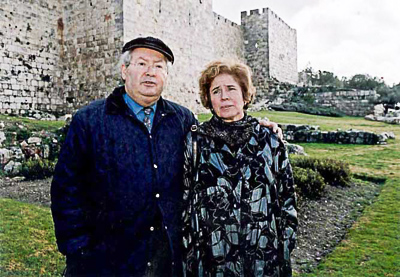
In 1971, Beate and Serge Klarsfeld identified Barbie as Klaus Altmann and the fact he was living in Bolivia. The Bolivian government refused to extradite Barbie, but the Klarsfelds never gave up. They ensured the Butcher of Lyon’s story stayed in front of the public and finally, in 1983, a democratic government was elected in Bolivia and they agreed to extradite Barbie to France where he would stand trial.

Serge and Beate Klarsfeld. Photo by personal photographer (c. 2007). PD-CCA 3.0 Unported License. Wikimedia Commons.

In the meantime, Allan Ryan, Director of the Office of Special Investigations issued a full report (refer below to the recommended reading section) on the U.S. government’s involvement with Barbie. The report’s conclusions resulted in a formal apology from the United States to France for enabling Klaus Barbie to escape French justice for 33 years.

Click here to watch the video Tracking Down Klaus Barbie – “Butcher of Lyon” and here to watch The Butcher of Lyon.

The Barbie Trial 

In 1984, Barbie was indicted and tried on forty-one separate counts of crimes against humanity committed as head of the Lyon Gestapo. His trial began in 1987 in Lyon and the proceedings were filmed. (The film can be viewed at the former Lyon Gestapo headquarters, now the Resistance and Deportation History Center ⏤ the testimony of the survivors is quite graphic.)

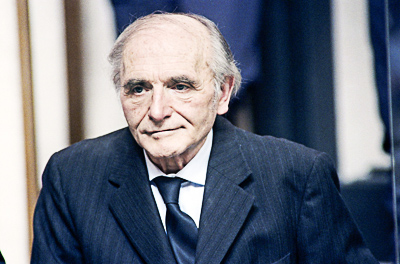
Klaus Barbie at the start of his trial. Photo by anonymous (11 May 1987). AFP Correspondent. https://correspondent.afp.com/trial-butcher-lyon
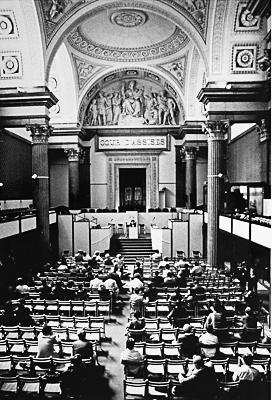
The courtroom where Klaus Barbie was tried. Photo by anonymous (c. 1987). B’nai B’Brith Klutznick Museum. United States Holocaust Memorial Museum. https://encyclopedia.ushmm.org/content/en/article/nikolaus-klaus-barbie-the-butcher-of-lyon
The courtroom where Klaus Barbie was tried. Photo by anonymous (c. 1987). B’nai B’Brith Klutznick Museum. United States Holocaust Memorial Museum.
https://encyclopedia.ushmm.org/content/en/article/nikolaus-klaus-barbie-the-butcher-of-lyon

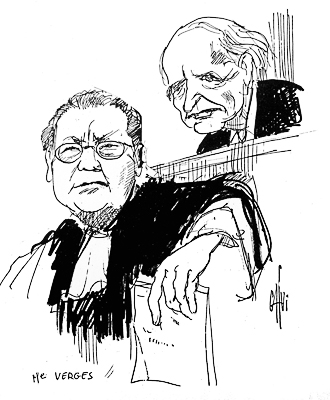
Barbie’s team of defense attorneys was led by Jacques Vergès (1925−2013), a Vietnamese French anti-colonial activist. His defense strategy included diversionary tactics such as trying to put France on trial by comparing its actions (e.g., torture) in the Algeria conflict and other colonial crimes to the crimes Barbie was charged with. Barbie argued he was a Bolivian citizen and that his extradition was illegal.

Trial illustration of Jacques Vergès (left) and Klaus Barbie (right). Illustration by Calvi (c. May 1987). Agence France-Presse. PD-CCA-Share Alike 4.0 International. Wikimedia Commons.

Klaus Barbie was the first and only former Nazi to be put on trial in France for crimes against humanity. It was decided that he could not be tried for war crimes as this had a statute of limitations under French law whereas crimes against humanity did not. Barbie’s orders to arrest and deport the children of Izieu played a critical role in having him tried (and convicted) for crimes against humanity. On 4 July 1987, Barbie was found guilty and sentenced to life imprisonment (France by then had eliminated the death penalty). Klaus Barbie, the “Butcher of Lyon” died of cancer in prison four years after his conviction.

One of our tour guides on our river cruise to Lyon told us she attended Barbie’s trial for three days and did not go back. I asked her why she didn’t return. (It was very difficult to get tickets to the public gallery.) Francis told us that the testimonies of the eyewitnesses and their stories were so horrible that she couldn’t sit through another day of listening to the atrocities committed by Barbie.

Click here to watch video of the Klaus Barbie trial news coverage.

Next Blog:       “The Colmar Pocket”


Correspondence and Commentary Policy 

We welcome everyone to contact us either directly or through the individual blogs. Sandy and I review every piece of correspondence before it is approved to be published on the blog site. Our policy is to accept and publish comments that do not project hate, political, religious stances, or an attempt to solicit business (yeah, believe it or not, we do get that kind of stuff). Like many bloggers, we receive quite a bit of what is considered “Spam.” Those e-mails are immediately rejected without discussion.

Our blogs are written to inform our readers about history. We want to ensure discussions are kept within the boundary of historical facts and context without personal bias or prejudice.

We average about one e-mail every two days from our readers. We appreciate all communication because in many cases, it has led to friendships around the world.


★ Read and Learn More About Today’s Topic ★

Bower, Tom. Klaus Barbie: The Butcher of Lyons. New York: Pantheon Books, 1984.

Chabrol, Claude (director) and Jean-Pierre Ramsay Levi (producer). The Eye of Vichy. Fit Production, Institut national de l’audiovisuel, TFI Films Production, et. al., 1993.

Delarue, Jacques. The Gestapo: A History of Horror. S. Yorkshire: Frontline Books, 2008 (originally published 1962).

Doré-Rivé, Isabelle (Editor and curator). Translation by John Doherty. War in a City: Lyon, 1939−1945. Lyon: Éditions Fage, 2013.

Goñi, Uki. The Real Odessa: How Perón Brought the Nazi War Criminals to Argentina. London: Granta Books, 2003.

Jackson, Julian. France: The Dark Years, 1940−1944. New York: Oxford University Press, 2001.

Klarsfeld, Serge. Translated by Glorianne Depondt and Howard M. Epstein. French Children of the Holocaust: A Memorial. New York: New York University Press, 1996.

Klarsfeld, Serge and Beate Klarsfeld. Translated by Sam Taylor. Hunting the Truth: Memoirs of Beate and Serge Klarsfeld. New York: Farrar, Straus and Giroux, 2015.

Lanzmann, Claude (director & producer). Shoah. Les Films Aleph and Historia Film, 1985.

Ophuls, Marcel (director & producer). Hotel Terminus: The Life and Times of Klaus Barbie. Icarus Films, 1988.

Ophuls, Marcel (director). The Sorrow and the Pity: Chronicle of a French City Under the Occupation. Milestone, 1969.

Paxton, Robert O. Vichy France: Old Guard and New Order, 1940−1944. New York: Knopf Publishing, 1972.

Robbins, Christopher. A Test of Courage: Michel Thomas. London: Century, 1999.

Ryan, Allan A. Jr. Klaus Barbie and the United States Government: A Report to the Attorney General. U.S. Department of Justice, Criminal Division, August 1983.

Galina Brok-Beltsova Obituary. The Times, 16 October 2024. Click here to read.

Disclaimer: 

There may be a chance that after we publish this particular blog, the video links associated with the blog are no longer accessible. We have no control over this. Many times, whoever posts the video has done so without the consent of the video’s owner. In some cases, it is likely that the content is deemed unsuitable by YouTube. We apologize if you have tried to access the link and you don’t get the expected results. Same goes for internet links.

Archival photos – public domain. If a copyright has been violated, please contact me. The photos/images have been added for informational purposes only, not for profit or for surreptitious advertising. Every effort is taken to ensure proper credit is given.

What’s New With Sandy and Stew?

Sandy and I visited Lyon as part of our river cruise through the south of France. I hired a private guide for a three-hour walking tour of the city with a focus on resistance activities. Unfortunately, he never showed up. The unoccupied zone is a topic I have not focused on except for the escape lines, the Milice, and Maquis resistance fighters. So, Lyon is a city that I have much to learn about. Writing this blog gives me the opportunity to learn more about its role in the war.

We did sign up for an afternoon excursion on one of the days that concentrated on the Colmar Pocket. Our guide was an exceptional expert on this subject (and very passionate about her subject). I am very fortunate to have met Angie, a World War I and II licensed tour guide. As my discussions with her progress, I will learn more about where and what she enjoys sharing with her clients. Stay tuned.

Thank you to all of you who subscribe to our bi-weekly blogs. It seems there isn’t a day that goes by where we don’t increase our readership. Please let your history buff friends and family members know about our blog site and blogs.

Someone Is Commenting On Our Blogs

Thanks to Tim P. for contacting us regarding Virginia Hall. Tim wanted to know if I had any connections to private guides in the cities where Virginia had her resistance operations. Unfortunately, I don’t have those connections at this time. I will be following up with Raphaëlle and Angie to see if they can refer someone.

Dave B. reached out to us regarding the Ritchie Boys and his father. Gerald was Jewish and managed to escape Nazi Germany with his family in the late 1930s. After “bouncing” around Europe, he settled in New York. Gerald was drafted in 1942 and in time, became one of the Ritchie Boys. Click here to read the blog, The Ritchie Boys. Interestingly, Gerald and his family ended up in Camp King in 1961 where Dave had some interesting experiences. Click here to read the blog, Camp King. Thanks, Dave, for sharing this with us.

If there is a topic you’d like to see a blog written about, please don’t hesitate to contact me. I love hearing from you so keep those comments coming.

Share This:


Follow Stew:

1462420482_Twitter1462422248_InstagramAmazonScreen Shot 2017-10-09 at 10.20.30 AM badgeRGB

Find Stew’s books on Amazon and Apple Books.

Please contact Stew directly for purchase of books, Kindle available on Amazon.  Stew.ross@Yooperpublications.com or  Contact Stew on the Home Page.


Shepherd logo.jpg

Shepherd.com is like wandering the aisles of your favorite bookstore.

Do you enjoy reading? Do you have a hard time finding the right book in the genre you enjoy? Well, Ben at Shepherd.com has come up with an amazing way to find that book.

Shepherd highlights an author (like me) and one of their books. The author is required to review five books in the same genre. So, if a reader is interested say in cooking, they can drill down and find specific books about cooking that have been reviewed by authors in that category. Very simple.

If you like to read, I highly recommend you visit Shepherd.com. If you do, please let me know what you think and I will forward Ben any suggestions or comments you might have.

Click here to visit Shepherd’s website.

Click the books to visit Stew’s bookshelf on WWII.

Image 11-16-22 at 10.38 AM

Check out Stew’s bookshelf on the French Revolution.

Shepherd FR Bookshelf


Please note that we do not and will not take compensation from individuals or companies mentioned or promoted in the blogs.

Stew_Ross_Logo_CMYKWalks Through History


Copyright © 2024 Stew Ross