Posted on

The Eagle Squadrons

I think most of us are familiar with some of the aerial fighter squadrons from both world wars. The Flying Tigers, the Tuskegee Airmen (The Red Tails–click here to read the blog), and the U.S. Navy “Jolly Rogers” were several of the well-known squadrons during World War II. The Lafayette Escadrille and 94th Aero Squadron (“Hat in the Ring”) were two of the most famous World War I airplane squadrons.

The concept of foreign volunteers (i.e., mercenaries) joining to fight combatant nations is nothing new. The German Hessians joined the British to fight American revolutionaries, the Swiss Guards protected the Pope in Vatican City as well as French monarchs in Paris while the Nepalese Gurkhas once fought against the British but later fought alongside British soldiers.

Today, you will be introduced to a famous fighter squadron but not as well-known as the ones I have mentioned. The Eagle Squadrons were made up of American pilots who volunteered to join the British Royal Air Force (RAF) before the United States entered the war following Japan’s attack on Pearl Harbor (7 December 1941).

Click here to watch the video Americans Flying for Britain.


“If you thought that science was certain well, that is just an error on your part.”

     ⏤ Dr. Richard Feynman

Theoretical physicist

Dr. Feynman also said, “Science is the belief in the ignorance of experts” because he knew that skepticism and a willingness to assimilate new evidence propel the scientific endeavor.


We are watching what seems to be a possible global rearrangement and at the very least, a new way of dealing with both our allies and not-so-friendly nations. Is this a temporary template for conducting foreign policy or are we seeing the beginnings of a permanent change?

We should revisit a quotation from Gen. Charles de Gaulle:

“No nation has friends, only interests”

It is always fun to read the many quotations from Winston Churchill who is also quoted quite often. It is too bad we are not exposed to more of Gen. de Gaulle’s quotes. Like Churchill, the French general had very insightful comments that are accurate and stand the test of time.


Did You Know?

Did you know that the first item sold on eBay was a broken laser pointer? A Silicon developer, Pierre Omidyar, invented eBay in 1995 (then called “Auction Web”) and tested his new online venture by loading an ad for his broken pointer that originally cost him US$30. He listed the laser pointer for $1.00 and after one week, bidding began with the final winning bid at $14.83.

Within two years, the site was re-branded as eBay and its millionth item was sold. So, who purchased the laser pointer? A Canadian, Mark Fraser, identified himself in 2015 as the person who became the first customer of eBay and has held on to the pointer for all these decades.

Mark Fraser holding the broken pointer he purchased from eBay. Photo by anonymous (c. September 2015). Rupley, Sebastian, eBay News Team, 11 September 2015. “Meet the Buyer of the Broken Laser Pointer.”
https://www.ebayinc.com/stories/news/meet-the-buyer-of-the-broken-laser-pointer/

I wonder what the pointer would fetch today if Mr. Fraser were to put it on eBay.


The Origin of the Eagle Squadrons

Prior to the United States entering World War II, a successful American businessman and socialite (and friend of Ernest Hemmingway), Charles Francis Sweeny (1909−1993), persuaded the British government to form a squadron comprised solely of American pilot volunteers. Sweeny and his wealthy friends not only raised the money to send the volunteers to England for training, but they also personally recruited the men.

Prior to the occupation of France in June 1940, Sweeny’s activities were considered illegal. He managed to thwart the FBI’s efforts to capture and imprison the “recruiters.” However, after France fell to Hitler, the United States government turned its head on his activities and even the FBI declared Sweeny’s recruiting efforts were legal.

Meanwhile, at the same time, there were parallel efforts being made in Canada. Several World War I aces, William (“Billy”) Bishop (1894−1956) and Clayton Knight (1891−1969), began to recruit and train Americans for service in the RAF. By the end of 1941, they had recruited more than 7,000 Americans with about 15% of them becoming pilots. (Sweeny’s uncle was recruiting Americans to fly for the French air force.)

Billy Bishop standing next to his Nieuport 23 airplane during World War I.
Billy Bishop standing next to his Nieuport 23 airplane during World War I. Photo by anonymous (c. 1918). PD-No known copyright restrictions. Wikimedia Commons.

The British government decided to accept the American volunteer pilots in July 1940. By then, the Battle of Britain had begun, and Britain was fighting for its life. The American pilots were desperately needed.

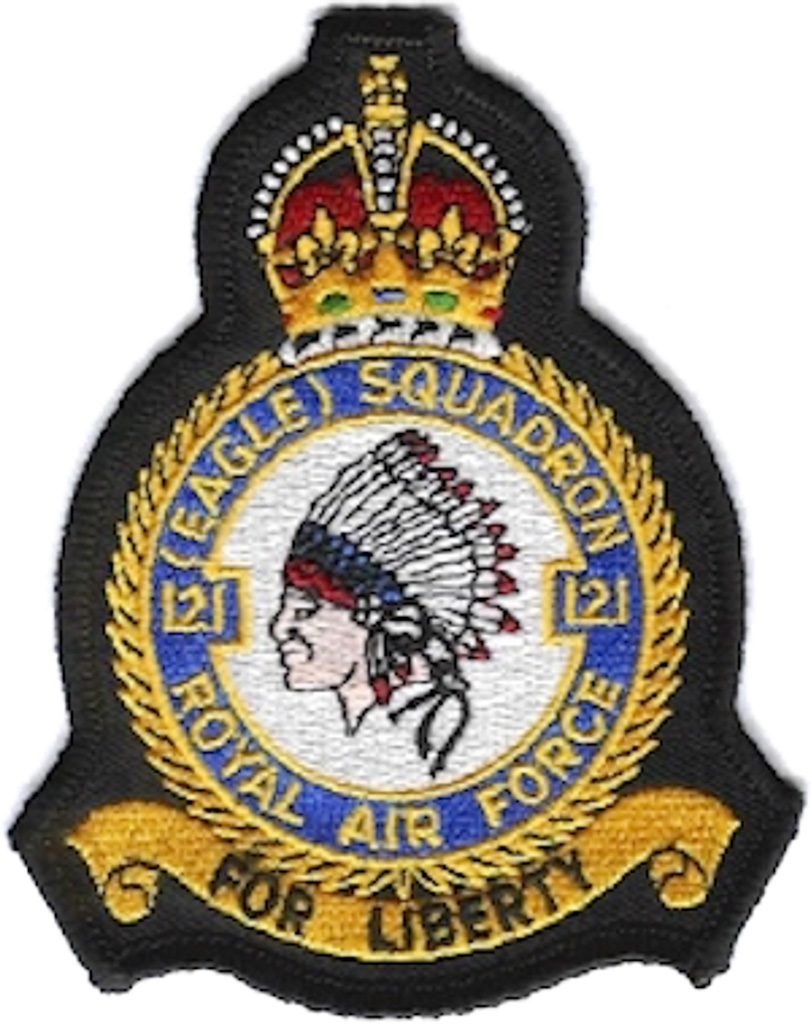
The first unit formed was the No. 71 Squadron known as “The Eagle Squadron.” Sweeny designed the shoulder patch bearing an American eagle. There were enough volunteers to form two additional units: the No. 121 and No. 133 Eagle Squadrons. The pilots began flying missions over France, escorting bombers, and performing targeted strikes.

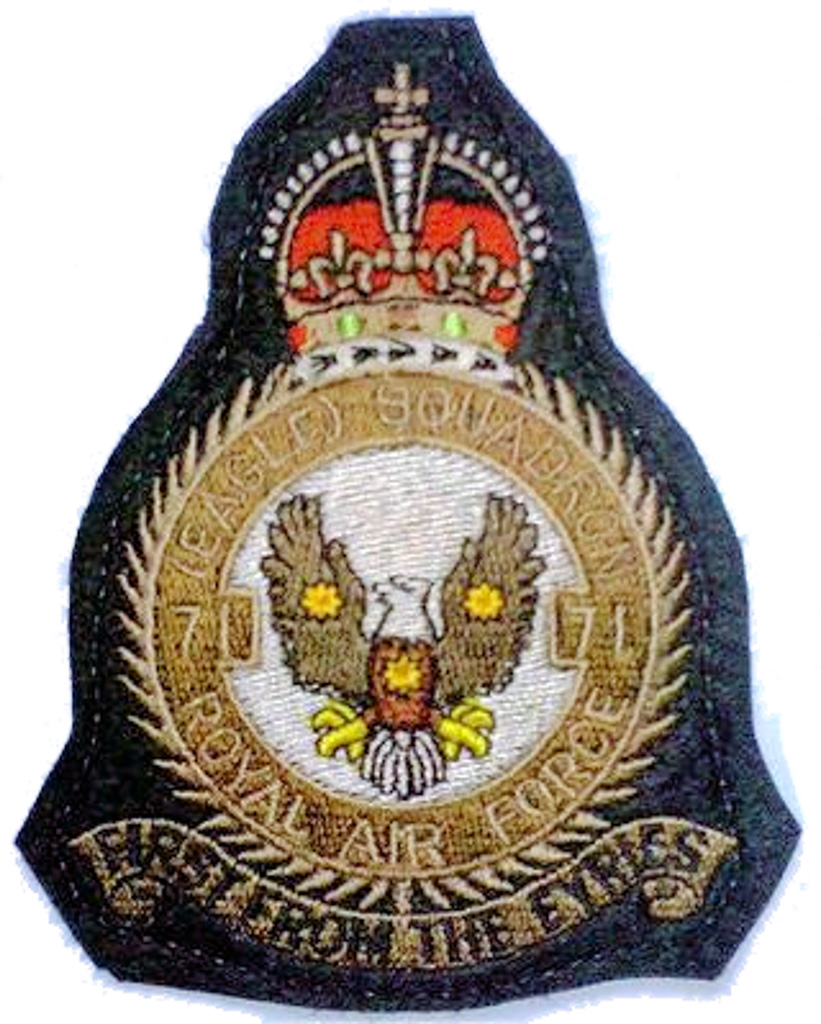
The emblem of the Eagle Squadrons. Photo by anonymous. Patch design by Charles Francis Sweeny (date unknown). PD-Creative Commons CC0 1.0 Universal Public Domain Dedication. Wikimedia Commons.
No. 71 Eagle Squadron RAF badge.
No. 71 Eagle Squadron RAF badge. Photo by anonymous (c. 1940). PD-U.K. Government public domain. Wikimedia Commons.
No. 121 Eagle Squadron RAF badge.
No. 121 Eagle Squadron RAF badge. Photo by anonymous (c. 1940). PD-U.K. Government public domain. Wikimedia Commons.
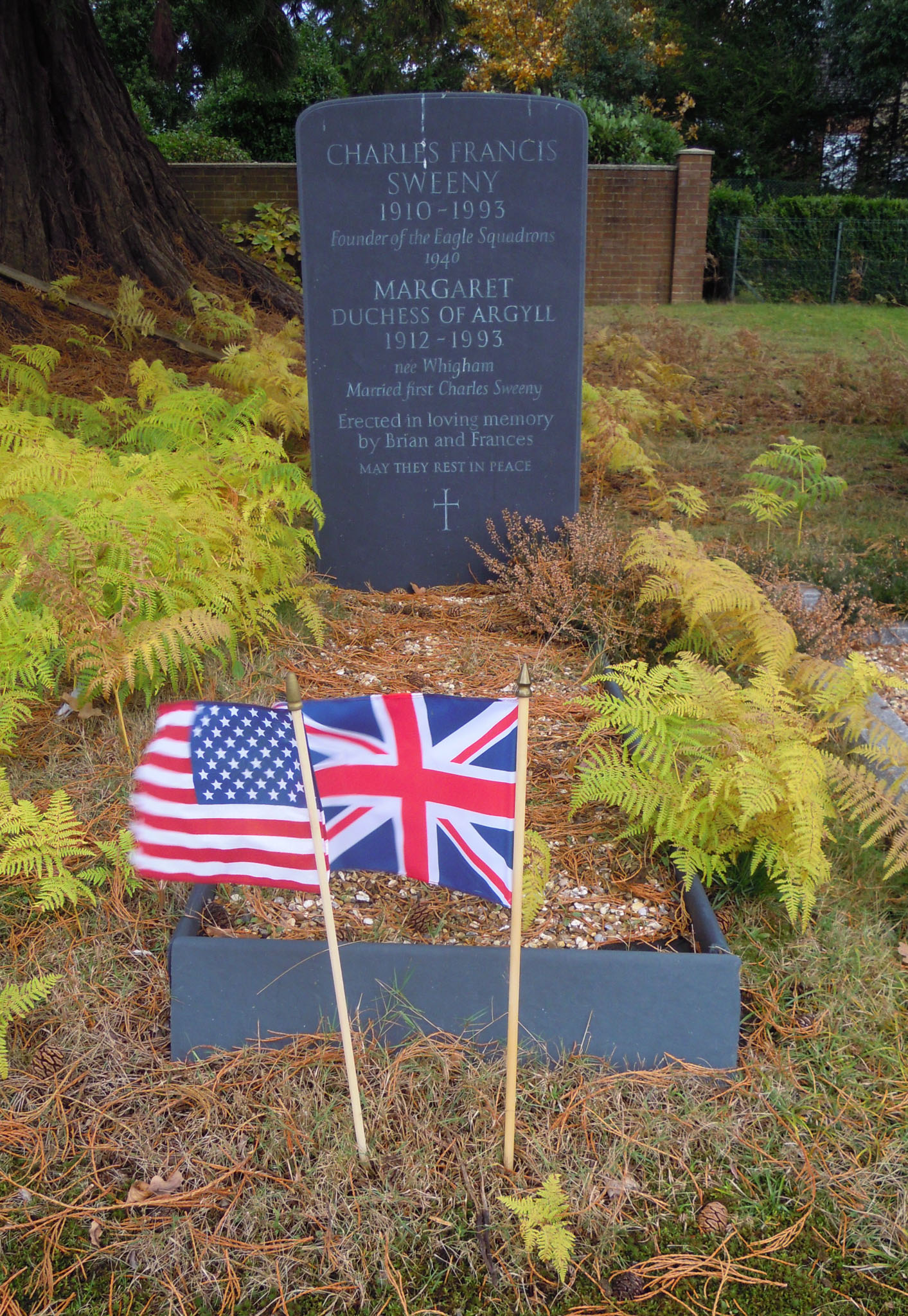
Grave site of Charles Francis Sweeny and his first wife. Photo by Jack1956 (17 November 2016). PD-Creative Commons CC0 1.0 Universal Public Domain Dedication. Wikimedia Commons.

The Eagle Squadrons

The requirements to join the Eagle Squadrons were a high school diploma, being of age 20 to 31 years, a vision of 20/40 correctable to 20/20, and 300 hours of certified flying time. It was actually easier to join the RAF than it was to get into the United States Army Air Corps (the predecessor of the United States Army Air Force, or “USAAF” formed in June 1941).

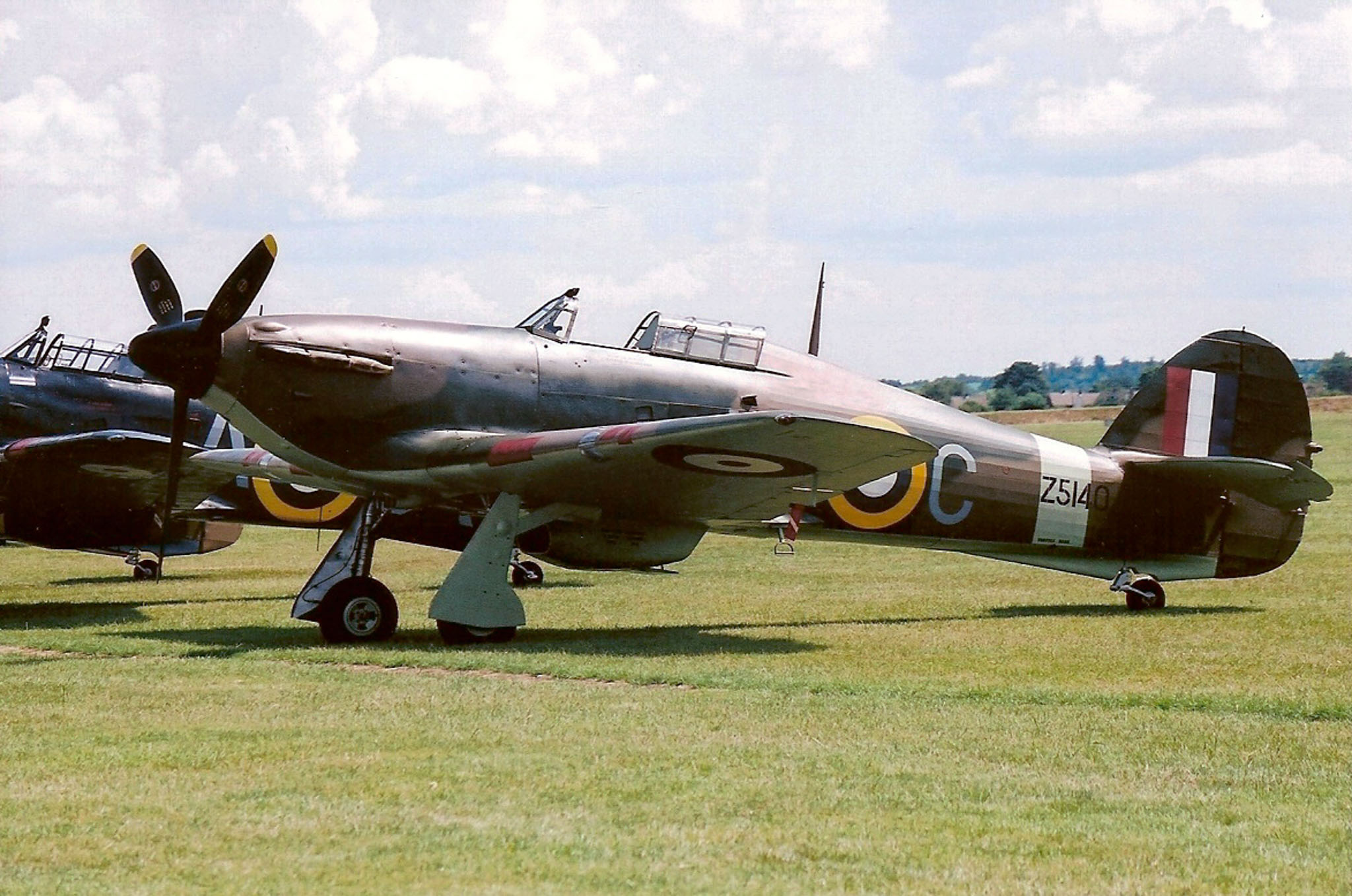
Training took place in England using Miles Master Trainers, Hawker Hurricanes, and Supermarine Spitfires. Upon graduation, the men were commissioned as RAF officers and assigned to various RAF fighter squadrons. The volunteers never renounced their American citizenship. Their RAF uniforms were modified to include the Eagle Squadron patch and the letters “ES” for Eagle Squadron.
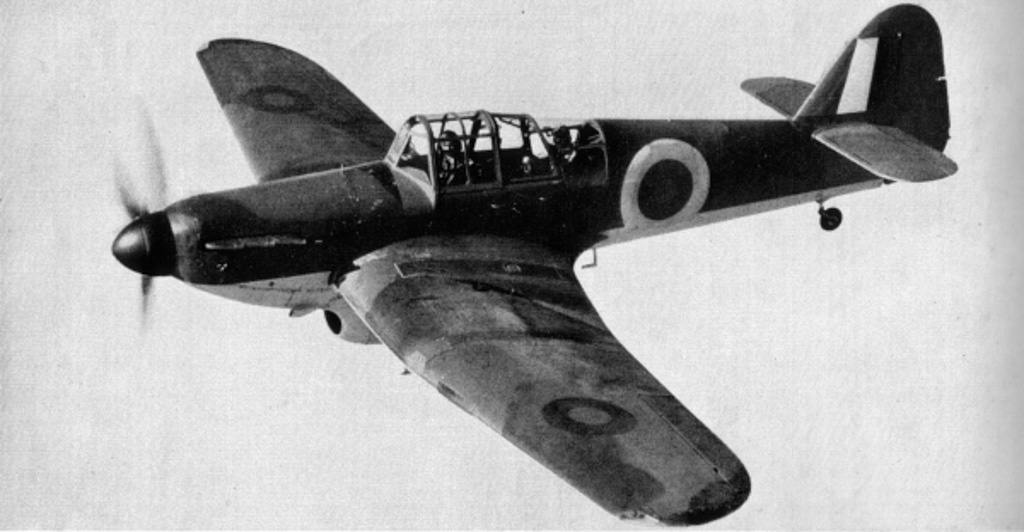
Miles M.9A Master advanced trainer.
Miles M.9A Master advanced trainer. Photo by anonymous. Prepared for Wikipedia by Keith Edkins (c. 1935-1940). PD-U.K. public domain. Wikimedia Commons.
Hawker Hurricane Mk.IIB.
Hawker Hurricane Mk.IIB. Photo by anonymous (date unknown). PD-GNU Free Documentation License, Version 1.2 or later. Wikimedia Commons.
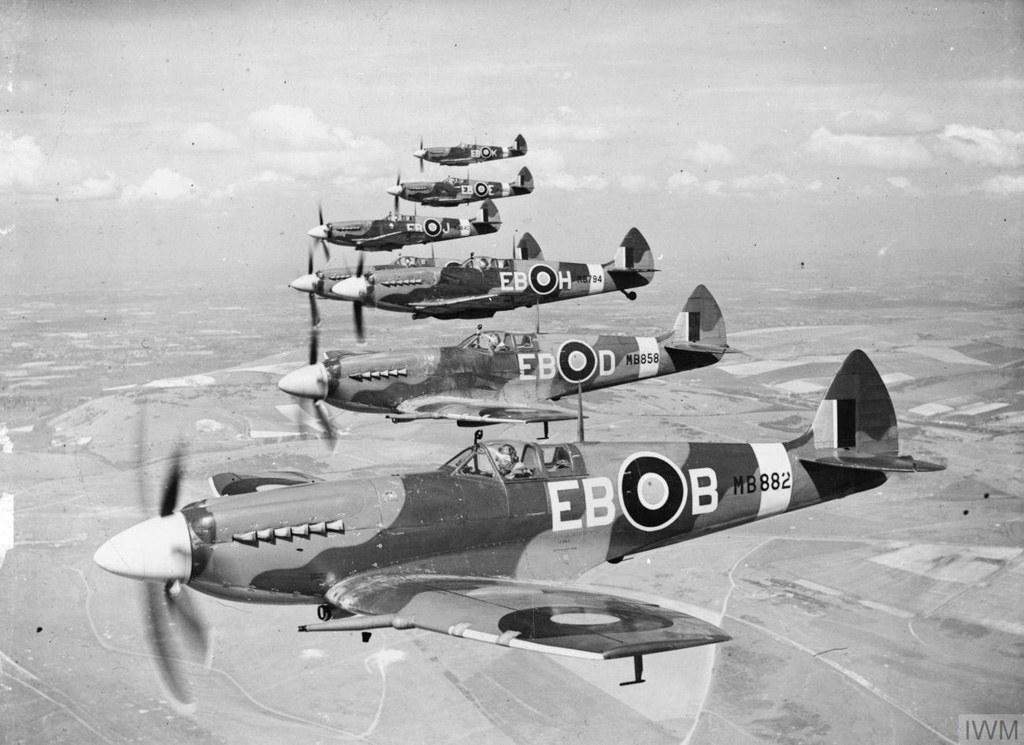
Supermarine Spitfire F Mk XIIs of No. 41 Squadron. Photo by anonymous (date unknown). PD-U.K. Government public domain. Wikimedia Commons.

Between September 1940 and July 1941, three Eagle Squadrons were formed and attached to the RAF. After the United States entered the war, the squadrons were turned over to the USAAF in late September 1942. The commander of the USAAF in Europe, Maj. Gen. Carl Spaatz (1891−1974), wanted to disperse the pilots amongst other fighter groups. However, the pilots wanted to stay together, and Gen. Spaatz agreed to their request. The three squadrons became the 334th (“Fighting Eagles”), 335th (“Chiefs”), and 336th (“Rocketeers”) Fighter Squadrons and formed the elite 4th Fighter Group (4th FG) based at RAF Debden, England.

The pilots eventually transitioned from the Spitfires to American P-47 Thunderbolts (1943−44) and P-51 Mustangs (1944−45). The 4th FG achieved the highest air/ground enemy aircraft destruction record in the USAAF. Some of the group’s accomplishments were being credited with 1,016 enemy aircraft destroyed (37 pilots became aces), the first fighter group to fly missions over Germany, the first to escort bombers over Germany, and the first to use belly tanks. Nathaniel Maranz (1919−?), an Eagle Squadron pilot, became the first American prisoner of war when he was shot down over the English Channel on 21 June 1941 and rescued by a German patrol boat.

American pilots of No. 71 “Eagle Squadron” rush to their Hawker Hurricanes at RAF Kirton-in-Lindsey. Photo by anonymous (17 May 1941). Imperial War Museum. PD-U.K. Government public domain. Wikimedia Commons.
American volunteer pilots of No. 121 Eagle Squadron playing poker in the dispersal hut at RAF Rochford in Essex. Photo by anonymous (c. August 1942).
American volunteer pilots of No. 121 Eagle Squadron playing poker in the dispersal hut at RAF Rochford in Essex. Photo by anonymous (c. August 1942). Imperial War Museum. PD-U.K. Government public domain. Wikimedia Commons.

The 4th FG is considered to have been instrumental in achieving Allied air superiority over Europe. Their final mission of World War II was on 25 April 1945. Today, the 4th Fighter Wing (assigned to the Air Combat Command’s Fifteenth Air Force) is the legacy of the Eagle Squadrons.

Click here to visit the Fourth Fighter Group WWII seb-site.

Click here to visit the American Air Museum Fourth Fighter Group WWII web-site.

Pilots of the Eagle Squadrons 

The first pilots of the Eagle Squadrons were Vernon “Shorty” Keogh (1911−1941), Andrew Mamedoff (1912−1941), and Eugene “Red” Tobin (1917−1941). The three Americans were among the first 32 volunteers recruited by Charles Sweeny, and he intended to have them join the French air force. However, Germany invaded France and the men were sent to England to join the RAF. As part of the No. 609 Squadron RAF, the men participated in the Battle of Britain earning them the Battle of Britain clasp to the 1939−45 campaign star. In September 1941, they were transferred to No. 71 Eagle Squadron. Unfortunately, all three men perished in 1941 during Eagle Squadron missions. On a side note, Mamedoff became the first American to take a “war bride” after marrying an English woman in 1941. He is also believed to be the first Jewish American pilot to have been killed in World War II (unsubstantiated).

The uniform of an American volunteer in No. 121 Eagle Squadron RAF. Photo by Daderot (4 November 2017). Oregon Air and Space Museum.
The uniform of an American volunteer in No. 121 Eagle Squadron RAF. Photo by Daderot (4 November 2017). Oregon Air and Space Museum. PD-Creative Commons CC0 1.0 Universal Public Domain Dedication. Wikimedia Commons.
Three American pilots of No. 71 Eagle Squadron RAF: Left to right: Pilot Officers G. Tobin, V.C. “Shorty” Keough, and A. Mamedoff. They are showing off their new squadron badge at RAF Church Fenton. Photo by anonymous (c. 1940). Imperial War Museum. PD-U.K. Government public domain. Wikimedia Commons.

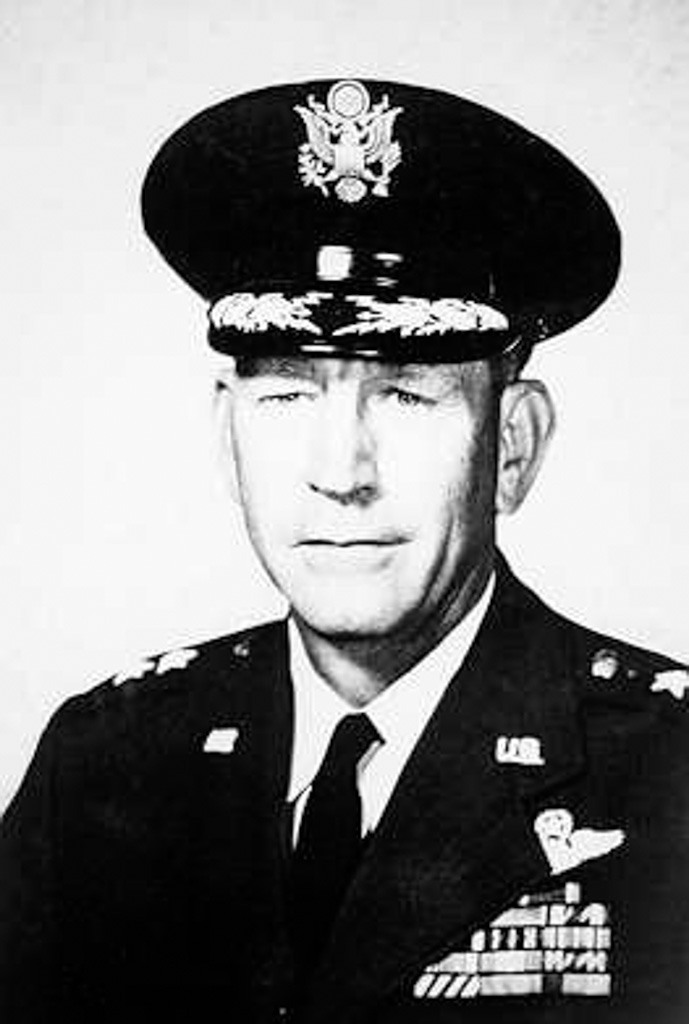
Chesley “Pete” Peterson (1920−1990) was assigned to the No. 71 Squadron upon his arrival in England in late September 1940. At the age of 21, Peterson was given command of the squadron and flew 42 missions (he flew a total of 130 missions during the war). As part of the group assigned to the USAAF 4th FG, Peterson was promoted to major and served as the FG’s executive officer. He became the youngest (age 23) colonel in the USAAF eventually rising to become a major general in 1965.
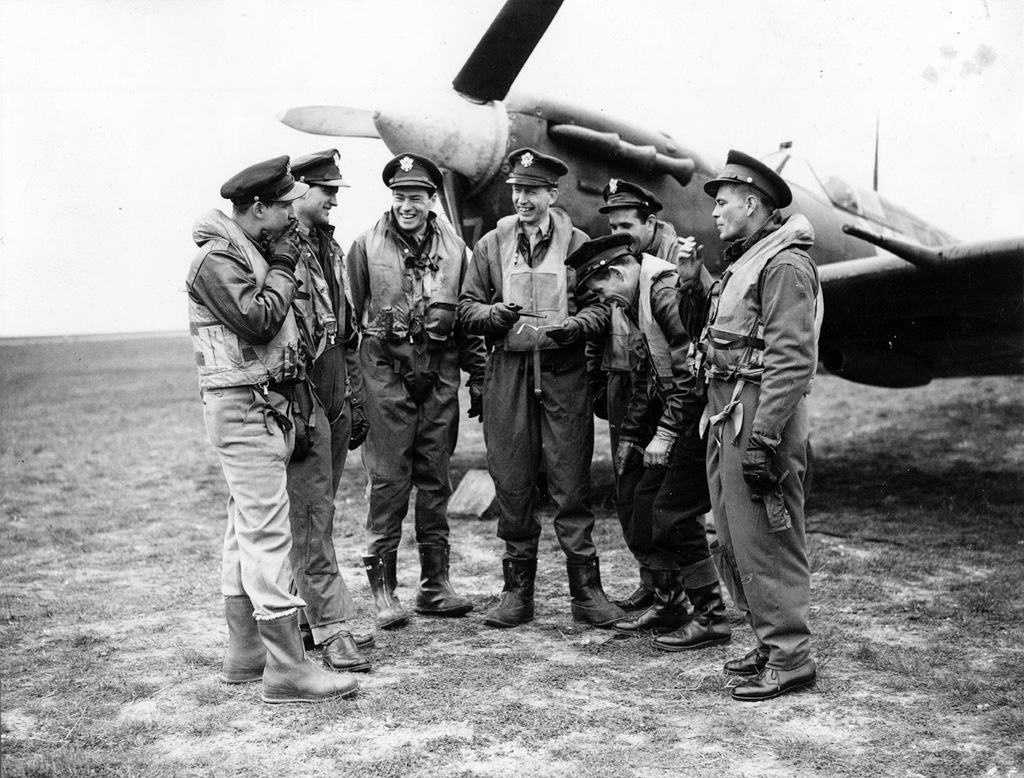
Pilots from the 4th Fighter Group in front of a Spitfire at RAF Debden airbase. The pilot in the center holding a pipe is Lt. Col. Chesley G. Peterson. The Spitfire is Peterson’s aircraft. Photo by anonymous (c. 1943). American Air Museum. PD-U.S. Government. Wikimedia Commons.
Maj. Gen. Chesley G. Peterson.
Maj. Gen. Chesley G. Peterson. Photo by anonymous (date unknown). PD-U.S. Government. Wikimedia Commons.

Donald Blakeslee (1917−2008) joined the RAF in May 1941. He quickly became known for his ability to shoot down enemy aircraft. He was assigned to the No. 133 Eagle Squadron as its commanding officer. Blakeslee quickly became an ace and has been credited with more than 500 missions flown. He is considered to be the most decorated World War II USAAF fighter pilot. His awards and honors include the Distinguished Service Cross, Silver Star, Legion of Merit, Distinguished Flying Cross, British Distinguished Flying Cross, and the French Croix de Guerre. He retired as a full colonel.
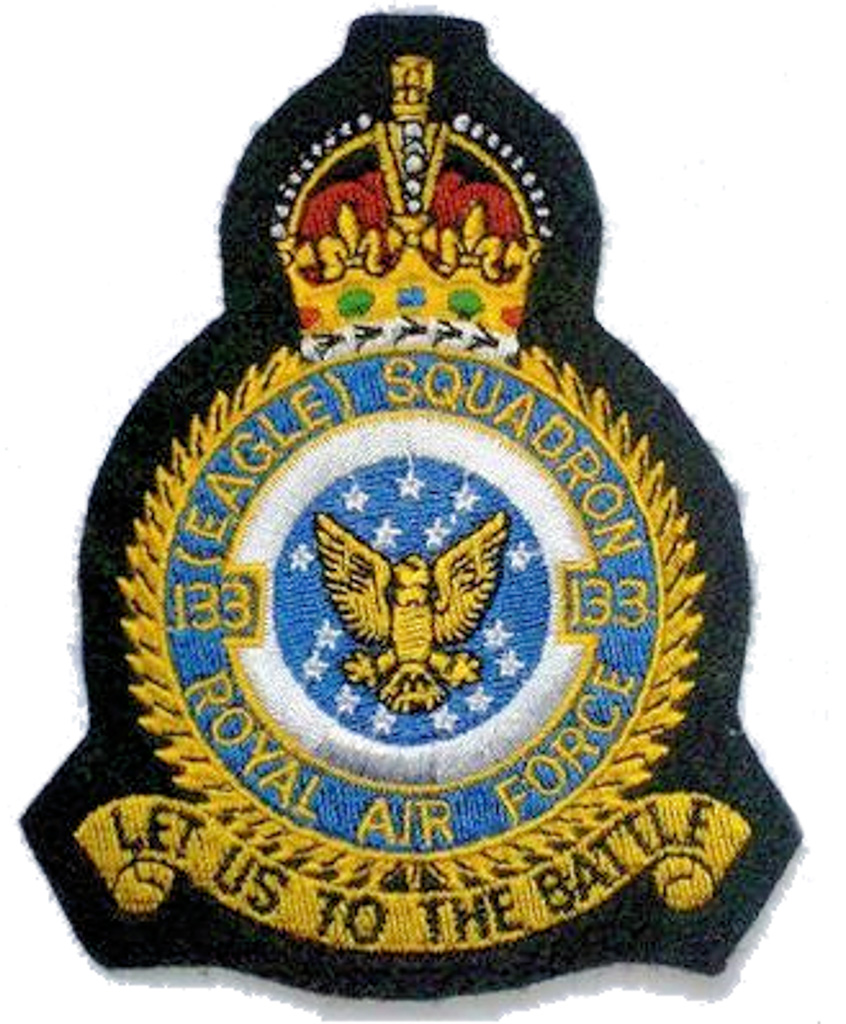
No. 133 Eagle Squadron RAF badge.
No. 133 Eagle Squadron RAF badge. Photo by anonymous (c. 1940). PD-U.K. Government public domain. Wikimedia Commons.
Generals gather for the occasion of the awarding of the Distinguished Service Cross to Col. Blakeslee and Capt. Gentile. Left to right: Gen. Jesse Auton, Gen. Eisenhower, Gen. Carl Spaatz, Gen. Jimmy Doolittle, Gen. Kepner, and Col. Blakeslee. Photo by anonymous (c. April 1944). PD-U.S. Government. Wikimedia Commons.

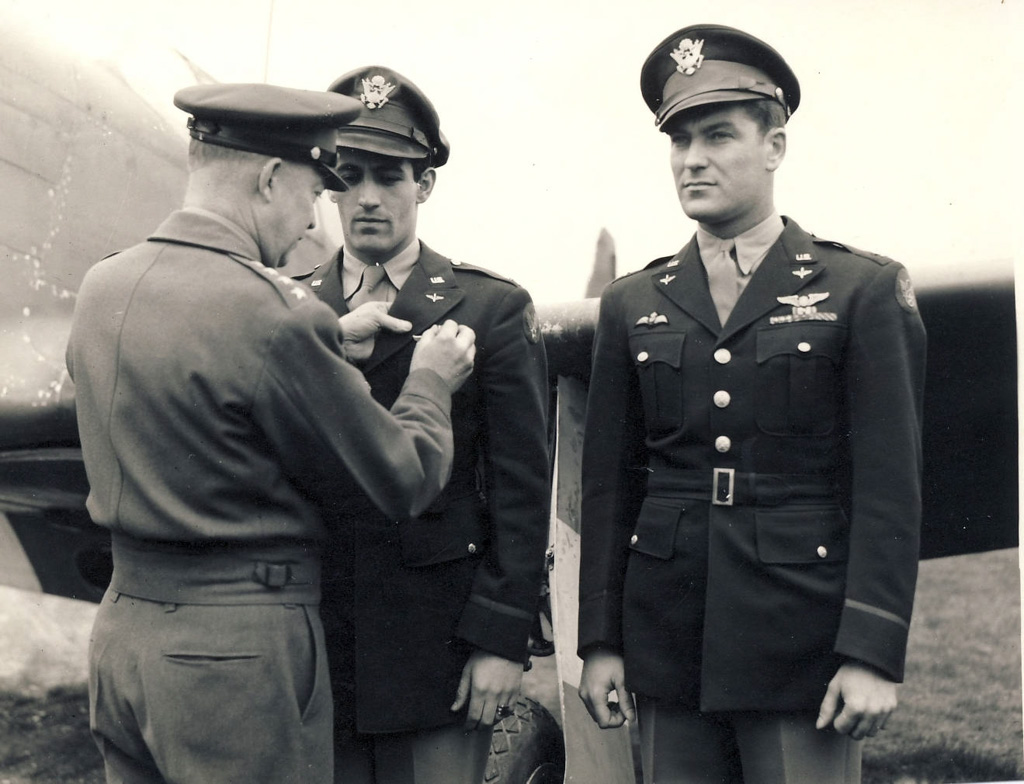
Dominic “Don” Gentile (1920−1951) almost surpassed Eddie Rickenbaker’s World War I record of 26 downed enemy aircraft. (Gentile was credited with 19.83 kills.) He flew the Supermarine Spitfire for the No. 133 Eagle Squadron before his transfer to the 4th FG where he first flew the P-47 before moving on to the P-51. On 13 April 1944, Gentile crashed his P-51 at Debden RAF while showing off for a group of journalists. Commanding Officer Blakeslee immediately grounded Gentile and sent him back to the United States to sell war bonds. He stayed in the air force after the war but in January 1951, Gentile was killed in a trainer aircraft crash.
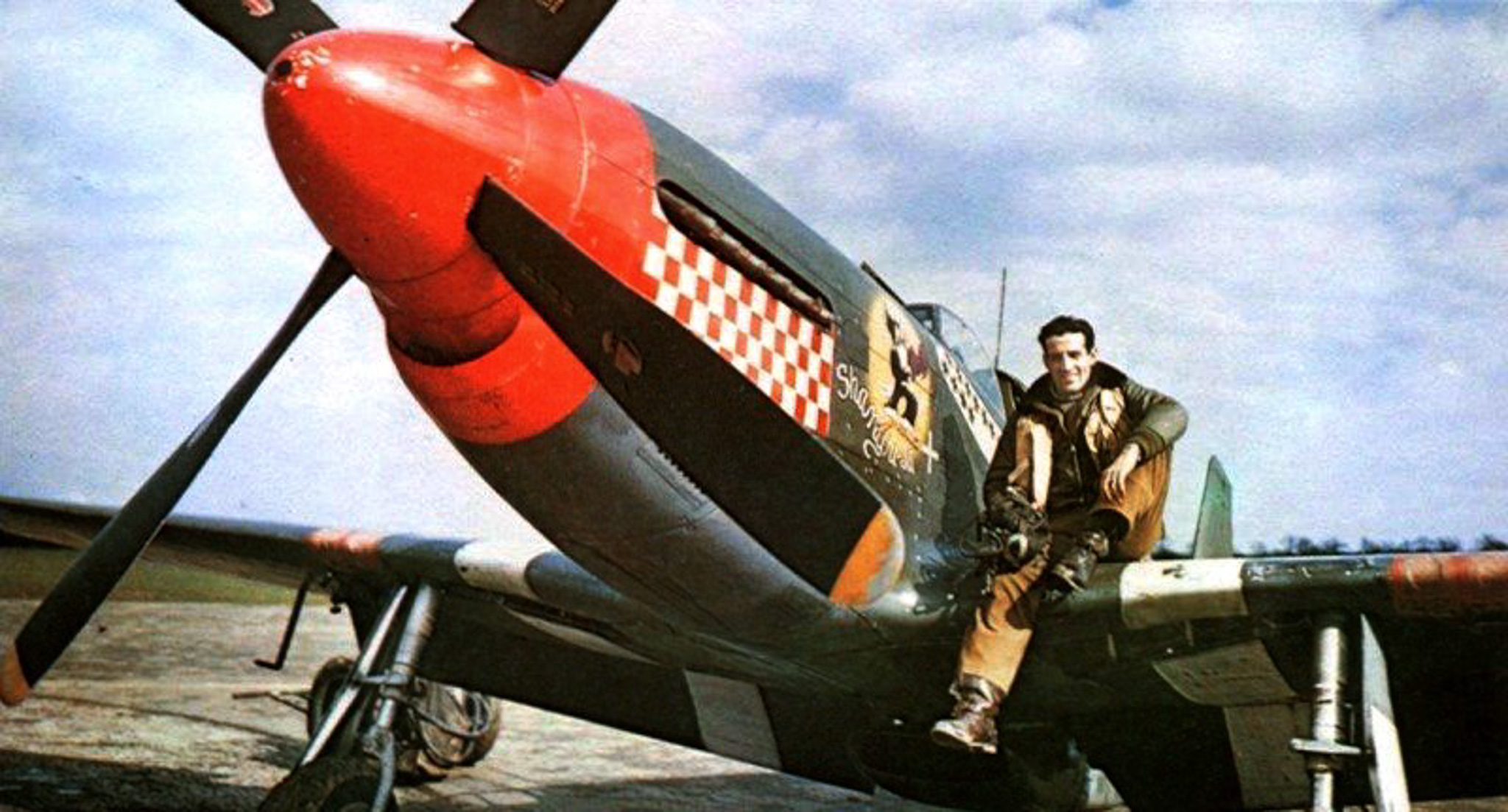
Don Gentile on the wing of his P-51B, “Shangri-La.”
Don Gentile on the wing of his P-51B, “Shangri-La.” Photo by anonymous (c. 1944). PD-U.S. Government. Wikimedia Commons.
Gen. Dwight D. Eisenhower awarding the Distinguished Service Cross to Dominic (“Don”) Salvatore Gentile (left) and Donald Blakeslee (right).
Gen. Dwight D. Eisenhower awarding the Distinguished Service Cross to Dominic (“Don”) Salvatore Gentile (left) and Donald Blakeslee (right). Photo by anonymous (11 April 1944). PD-U.S. Government. Wikimedia Commons.

The Classic Eagle Squadron March

Listen to this rousing march written specifically in memory of the Eagle Squadrons.

Click here.

Next Blog:       “SS Cap Arcona


Correspondence and Commentary Policy 

We welcome everyone to contact us either directly or through the individual blogs. Sandy and I review every piece of correspondence before it is approved to be published on the blog site. Our policy is to accept and publish comments that do not project hate, political, religious stances, or an attempt to solicit business (yeah, believe it or not, we do get that kind of stuff). Like many bloggers, we receive quite a bit of what is considered “Spam.” Those e-mails are immediately rejected without discussion.

Our blogs are written to inform our readers about history. We want to ensure discussions are kept within the boundary of historical facts and context without personal bias or prejudice.

We average about one e-mail every two days from our readers. We appreciate all communication because in many cases, it has led to friendships around the world.


★ Read and Learn More About Today’s Topic ★

Caine, Philip D. Eagles of the RAF The World War Eagle Squadrons. Washington, D.C.: National Defense University Press, 1991.

Childers, Col. James Saxon. War Eagles: The Story of the Eagle Squadron. Halstad, MN: Pickle Partners Publishing (2016). Originally published by Windmill Press, 1943.

Gentile, Don. One Man Air Force. New York: L.B. Fischer, 1944. Copyright held by North American Newspaper Alliance.

Haugland, Vern (author), Lt. Gen. Ira C. Eaker (USAF Ret.) (Foreword). The Eagle Squadrons: Yanks in the RAF, 1940−1942. New York: Ziff-Davis Flying Books (1979). Republished by TAB Books in 1992. Lt. Gen. Eaker was the model for the fictional Maj. Gen. Pat Pritchard in the 1949 movie, Twelve O’Clock High. (If you haven’t seen the movie you are missing out on probably the most realistic movie about World War II heavy bombers.)

Holmes, Tony. American Eagles: US Fighter Pilots in the RAF 1939-1945 (Images of War). Barnsley, UK: Pen & Sword Aviation Publishing, 2015.

Kan, Kenneth C. First in the Air: The Eagle Squadrons of World War II. Washington, D.C.: Air Force History and Museums Program, 2007.

Kershaw, Alex. The Few: The American “Knights of the Air” Who Risked Everything to Fight in the Battle of Britain. Boston: Da Capo Press, 2006. This book includes the stories of the first three men to join the Eagle Squadrons.


Disclaimer: 

There may be a chance that after we publish this particular blog, the video links associated with the blog are no longer accessible. We have no control over this. Many times, whoever posts the video has done so without the consent of the video’s owner. In some cases, it is likely that the content is deemed unsuitable by YouTube. We apologize if you have tried to access the link and you don’t get the expected results. Same goes for internet links.


What’s New With Sandy and Stew?

Three months after moving into our new home outside the Nashville area, we were hit with the Polar Vortex creating one of the worst ice storms the area has seen. Funny but the winter before we left Nashville some nine years ago, the worst ice storm in fifty years came through. Someone asked me if we were to blame for both. I don’t know. Two weeks after I joined a bank some forty years ago, the Challenger blew up. Two weeks after I joined another bank in late August 2001, the 9/11 terrorist attacks occurred. Trust me, I didn’t have anything to do with the Covid pandemic (that I can recall).

I have read The Wall Street Journal (WSJ) now for about fifty years. There are several sections that are of particular interest to me. One is the “Review” section every Saturday. In this section there are book reviews and I focus on non-fiction books with subjects that pertain to what I write about in our blogs and the Paris walking tour books. I have found over the years that if a book makes it to the WSJ, I can be assured it’s well-written and at least worth a look. Many of the books in my library were purchased based on their reviews.

Recently, a book caught my eye. It is Josephine Baker’s Secret War by Hannah Diamond (Yale University Press, 2025). Our 2021 blog, An African American in Paris (click here to read the blog), told the story of Josephine and her wartime exploits. For an expanded story, you might want to check out Ms. Diamond’s book.

Another book I would highly recommend is David L. Roll’s book, George Marshall: Defender of the Republic (Caliber, 2019). Gen. Marshall was an incredible person, and it would have been difficult for the Allies to win the war without him. He would have been the commander of Allied troops for the invasion of Europe, but Gen. Marshall was indispensable to President Roosevelt as his chief of staff and as such, Gen. Eisenhower was appointed Supreme Commander. This is a book I originally purchased based on the WSJ review. The personal and professional standards set by Gen. Marshall should be taught in every school. I gave each of my children a copy of this book.

Thank you to all of you who subscribe to our bi-weekly blogs. It seems there isn’t a day that goes by where we don’t increase our readership. Please let your history buff friends and family members know about our blog site and blogs.

Someone Is Commenting On Our Blogs

I have a lot of people to thank so it will take me several blogs to catch up. If I miss someone who has communicated with us (in a nice way), please don’t get mad at me for not mentioning your comments. I’m trying my best to catch up after our little sabbatical.

First and foremost, thanks to all of you who reached out to us after the last blog was published. It is good to be back, and I appreciate all of your kind comments and concerns about us.

Thanks to Edward N. for his comments on our blog, Salon Kitty (click here to read the blog). Edward is an expert in film and noted how the technical process of recording in the 1940s might have been different than what the blog mentioned.

Hazel S. contacted us about the blog, Cour des Miracles (click here to read the blog). There was an image of an illustration of a beggar that she identified as “The Man with the Twisted Lip” from Sir Arthur Conan Doyle’s short story. The artist was Sidney Paget and the story appeared in the Strand Magazine. Thanks Hazel. We have corrected the accreditation in the blog.

Monique T. wrote us about her family in response to the blog, An (extra)Ordinary Holocaust Story of Survival (click here to read the blog). Madame T. is 82-years-young and gave me permission to pass her contact information onto Marianne Golding. Marianne is from the Seidler family and is writing a book about Monique’s family and the Seidler family during World War II. It seems Monique will be able to fill in some of the unknown blanks Marianne has run into.

Paul A. is researching a particular French resistance operative and needed some information on the White Buses from the blog, Ten Gifts of the White Bus Rescue (click here to read the blog). Recall this was a guest blog written by Dr. Roger Ritvo. We were able to connect Paul and Roger. Ironically, several weeks later I received an email from Marzio A. It seems his grandfather assisted Count Bernadotte with the White Bus rescue. He took exception to the Count being called a hero and proceeded to explain what happened behind the scenes as told to him by his grandparents. An interesting twist to the accepted story.

Tim P. has been reading a lot about the French Resistance and contacted us about our blog, The Rasputin of the Abwehr (click here to read the blog). He mentioned he was going on a trip to France and asked about areas where he could visit to gain more knowledge. That’s hard to pin down when the entire country was occupied. That’s why I concentrated on Paris for my three books, Where Did They Put the Gestapo Headquarters? For example, Viriginia Hall (The Butcher of Lyon–click here to read the blog) operated in and around Lyon. Yet there really aren’t any specific sites that I know of to follow her footsteps. Same goes for Nancy Wake (The White Mouseclick here to read the blog). I do know of many resistance museums. However, the printed content accompanying the photographs and exhibits are only in French.

If there is a topic you’d like to see a blog written about, please don’t hesitate to contact me. I love hearing from you so keep those comments coming.

Share This:


Follow Stew:

1462420482_Twitter1462422248_InstagramAmazonScreen Shot 2017-10-09 at 10.20.30 AM badgeRGB

Find Stew’s books on Amazon and Apple Books.

Please contact Stew directly for purchase of books, Kindle available on Amazon. Stewross55@gmail.com or  Contact Stew on the Home Page.


Please note that we do not and will not take compensation from individuals or companies mentioned or promoted in the blogs.

Stew_Ross_Logo_CMYKWalks Through History

Copyright © 2026 Stew Ross
Posted on

Avenue Boche

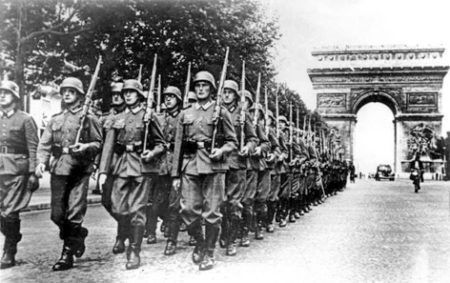
At about 6:00 a.m. on 14 June 1940, the German army marched into Paris. Two hours later, Wehrmacht headquarters were established in the Hôtel de Crillon on the Place de la Concorde. At 9:45 a.m., the Nazi swastika flag was hanging over the tomb of the unknown soldier from the center of the Arc de Triomphe. Eight hours later, officers and soldiers had taken over the buildings where they would live, work, and relax for the next four years. It was clear that before they arrived, senior officers knew exactly which buildings were going to be appropriated for the German occupation forces.

Wehrmacht troops marching on the Champs Elysée. Photo by anonymous (c. 1940). Bundesarchiv, Bild 146-1994-036-09A/CC-BY-SA. PD-CCA-Share Alike 3.0 Germany. Wikimedia Commons.

One of the most opulent and upscale Paris neighborhoods was centered along avenue Foch in the 16th arrondissiment. (During the Belle Epoque period, the street was named avenue Bois.) Mansions owned by French millionaires, industrialists, celebrities, and bankers lined the grand avenue. That is, until 14 June when the Gestapo began to take over the mansions. Over time, the French came to refer the street as “Avenue Boche.” (Boche was a derogatory term used to describe the German occupiers.)


Did You Know?

Did you know that the last surviving member of an elite French commando unit passed away on 3 July 2023?

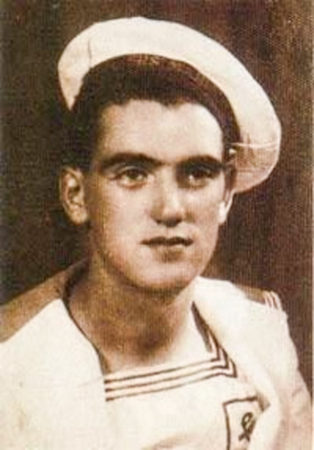
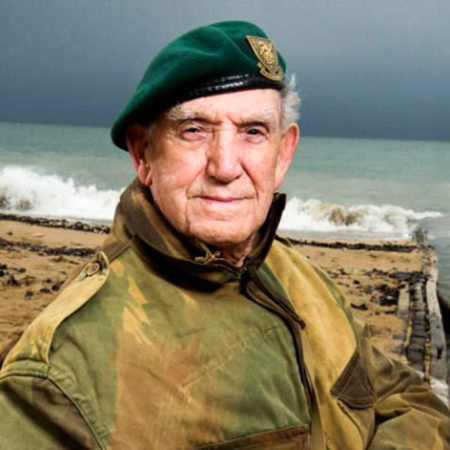
Léon Gautier (1922−2023) was a soldier in the 1er bataillon de fusiliers marins commandos, or commonly known as the “Kieffer Commandos” aptly named for its commander, Philipp Kieffer (1899−1962). There were 177 Kieffer commandos who landed on Sword Beach early on the morning of 6 June 1944. Their initial target was a heavily fortified bunker but standing between them and the bunker was a wide-open beach. After hitting the sand, it took the men four hours of heavy fighting, cutting through barbed wire, and withstanding a hailstorm of bullets, to take their objective. The men spent seventy-eight straight days in combat and half of them were killed. Only two dozen men escaped death or injury ⏤ Léon Gautier was among the lucky ones.

Léon Gautier during World War II.
Léon Gautier during World War II. Photo by anonymous (c. 1942). AFP/Getty Images.

The fighting unit exists today as part of the Naval Commandos of the French navy. The green beret and bronze shield badge are worn proudly seventy-nine years after the unit received its official designation in March 1944.

Léon Gautier proudly wearing the green beret with bronze shield of the Kieffer Commandos.
Léon Gautier proudly wearing the green beret with bronze shield of the Kieffer Commandos. Photo by François Gondrée (31 May 2014).

M.Gautier’s great-great-grandson was born on 6 June 2017, the 73rd anniversary of D-Day.

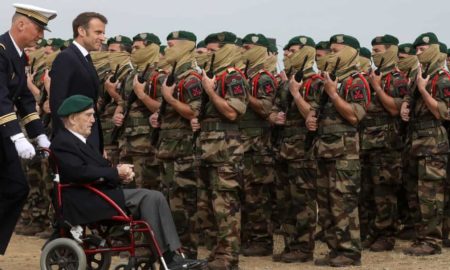
Accompanied by Emmanuel Macron , Léon Gautier attends the D-Day ceremony at Colleville-Montgomery.
Accompanied by Emmanuel Macron (standing behind Gautier), Léon Gautier attends the D-Day ceremony at Colleville-Montgomery. Photo by Stephane Lemouton (6 June 2023). Lemouton Stephane/Abaca/Shutterstock.

The American Hospital of Paris  

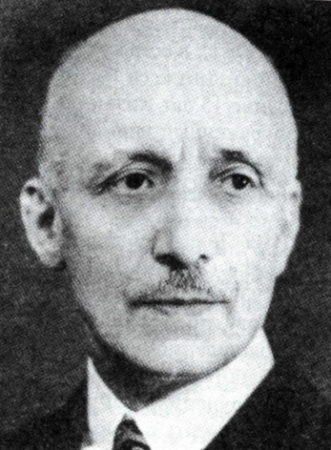
As it became apparent the Germans would enter Paris unopposed, Dr. Thierry de Martel (1876−1940), chief surgeon at the American Hospital told his friend and U.S. ambassador to France, William Bullitt (click here to read the blog, The American Mayor of Paris) that he would never leave the city. Dr. de Martel was antisemitic and anti-German. His son died in the first world war and the father had an intense hatred for Germans. He could not bear to think about swastika flags flying from buildings in his beloved city. He saw only one option available to him. On the morning of 14 June, Dr. de Martel sat down on his living room couch and injected himself with a lethal dose of strychnine.

Dr. Thierry de Martel.
Dr. Thierry de Martel. Photo by anonymous (c. 1920). PD-Expired copyright. Wikimedia Commons.
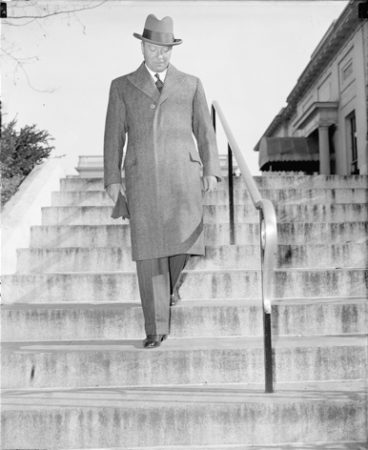
William C. Bullitt, U.S. envoy to France, leaving the White House after a meeting with President Roosevelt.
William C. Bullitt, U.S. envoy to France, leaving the White House after a meeting with President Roosevelt. Photo by Harris & Ewing (c. 1939). Library of Congress. PD-No known restrictions. Wikimedia Commons.

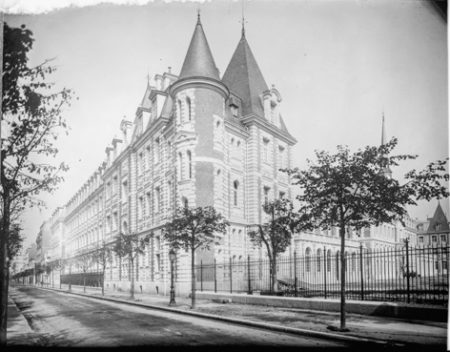
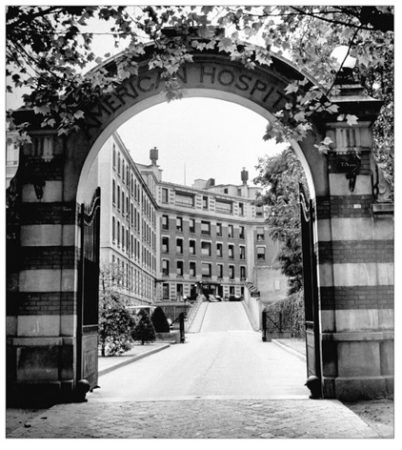
The American Hospital was founded in 1906 in the Paris suburb of Neuilly-sur-Seine and it is the only civilian hospital in Europe that does not receive government subsidies from France or the United States. It is a nonprofit organization and relies solely on donations. The hospital was inaugurated with 24-beds and today its capacity is 187 beds. Within five years, the hospital became one of the primary care centers for the wounded men in World War I reaching a capacity of 2,000 beds at its peak. In 1914, the American Hospital’s famous motor-ambulance corps was established (click here to read the blog, The Rochambelles). Notable patients of the hospital over the decades include Gertrude Stein (died), Rock Hudson (treated for AIDs), Ernest Hemingway (head wound and removal of his appendix), Aristotle Onassis (died), Sara Delano Roosevelt (treated for pneumonia), and the actor, Bette Davis (died).

The American Hospital of Paris. Photo by anonymous (c. 1908). Library of Congress. National Photo Company Collection. PD-No known restrictions. Wikimedia Commons.
Entrance to the American Hospital of Paris. Photo by anonymous (c. 1930).
Entrance to the American Hospital of Paris. Photo by anonymous (c. 1930). https://erenow.net/ww/americans-in-paris-life-and-death-under-nazi-occupation-1940-1944/18.php

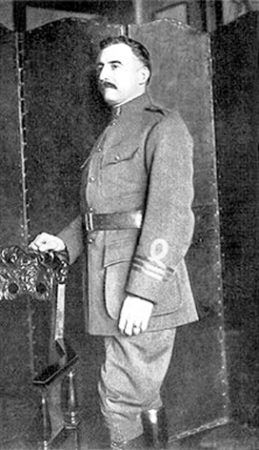
After Dr. de Martel committed suicide, Dr. Sumner W. Jackson replaced him as the hospital’s chief surgeon (and leader). The Germans allowed the hospital to treat wounded Allied POWs as it saved them an immense cost. Dr. Edmond Gros suffered an emotional and physical breakdown and resigned his position on the hospital’s board of governors. He was replaced by Aldebert de Chambrun (1872−1962), who became a collaborationist with the Germans during their four years of occupation.

Dr. Edmund Gros. Lt. Col. Gros suggested the name “Lafayette Escadrille” for the American aviation unit fighting in France.
Dr. Edmund Gros. Lt. Col. Gros suggested the name “Lafayette Escadrille” for the American aviation unit fighting in France. Photo by anonymous (c. 1918). PD-U.S. Government. Wikimedia Commons.
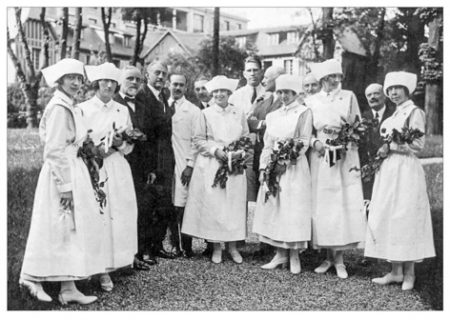
Dr. Sumner Jackson, Dr. Thierry de Martel, Dr. Edmund Gros, and Toquette Jackson.
Dr. Sumner Jackson (center), Dr. Thierry de Martel (in profile just in front of Dr. Jackson), Dr. Edmund Gros (fourth from left), and Toquette Jackson (third nurse from right). Photo by anonymous (c. 1940). Courtesy of Loraine Riemer.

After the German occupation of Paris and France, Dr. Jackson used his position to begin undercover resistance activities to shelter, provide false documents, and move Allied soldiers across the border to Spain. It worked well until four years later when the Gestapo caught up with Dr. Jackson, his wife, and their teenage son.

Let’s Meet the Jackson Family 

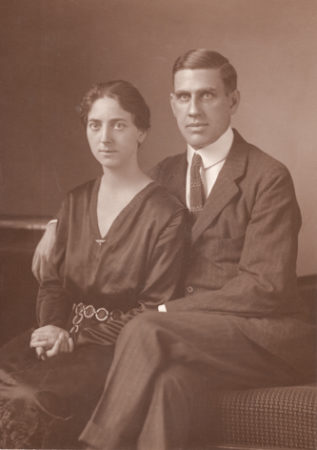
Sumner Jackson (1884−1945) was a Jefferson Medical College graduate in 1914 and became a battlefield surgeon in France during World War I. He met a Swiss-born nurse, Charlotte (“Toquette”) Sylvie Barrelet de Ricout (1888−1968), during this time and they were married in 1917. Returning to the United States, the couple did not seem to fit in, and by 1921, they had returned to Paris. Sumner began as a staff surgeon with the American Hospital and during the interwar years, he gained a steadfast professional and personal reputation eventually becoming Dr. de Martel’s assistant. During that time, Dr. Jackson treated American expats such as Gertrude Stein, Zelda Fitzgerald, Ernest Hemingway, and e.e. cummings. A contemporary report to the hospital’s governors stated, “Too much praise cannot be given to Dr. Sumner Jackson.”

Sumner and Charlotte Jackson.
Sumner and Charlotte Jackson. Photo by anonymous (date unknown). Courtesy of Loraine Riemer.

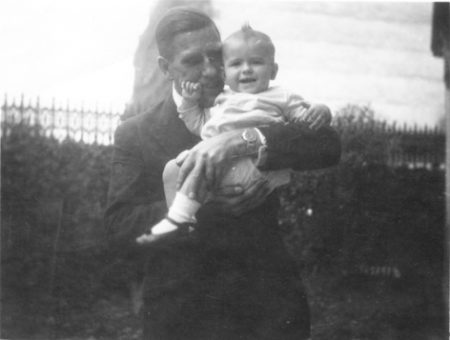
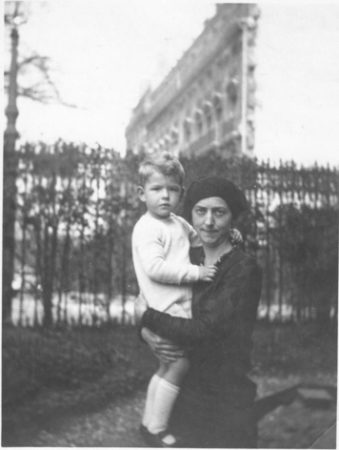
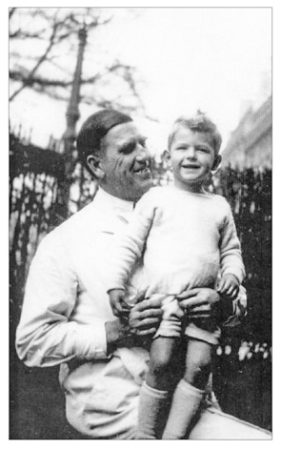
In January 1928, Toquette gave birth to the couple’s only child, a son named Phillip (1928−2016) and he went by “Pete” for the remainder of his life. Pete adored his parents and the three of them lived comfortably on the ground floor of their residence at 11, av. Foch.

Dr. Jackson standing in the garden with his son, Pete.
Dr. Jackson standing in the garden with his son, Pete. Photo by anonymous (c. October 1928). Courtesy of Loraine Riemer.
Toquette and Pete in the garden of their apartment at 11, avenue Foch. Photo by anonymous (c. August 1930). Courtesy of Loraine Riemer.
Dr. Sumner Jackson and his son, Pete, in the garden of their avenue Foch apartment.
Dr. Sumner Jackson and his son, Pete, in the garden of their avenue Foch apartment. Photo by anonymous (c. 1930). Courtesy of Loraine Riemer.

Avenue Boche

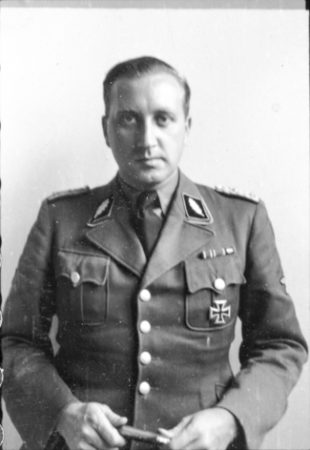
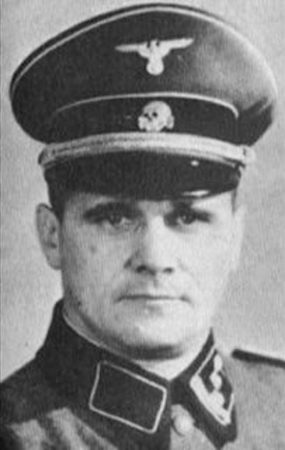
Following on the heels of the Wehrmacht entering Paris was a small Sonderkommando unit of Gestapo men. Handpicked by SS-Obergruppenführer Reinhard Heydrich, the unit’s commander was thirty-year-old SS-Standartenführer Helmut Knochen (1910−2003). Knochen, the head of the Paris Gestapo, settled into his offices located at 72, av. Foch. His superiors, SS-Sturmbannführer Karl Bömelburg (1885−1946) and SS-Brigadeführer Karl Oberg (1897−1965) had offices at 84, av. Foch and nearby at 57, bd Lannes (Waffen-SS headquarters), respectively. The head of Sicherheitsdienst-SD counterintelligence, SS-Sturmbannführer Hans Josef Kieffer (1900−1947), worked out of 84, av. Foch. Reporting to Adolf Eichmann, SS-Hauptsturmführer Theodor Dannecker (1913−1945), head of the Bureau of Jewish Affairs, had his offices at 31 bis, av. Foch. The buildings at 80-84, av. Foch contained Gestapo offices used for imprisonment and torture. The KriPo, or Nazi police responsible for criminal investigations were housed at 74, av. Foch. The Paris Gestapo Amt III (intelligence operations) was headquartered at 58-60, av. Foch. Around the corner and within a short walking distance were the rue Pergolèse residences of Hugo Bleicher (1899−1982), the Nazis’ premier spy catcher and his next-door neighbor, the French traitor, Henri Déricourt (1909−1962).

SS-Standartenführer Helmut Knochen.
SS-Standartenführer Helmut Knochen. Photo by Kurt Alber (c. 1942). Bundesarchiv, Bild 101III-Alber-096-10/CCA-BY-SA. PD-CCA-Share Alike 3.0 Germany. Wikimedia Commons.
SS-Sturmbannführer Hans Josef Kieffer.
SS-Sturmbannführer Hans Josef Kieffer. Photo by anonymous (date unknown). https://www.memoiresdeguerre.com
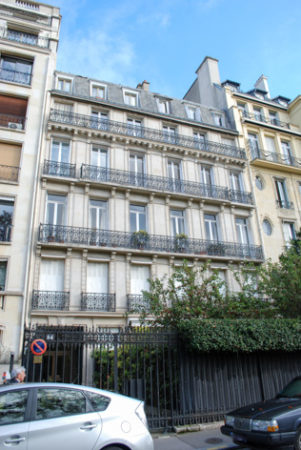
Exterior of 84, avenue Foch. The top floors contained rooms for Gestapo interrogation and torture as well as prisoner holding cells.
Exterior of 84, avenue Foch. The top floors contained rooms for Gestapo interrogation and torture as well as prisoner holding cells. Photo by Sandy Ross (c. September 2017).

Dr. Jackson and his family were surrounded by the most dangerous Nazis in Paris. It was a web of killers, double agents, collaborationists, and informers. Due to his position, protection from de Chambrun, and luck, the Jacksons almost managed to pull off their resistance activities for the entire four years of occupation without any interference from the Gestapo. However, in May 1944, their luck ran out.

Exterior of former residence of the Jackson family at 11, avenue Foch. The fence is original and behind it is the garden where photos were taken of Pete with his parents.
Exterior of former residence of the Jackson family at 11, avenue Foch. The fence is original and behind it is the garden where photos were taken of Pete with his parents. Photo by Sandy Ross (c. September 2017).

Resistance Activities

Pete hated the German occupiers and like many other teenagers, he carried chalk with him to scribble “V” on walls in recognition of the Allied victory sign. (That is until his parents found out.)

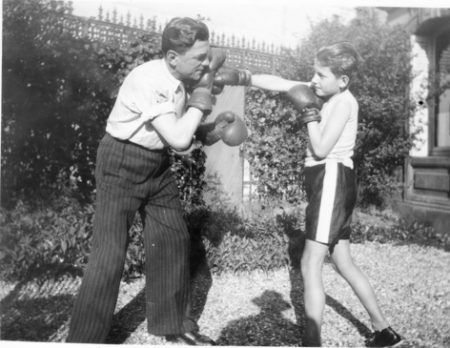
Dr. Jackson giving his son, Pete, boxing lessons in the garden of their apartment at 11, avenue Foch.
Dr. Jackson giving his son, Pete, boxing lessons in the garden of their apartment at 11, avenue Foch. Photo by anonymous (c. May 1938). Courtesy of Loraine Riemer.

Dr. Jackson had been aiding Allied agents and downed airmen since the occupation. However, by the spring of 1943, Toquette was approached by representatives of the Goélette-Frégate resistance network and asked the Jacksons to provide their home as a drop-off site for important intelligence material. It would put the Jackson family at great risk, but they finally agreed to the arrangement. They allowed Goélette agents to meet at the apartment but refused to allow radio transmissions as that would be an unnecessary risk. Despite their efforts to shield Pete, he eventually became involved in the family’s resistance activities including foolishly taking photos of the U-boat pens at Saint-Nazaire and the Atlantic Wall coastal defenses. (German soldiers were under orders to immediately execute any non-German caught taking photographs.)

By the fall of 1943, the Jackson’s “letter box” became an integral part of Goélette’s operations. Besides the normal maps and photographs, extremely important information passed through the avenue Foch residence including the first designs of Germany’s new V-1 rocket.

The Jacksons were no different than any other Parisian family in early 1944. They suffered from a lack of food and clothing. However, there was another gruesome fact. By mid-1943 and into 1944, Knochen and Keiffer had built up a sizeable network of spies, collaborationists, and informers. French résistants were being denounced, French and British resistance networks and circuits (e.g., British-led Special Operations Executive) were infiltrated, and scores of resistance agents were arrested, tortured, and deported/murdered under Hitler’s directive, Nacht und Nebel (click here to read the blog, Night and Fog).

Goélette knew the Germans were tightening the noose around the organization and Toquette was warned. On 24 May 1944, Goélette and its agents, including Toquette (nom de guerre: Colombiers), were betrayed to the Germans.

Arrest, Deportation, and Concentration Camps 

The Gestapo sent three members of the Milice (a Vichy collaborationist paramilitary organization) to the Jackson residence where Toquette and Pete were arrested. Almost simultaneously, the Gestapo arrested Dr. Jackson at the hospital.

The Milice interrogated each family member but never tortured them. On 7 June, they were turned over to the Gestapo for further questioning. As the Allies broke out of the Normandy beaches, Dr. Jackson and Pete were loaded into a bus destined for the Compiègne detention camp and from there, in mid-July, they were deported to KZ Neuengamme in northern Germany. Toquette was sent to the Romainville detention center and a month later, put on the last train out of Paris (click here to read the blog, The Last Train Out of Paris) with KZ Ravensbrück as her final destination.

The front entrance to KZ Neuengamme.
The front entrance to KZ Neuengamme. Photo by City of Hamburg (1 August 2020). PD-CCA-Share Alike 4.0 International. Wikimedia Commons.

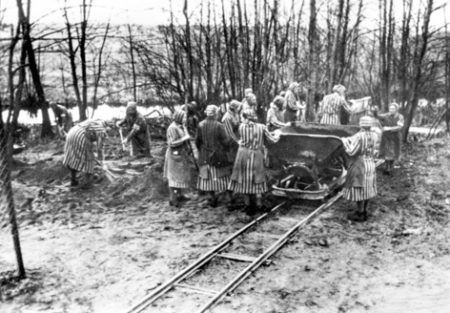
The Jacksons survived the winter of 1944/45 in the camps through sheer strength of willpower, courage, and determination. They all worked at hard labor. Dr. Jackson toiled as a machinist in a munitions factory (where he lost a finger) while Pete was assigned to clear bomb damage. Fortunately, Dr. Jackson found a replacement for his son and Pete was able instead to get a job in the camp kitchen, likely saving his life. Toquette’s life at KZ Ravensbrück was brutal. Starvation, lack of medical care, illness, and horrible working conditions contributed to Toquette’s physical deterioration. Worse than all of that, Toquette never knew what happened to her husband and son.

Women prisoners laboring at KZ Ravensbrück.
Women prisoners laboring at KZ Ravensbrück. Photo by anonymous (date unknown). Bundesarchiv, Bild 183-1985-0417-15/CC-BY-SA 3.0. PD-CCA-Share Alike 3.0 Germany. Wikimedia Commons.

SS Thielbek and the White Buses 

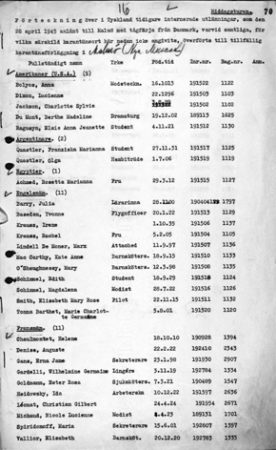
As the war neared its end, Heinrich Himmler gave the orders that all evidence of Nazi crimes was to be eliminated. This meant concentration camp prisoners were to be murdered so they couldn’t testify against their captors. However, Himmler was looking for ways to save his skin and he agreed to release some of the women prisoners (click here to read , The White Buses and here to read Ten Gifts of the White Bus Rescue). Under the White Bus project, Toquette was released and on 28 April 1945, she landed at Malmö, Sweden. Toquette’s physical condition was such that she was barely alive and had she not been released, it likely Toquette would have perished in the camp before its liberation. Of the 550 women deported with her from Paris on 15 August 1944, Toquette was one of only seventeen survivors.

Partial passenger list of former KZ Ravensbrück prisoners arriving by ferry at Malmö, Sweden. Toquette is listed third under “Amerikaner (U.S.A.).”
Partial passenger list of former KZ Ravensbrück prisoners arriving by ferry at Malmö, Sweden. Toquette is listed third under “Amerikaner (U.S.A.).” Photo by anonymous (c. April 1945).
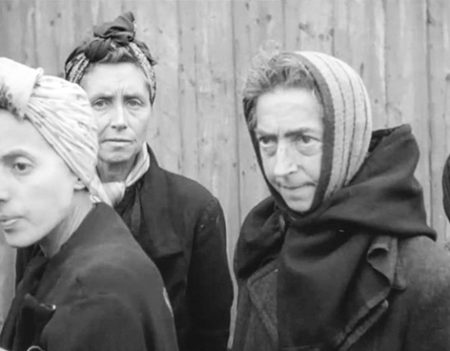
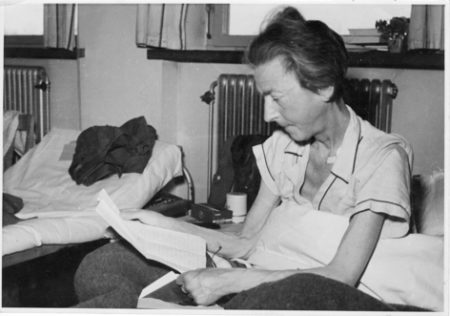
Charlotte (“Toquette”) Jackson (right) arriving in Malmö, Sweden after her release from KZ Ravensbrück.
Charlotte (“Toquette”) Jackson (right) arriving in Malmö, Sweden after her release from KZ Ravensbrück. Photo by anonymous (28 April 1945). Courtesy of Loraine Riemer.
Toquette recuperating in Malmö, Sweden.
Toquette recuperating in Malmö, Sweden. Photo by anonymous (c. April 1945). Courtesy of Loraine Riemer.

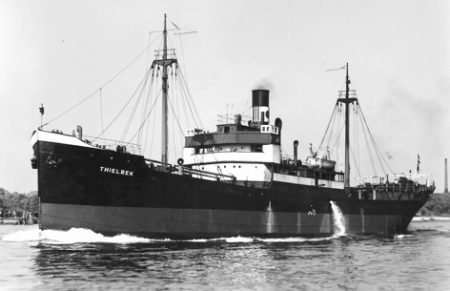
There were nine thousand inmates at KZ Neuengamme. By April 1945, the British were advancing toward the camp and six thousand men (including Dr. Jackson and Pete) were shipped to Lübeck where on 3 May, they boarded the cargo carrier, SS Thielbek. (Two passenger ships, Cap Arcona and the Deutschland, were also used.) The remaining three thousand prisoners at KZ Neuengamme were murdered by the camp guards.

SS Thielbek.
SS Thielbek. Photo by anonymous (date unknown). https://www.shipsnostalgia.com

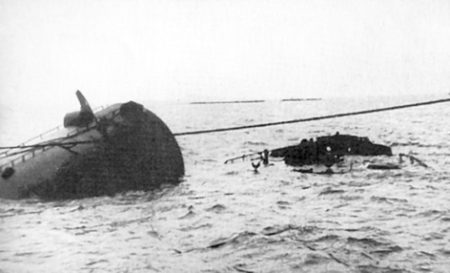
Under Himmler’s orders, the Nazis planned to scuttle the three ships with all inmates on board. However, the British did not know the ships carried the prisoners and on the afternoon of 3 May, RAF fighters attacked. Pete was on deck when the Thielbek took a direct hit. He looked for his father and not seeing him, Pete jumped into the water. Reaching a lifeboat, Pete climbed in but was thrown back into the sea once the German sailors realized he was a prisoner. He swam to shore with two hundred other men. The first 150 ashore were mowed down by SS machine guns. Pete and the other fifty men swam away and came ashore further down the beach where they were taken by the SS to Neustadt along with 200 other survivors from the sinking ships. Lined up to be shot, Pete and the others heard the sound of British tanks and their would-be executioners fled. The arrival of British troops saved the lives of fifty survivors of the sinking of the Thielbek. Pete was one of them.

The wreck of the SS Thielbeck. Photo by anonymous (c. May 1945). Traces of War. Getuigen.

An eyewitness told Pete that his father was seen in the water clinging to a plank but was clearly having “difficulties.” Dr. Jackson’s body was never recovered.

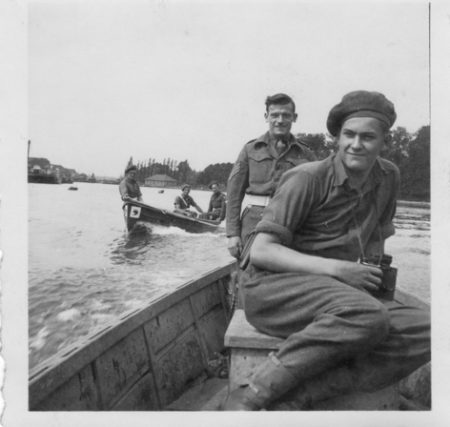
Pete in Neustadt one month after escaping death at the hands of the Nazis. Photo by anonymous (c. June 1945). Courtesy of Loraine Riemer.

Post War 

Pete enlisted in the British army and ultimately returned to Paris where he was reunited with his mother in September 1945. The apartment on avenue Foch was just as they left it more than a year and a half earlier.

At the age of seventeen, Pete returned to Germany in 1946 to testify against fourteen men who had run the Neuengamme concentration camp. Every defendant Pete testified against was found guilty and hanged.

Pete Jackson remained in Paris, awarded the French Legion of Honor as well as the Croix de Guerre, and after a serious accident in the late 1990s, lived out his life at L’Hôpital des Invalides. Pete strove his entire life to encourage improvement of Franco-German relations.

Toquette passed away in 1968 at the American Hospital of Paris.

The Jackson Award         

In 2013, the board of governors of the American Hospital of Paris created the Jackson Award to commemorate the services of Dr. and Mrs. Jackson to the hospital before and during World War II. The first recipients of the Jackson medal were Sumner and Toquette and Pete accepted the award on their behalf.

I’m grateful to have developed a dialogue with Pete’s daughter, Loraine and I thank her for providing some of the images used in this blog. The Jackson’s avenue Foch apartment will be one of the featured stops in volume two of Where Did They Put the Gestapo Headquarters?


Next Blog:  “The British Kardashian Sisters”


Correspondence and Commentary Policy 

We welcome everyone to contact us either directly or through the individual blogs. Sandy and I review every piece of correspondence before it is approved to be published on the blog site. Our policy is to accept and publish comments that do not project hate, political, religious stances, or an attempt to solicit business (yeah, believe it or not, we do get that kind of stuff). Like many bloggers, we receive quite a bit of what is considered “Spam.” Those e-mails are immediately rejected without discussion.

Our blogs are written to inform our readers about history. We want to ensure discussions are kept within the boundary of historical facts and context without personal bias or prejudice.

We average about one e-mail every two days from our readers. We appreciate all communication because in many cases, it has led to friendships around the world.


★ Read and Learn More About Today’s Topic ★

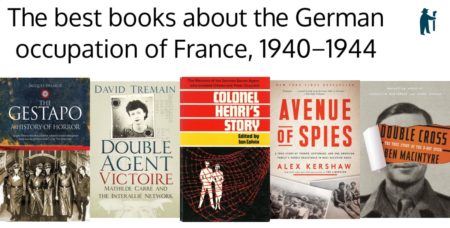
Bleicher, Hugo. Colonel Henri’s Story. London: William Kimber and Co. Limited, 1954.

Brouwer, Marilyn. The Fascinating Story of the American Hospital of Paris. Bonjour Paris, 3 May 2021. Click here to read the article.

Brownell, Will and Richard N. Billings. So Close to Greatness: A Biography of William C. Bullitt. New York: Macmillan Publishing Company, 1987.

Delarue, Jacques. The Gestapo: A History of Horror. Barnsley: Frontline Books, 2008. (Originally published by Libraire Arthème Fayard, 1962.)

Etkind, Alexander. Roads Not Taken: An Intellectual Biography of William C. Bullitt. Pittsburgh: University of Pittsburgh Press, 2017.

Glass, Charles. Americans in Paris: Life & Death Under Nazi Occupation. New York: Penguin Books, 2010.

Glass, Charles. American Hospital of Paris: Brave Volunteers & Heroes of the Resistance. Click here to read the article.

Helm, Sarah. A Life in Secrets: Vera Atkins and the Missing Agents of WWII. New York: Anchor Books, 2007.

Kershaw, Alex. Avenue of Spies: A True Story of Terror, Espionage, and One American Family’s Heroic Resistance in Nazi-Occupied Paris. New York: Broadway Books, 2015.

Lagard, Dorothée. Américan Hospital of Paris 1906−2006: L’aventured’un siècle. Paris: Cherche Midi, 2006. (French edition)

Vaughan, Hal. Doctor to the Resistance: The Heroic True Story of an American Surgeon and His Family in Occupied Paris. Dulles, VA: Potomac Books, Inc., 2004.

Vega, Ricardo and Richard Lerchbaum (producers). Doctor Jackson’s File (Le dossier du Docteur Jackson). Lunaticas Productions, 2015.

Disclaimer:

There may be a chance that after we publish this particular blog, the video links associated with the blog are no longer accessible. We have no control over this. Many times, whoever posts the video has done so without the consent of the video’s owner. In some cases, it is likely that the content is deemed unsuitable by YouTube. We apologize if you have tried to access the link and you don’t get the expected results. Same goes for internet links.

What’s New With Sandy and Stew?

Sandy and I attended my 50th high school reunion in late July. We traveled to Akron, Ohio for what was a three-hour gathering of people I didn’t recognize but my memory was somewhat refreshed by their name tags. In many cases, I didn’t remember the person even with the help of a name badge. Unfortunately, the high school senior yearbook photos were not included on the badges and that little detail might have helped. Kudos to the committee of five people organizing the reunion. Other than the missing nametag pictures and the loud music (didn’t they know we’re old and can’t hear?), they did a wonderful job of planning, communicating, and executing the affair. I can’t wait for the 100th reunion.

By the way, did you know that a new movie starring Anthony Hopkins will have a screening at this year’s BFI London Film Festival? “One Life” is the story of Sir Nicholas Winton and his efforts to save children from the Nazis (click here to read the blog, Kindertransport and Mr. Winton).

Thank you to all of you who subscribe to our bi-weekly blogs. It seems there isn’t a day that goes by where we don’t increase our readership. Please let your history buff friends and family members know about our blog site and blogs.

Someone Is Commenting On Our Blogs 

It is always a pleasure to hear from Nicole C. She always has so many personal stories and memories regarding our blog topics. This time she commented on our blog, Mulberry Harbor & The Delta Works (click here to read).

Nicole remembers as a ten-year-old in a French school hearing about the 1953 Great Flood. The students were asked to knit a square of wool to make blankets. Nicole says that is how she learned to knit. They also sent toys to the Dutch children affected by the disaster.

Nicole, I’ll keep the blogs coming if you promise to keep sending us your stories and memories.

If there is a topic you’d like to see a blog written about, please don’t hesitate to contact me. I love hearing from you so keep those comments coming.


Shepherd logo.jpg

Do you enjoy reading? Do you have a hard time finding the right book in the genre you enjoy? Well, Ben at Shepherd.com has come up with an amazing way to find that book.

Shepherd highlights an author (like me) and one of their books. The author is required to review five books in the same genre. So, if a reader is interested say in cooking, they can drill down and find specific books about cooking that have been reviewed by authors in that category. Very simple.

If you like to read, I highly recommend you visit Shepherd.com. If you do, please let me know what you think and I will forward Ben any suggestions or comments you might have.

Click here to visit Shepherd’s website.

Click the books to visit Stew’s bookshelf.

Image 11-16-22 at 10.38 AM

Check out Stew’s new bookshelf on the French Revolution.

Shepherd FR Bookshelf


Share This:


Follow Stew:

1462420482_Twitter1462422248_InstagramAmazonScreen Shot 2017-10-09 at 10.20.30 AM badgeRGB

Find Stew’s books on Amazon and Apple Books.

Please contact Stew directly for purchase of books, Kindle available on Amazon.  Stew.ross@Yooperpublications.com or  Contact Stew on the Home Page.

Please note that we do not and will not take compensation from individuals or companies mentioned or promoted in the blogs.

Stew_Ross_Logo_CMYKWalks Through History


Copyright © 2023 Stew Ross