Posted on

The Grey Ghost

My aunt and three uncles served in World War II. Aunt Marge was a lieutenant and nurse who followed the 6 June 1944 invasion forces into Europe. Uncle Pete was an army sergeant serving in the Pacific Theater while Uncle Bill was the naval commander of a mine sweeping vessel in the Pacific. My mother’s only brother, Hal, enlisted in the U.S. Army Air Force in 1942. He was a young P-47 Thunderbolt fighter pilot in Europe and completed 97 missions. Hal’s missions were primarily over Italy and then Germany. His primary responsibilities included destroying enemy assets such as rail lines, depots, manufacturing, or any target deemed necessary for destruction.
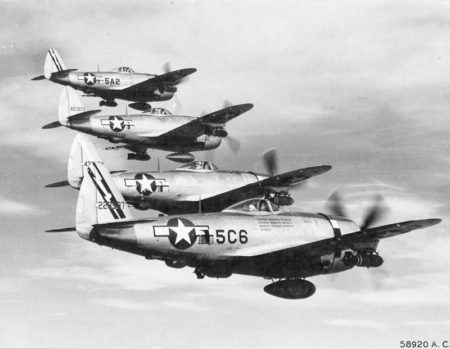
P-47s of the 345th Fighter Squadron, 350th Fighter Group, 12th Air Force. Photo by anonymous (c. 1944). United States Army Air Forces. PD-U.S. government. Wikimedia Commons.

By August 1945, Germany and Japan had surrendered. More than 12.0 million American service men and women spread across 55 theaters of war needed to get home. One of the many vessels used to return them to the United States was the ocean liner, RMS Queen Mary. Stripped of its luxury furnishings and non-essential items, the ship was painted grey in 1939 and used as a transport ship.

Uncle Hal and 810,000 U.S. military personnel returned to America aboard the Queen Mary otherwise known as “The Grey Ghost.”

My aunt and uncles along with millions more like them came home and went on to become known as “The Greatest Generation.”


REVOLUTIONARY PARIS – Volume One & Volume Two
These books are about Paris. They are about the places, buildings, sites, people, and streets that were important parts of the French Revolution. You are about to enter a journey into history beginning in 1789 at the village of Versailles with the procession of the Estates-General and ending on the Place de la Révolution with the execution of Maximilien Robespierre on 28 July 1794. This is your personal walking tour of the French Revolution as it occurred in Paris and Versailles.


Did You Know?

Did you know that an urban model for mixed-use residential, commercial, and parks is being developed? It is called the “15-minute city” and is based on one’s ability to get to the shops and parks within a 15-minute walk from your residence. Scholars at Massachusetts Institute of Technology are researching, quantifying, and measuring the “urban fabric” to see if this model can become a reality. As you may suspect, there are those who enthusiastically support an urban model like this while others bemoan the likely demise of the automobile.
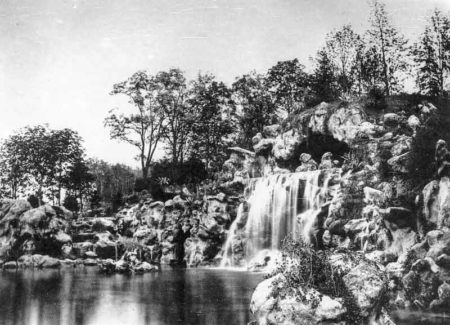
The waterfall at Bois de Boulogne, one of the parks enlarged by Baron Haussmann. Photo by Charles Marville (c. 1858). PD-Author’s life plus 70 years or fewer. Wikimedia Commons.

For those of you who have traveled in Europe, you are undoubtedly familiar with a city that was transformed in the mid-19th-century into a “15-minute walking city.” It is Paris. Napoléon III’s primary instruction to Baron Haussmann was to ensure every citizen could reach a park within a 15-minute walk. Prior to the seventeen-year “destruction and reconstruction” of the city, only forty-eight acres of parks existed. After 1870, more than 5,000 acres of new or expanded parks and twenty-four new squares were being enjoyed by the Parisians. Napoléon III’s goal of a “15-minute walkable city” had been achieved.
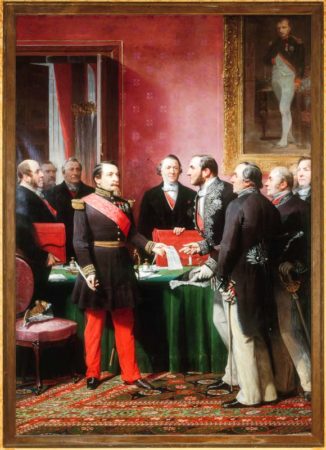
Napoléon III handing over to Baron Haussmann the decree to annex neighboring Paris communes. Painting by Adolphe Yvon (c. 1865). Musée Carnavalet. PD-Author’s life plus 100 years or fewer. Wikimedia Commons.

So, why spend millions and millions of dollars on studies when we can see and experience a contemporary example of the “15-minute city”? It does work.

Our next blog will be an expanded reprint of Charles Marville and le Vieux Paris.

(Click here to read The Missing Emperor and here to read Paris Digs.)


Operation Magic Carpet 

By mid-1943, Gen. George C. Marshall (1880−1959), Army Chief of Staff, and others were sufficiently convinced Germany would ultimately be defeated. The general, a World War I veteran, was determined to avoid a similar demobilization debacle the army experienced in 1918-1919. However, twenty-five years later, he was faced with the same logistic issues but on a larger scale: how to get millions of service personnel back to the United States in a timely, orderly, and fair manner. He really couldn’t bring the men and women home until both Germany and Japan had surrendered. So, in July 1943, Gen. Marshall tasked the War Shipping Administration (WSA) to come up a plan for demobilization addressing which soldiers would remain in Germany, which soldiers would be sent to Japan to fight and finally, who would be the lucky ones to go home. The WSA was responsible for developing and coordinating the plan called “Operation Magic Carpet.” Read More The Grey Ghost
Posted on

New Forest Airfields

How have I come up with blog topics every two weeks for more than ten years? They originate from very diverse origins, but my favorite source is you. Many of our readers communicate with us and either provide specific topics or in the course of discussions, give me the idea for a future topic. Our topic today was inspired by Pat Vinycomb. Pat let us know her father, Stan Booker (click here to read the blog, Last Train Out of Paris), recently donated his World War II RAF uniform to the “Friends of the New Forest Airfields” (more on that later).

We’ve previously written about RAF (Royal Air Force) stations used by Allied fighters and bombers (click here to read, Rendezvous with the Gestapo and here to read Biggin Hill). But it wasn’t until Pat introduced me to the new non -profit organization that I began to research the twelve New Forest airfields and learn about the English air bases and how they were used during World War II (both in England and Europe).


Join Stew Ross for a Discussion on 

BONJOUR PARIS

“Walking History: In the Footsteps of Marie Antoinette” 

6 December 2023

11:30 − 12:30 (EST)

Register Now:

Click here.


Did You Know?

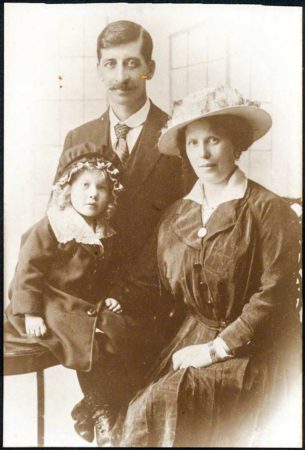
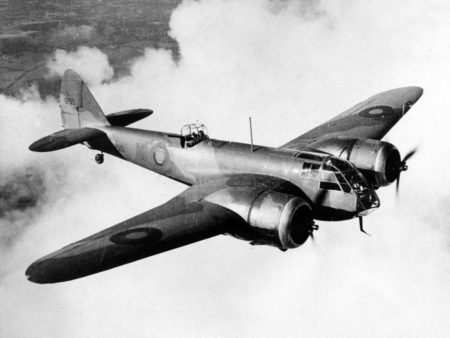
Did you know Robert Fripp (a founding member of the King Crimson progressive rock band) is the nephew of Alfred “Alfie” Fripp, the longest surviving British POW of World War II? Alfred Fripp (1914−2013) joined the Royal Air Force (RAF) in 1930 after the navy rejected him due to his height. After various assignments, Alfie became a flight sergeant in No 57 Squadron RAF and was a reconnaissance observer over Germany on a Bristol Blenheim aircraft. His aircraft was shot down on 13 October 1939 (England had declared war on Germany six weeks earlier on 3 September 1939). Alfie and his pilot, Mike Casey, were quickly captured and Alfie was sent to the first of his twelve POW camps over the next four and a half years before his liberation in 1945.

Alfie Fripp and his parents.
Alfie Fripp and his parents. Photo by anonymous (c. 1917). PD-Author’s life plus 70 years or fewer. Wikimedia Commons.

During his imprisonment at Stalag Luft III, Alfie became involved in the “Great Escape” in March 1944. He collected maps from Red Cross parcels as well as scrounging up digging tools. He was transferred to another POW camp about two months before the big escape. Only three POWs successfully escaped while fifty men, including Mike Casey, were captured, and murdered by the Gestapo.

RCAF Bristol Blenheim Mk I in flight. This is a similar type aircraft that Alfie Fripp was flying in when the plane went down, and Alfie was captured.
RCAF Bristol Blenheim Mk I in flight. This is a similar type aircraft that Alfie Fripp was flying in when the plane went down, and Alfie was captured. Photo by anonymous (date unknown). PD-Expired copyright. Wikimedia Commons.

Alfie retired from the RAF in 1969 as a Squadron Leader. When he passed away at the age of 98, Alfie was the last of the “39ers,” or those men taken prisoner in 1939. After his uncle died, Robert Fripp performed a musical tribute to Alfie on the BBC.


New Forest

The New Forest is one of the largest remaining tracts of forest, pasture, and heathland (i.e., peat used for fuel) in southern England. Today, about ninety percent of the land belongs to the monarchy. It has been inhabited since the Bronze Age, but the soil quality is poor (very acidic) and not very suitable for agricultural purposes. The area was proclaimed a “Royal Forest” by William the Conqueror, and it was the only forest described in detail in the Domesday Book. Read More New Forest Airfields